Definition
Mercenaries are soldiers who join an armed conflict mainly for private gain, serving a state or group other than their own without belonging to its regular army. Under Article 47 of Additional Protocol I (1977), a fighter counts as a mercenary only if six strict conditions all apply, so most modern private military contractors fall outside the legal definition.
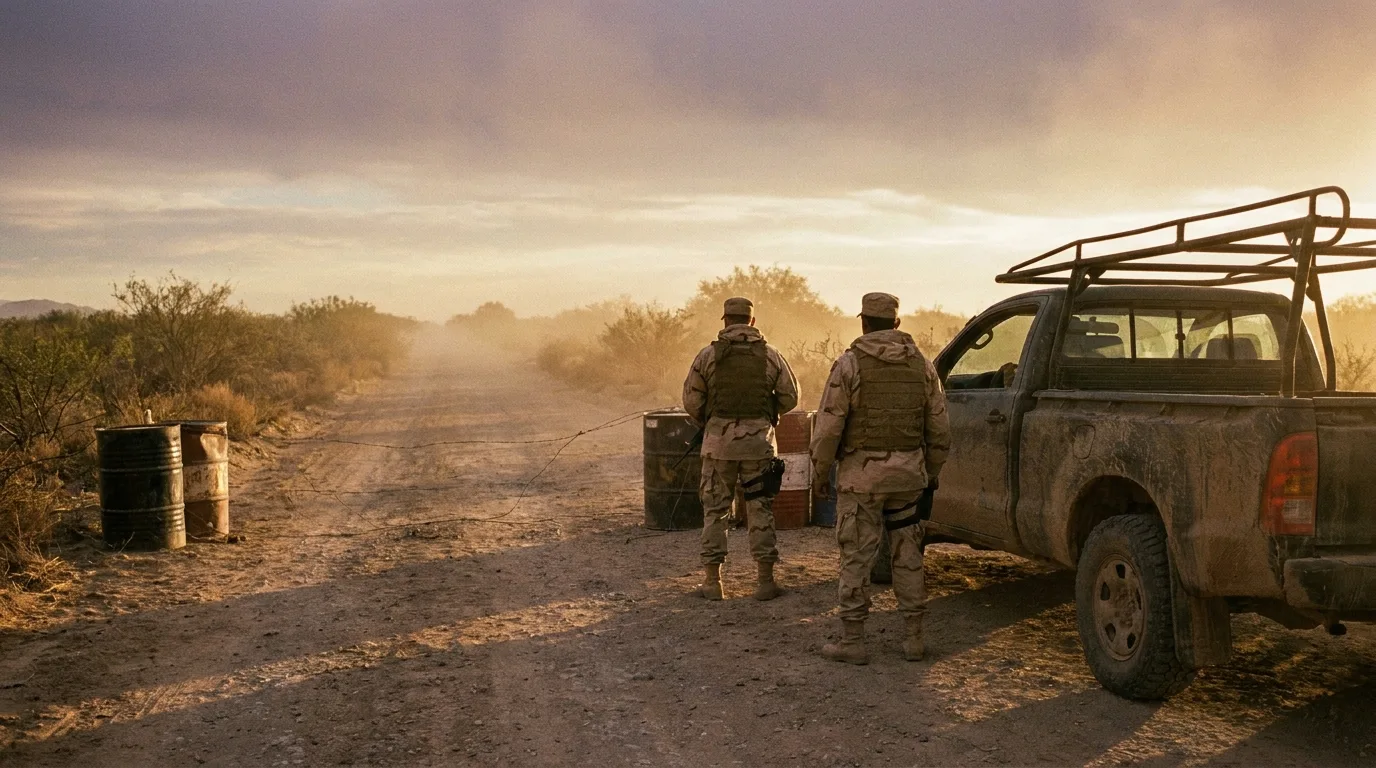
Mercenaries are soldiers who join an armed conflict mainly for private gain, serving a state or group other than their own without belonging to its regular army. The idea is simple, yet the legal definition is so narrow that almost nobody meets it, which is why the word turns up in political speech far more often than in court.
One case from West Africa shows why the question is harder than it looks.
Sierra Leone, 1995: a government hires an army
By early 1995 Sierra Leone’s civil war had reached the outskirts of Freetown. The rebel Revolutionary United Front (RUF) held much of the countryside, including the diamond fields of Kono, and the national army was weak and divided. The military government then hired a private military company.
The firm was Executive Outcomes, founded in South Africa in 1989 and staffed largely by veterans of the South African Defence Force. It sent a few hundred men with helicopters. Within months the RUF had been pushed back from the capital and the Kono diamond area retaken. Elections followed in 1996.
Then the contract ended. The Abidjan peace accord of November 1996 required outside troops to leave, and Executive Outcomes withdrew early in 1997. In May 1997 army officers overthrew the elected government and invited the RUF into Freetown. Both sides of the debate still cite these events:
- Supporters say a small, paid force did what the United Nations and regional armies had not.
- Critics say the company was paid partly through mining interests, answered to its clients rather than to Sierra Leoneans, and left the state no stronger than before.
Whether its employees were mercenaries in the legal sense is another matter, and the answer is probably no.
Where the word comes from
The term comes from the Latin *merces*, meaning wages. Hired soldiers are as old as organized war:
| Period | Example |
|---|---|
| 401 BC | About ten thousand Greeks, later described by Xenophon in the *Anabasis*, served the Persian prince Cyrus the Younger. |
| 14th to 15th century | Italian city states hired *condottieri*, captains who sold the services of their own companies under contract. |
| 1506 to today | The Swiss Guard has served the Pope since 1506, a relic of the era of Swiss pikemen for hire. |
| 1776 to 1783 | The British crown hired roughly 30,000 German auxiliaries, the “Hessians”, for the American Revolution. |
Americans have an old grievance here. The Declaration of Independence accuses King George III of “transporting large Armies of foreign Mercenaries to compleat the works of death, desolation and tyranny.” Centuries earlier, Machiavelli’s *The Prince* had called hired troops useless and dangerous, loyal only until the fighting turns serious.
Conscript national armies later made the hired soldier look like a relic, until mercenaries returned after 1960, above all during the Congo crisis. In African public opinion they were tied to colonialism and white minority rule, and that experience shaped the law that followed.
How international law defines mercenaries
The standard definition is Article 47 of Additional Protocol I to the Geneva Conventions, adopted in 1977. The text of Article 47 in the ICRC treaty database lists six conditions, and a person must meet all of them:
- Specially recruited, locally or abroad, to fight in an armed conflict.
- Takes a direct part in the hostilities.
- Motivated essentially by private gain, with promised pay substantially higher than that of combatants of similar rank in the army they serve.
- Neither a national of a party to the conflict nor a resident of territory it controls.
- Not a member of the armed forces of a party to the conflict.
- Not sent on official duty by a state outside the conflict.
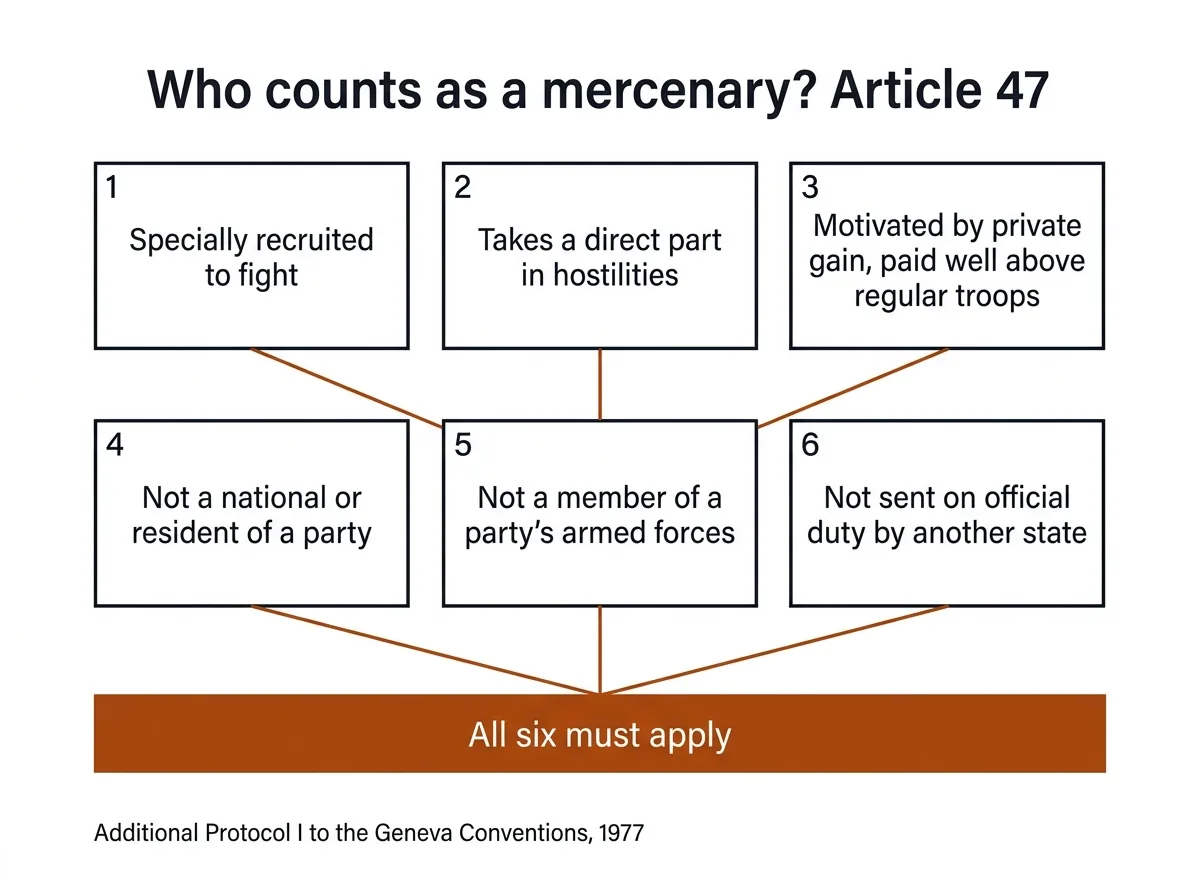
The consequence is narrow too. A mercenary loses the right to combatant and prisoner of war status, though basic humane treatment and human rights guarantees still apply. The protocol itself does not make mercenary service a crime.
Two later treaties go further. The 1977 Organization of African Unity convention and the 1989 UN International Convention against the Recruitment, Use, Financing and Training of Mercenaries both create offenses. The UN convention entered into force in 2001 with relatively few parties. The United States has joined neither it nor Protocol I.
Experts have mocked these tests for decades. The historian Geoffrey Best remarked that any mercenary who could not exclude himself from the definition deserved to be shot, and his lawyer with him. A fighter escapes it by enlisting in the hiring army, by holding the right passport, or by doing guard work rather than combat.
Mercenaries and contractors are not the same thing
Most people called mercenaries today work for private military companies or security firms:
| Mercenary (Article 47) | Private military or security contractor | |
|---|---|---|
| Typical role | Fights directly | Guards, trains, supplies, sometimes fights |
| Employer | A party to the conflict, often informally | A registered company under contract |
| Legal status | No right to POW status | Usually civilians; lose protection if they join combat |
| Rules | Offense under the 1989 UN convention for parties | National law, the 2008 Montreux Document, voluntary codes |
The French Foreign Legion and the British Gurkhas are classic edge cases. Their recruits are foreigners and they are paid, but they are enlisted members of a national army, so condition five rules them out.
Two recent examples show how the line blurs:
- Blackwater guarded U.S. diplomats in Iraq under State Department contracts. In 2007 its guards opened fire in Baghdad’s Nisour Square, killing 17 Iraqi civilians. Several were later convicted in U.S. federal court and were pardoned in 2020.
- The Wagner Group, a Russian network, appeared in eastern Ukraine in 2014 and later operated in Syria, Libya, the Central African Republic and Mali. The U.S. Treasury designated it a transnational criminal organization in 2023. After founder Yevgeny Prigozhin died in an August 2023 plane crash, much of its African work passed to units under Russia’s defense ministry.
Three ways to judge the use of mercenaries
The case against. This view runs from Machiavelli to the political scientist Sarah Percy, whose *Mercenaries: The History of a Norm in International Relations* (2007) argues that hired soldiers offend two widely held beliefs: that force should serve a cause, and that a legitimate authority should control it. For many post colonial governments the issue is also self determination. Mercenaries were used against independence movements, and a government that rents its security may never build institutions that answer to its own citizens.
The case for a market. Some analysts and industry groups argue that the stigma blocks useful options. Paid units can deploy faster than UN peacekeepers and cost less, and in this reading Sierra Leone shows a bad rule leaving civilians unprotected. They prefer licensing, clear contracts and prosecution of abuses to a blanket ban.
The case for regulation. A middle position, associated with scholars such as Peter W. Singer (*Corporate Warriors*, 2003) and Deborah Avant (*The Market for Force*, 2005), accepts that governments already depend on contractors. Its concern is accountability: who answers when a contractor kills a civilian, and whether leaders use contractors to hide casualties from voters. The Montreux Document, backed by the United States and many other countries, belongs to this approach.
Common questions
Are mercenaries legal?
Mercenary service is not a crime under the Geneva Conventions. Countries that joined the 1989 UN convention or the African convention must punish it, and many nations bar their citizens from joining foreign wars.
Is the Wagner Group a mercenary group?
In everyday speech, yes. Under Article 47, many of its fighters would fall outside the definition, because they were Russian nationals serving a country that was itself a party to the war in Ukraine.
Does the United States use mercenaries?
It uses private contractors on a large scale, mostly for logistics and security. Under international law these are not mercenaries, and Washington does not describe them that way.
How much do mercenaries get paid?
There is no reliable public data. Article 47 requires only that the pay be substantially higher than what comparable regular soldiers receive.
Sources
- Additional Protocol I to the Geneva Conventions (1977), Article 47
- International Convention against the Recruitment, Use, Financing and Training of Mercenaries (1989)
- OAU Convention for the Elimination of Mercenarism in Africa (1977)
- Sarah Percy, Mercenaries: The History of a Norm in International Relations (Oxford University Press, 2007)
- Peter W. Singer, Corporate Warriors: The Rise of the Privatized Military Industry (Cornell University Press, 2003)
- Deborah D. Avant, The Market for Force (Cambridge University Press, 2005)
- The Montreux Document on private military and security companies (2008)
- Niccolò Machiavelli, The Prince (1532), chapter 12