Definition
A failed state is a country whose government can no longer perform the basic functions of a state: keeping order, holding its territory and borders, and providing basic services. The country still exists formally, but armed groups or local authorities have taken over much of what the government used to do.
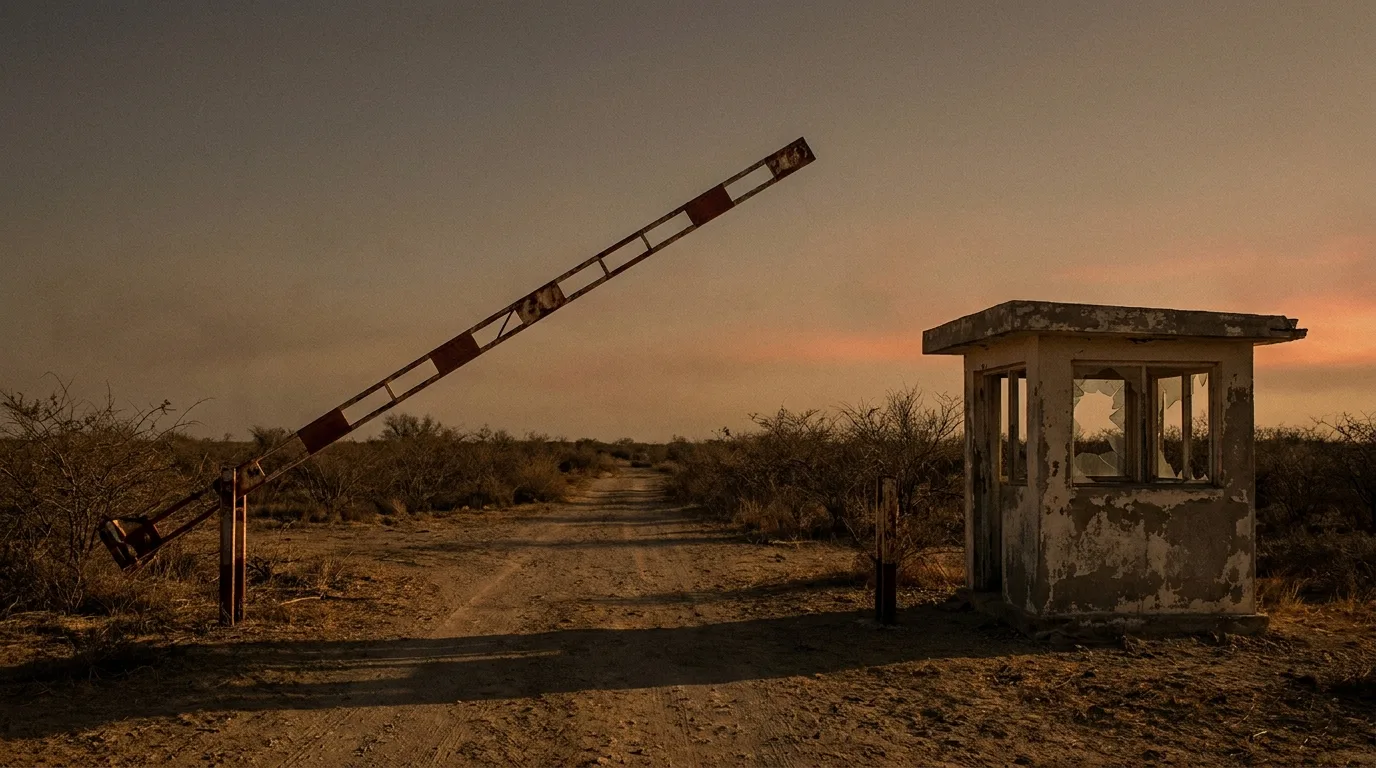
A failed state is a country whose government is no longer able to perform the basic functions of a state: keeping order, holding its territory and borders, and being able to provide basic services to citizens. The country still exists on the map and usually keeps a seat at the United Nations, but within its borders armed groups, warlords or local authorities have taken over much of what the government used to do.
There is no legal definition, and scholars disagree about where to draw the line. This guide breaks it into four tests and applies them to real cases.
Where the term came from
The phrase entered the policy vocabulary in 1992, when two U.S. State Department officials, Gerald Helman and Steven Ratner, published “Saving Failed States” in *Foreign Policy*. They wrote a year after the regime of Siad Barre fell in Somalia, as famine and clan conflict spread. Their argument was that the international community needed new tools for governments that had failed so completely they could no longer rule.
The idea is older. In his 1919 lecture “Politics as a Vocation”, Max Weber defined the state as the community that successfully claims a monopoly on the legitimate use of physical force within a given territory. State failure, in this sense, is the loss of that monopoly. I. William Zartman’s edited volume *Collapsed States* (1995) studied the extreme end of the scale, and Robert Rotberg’s *When States Fail* (2004) gave the concept its most cited academic framing.
The four tests of state failure
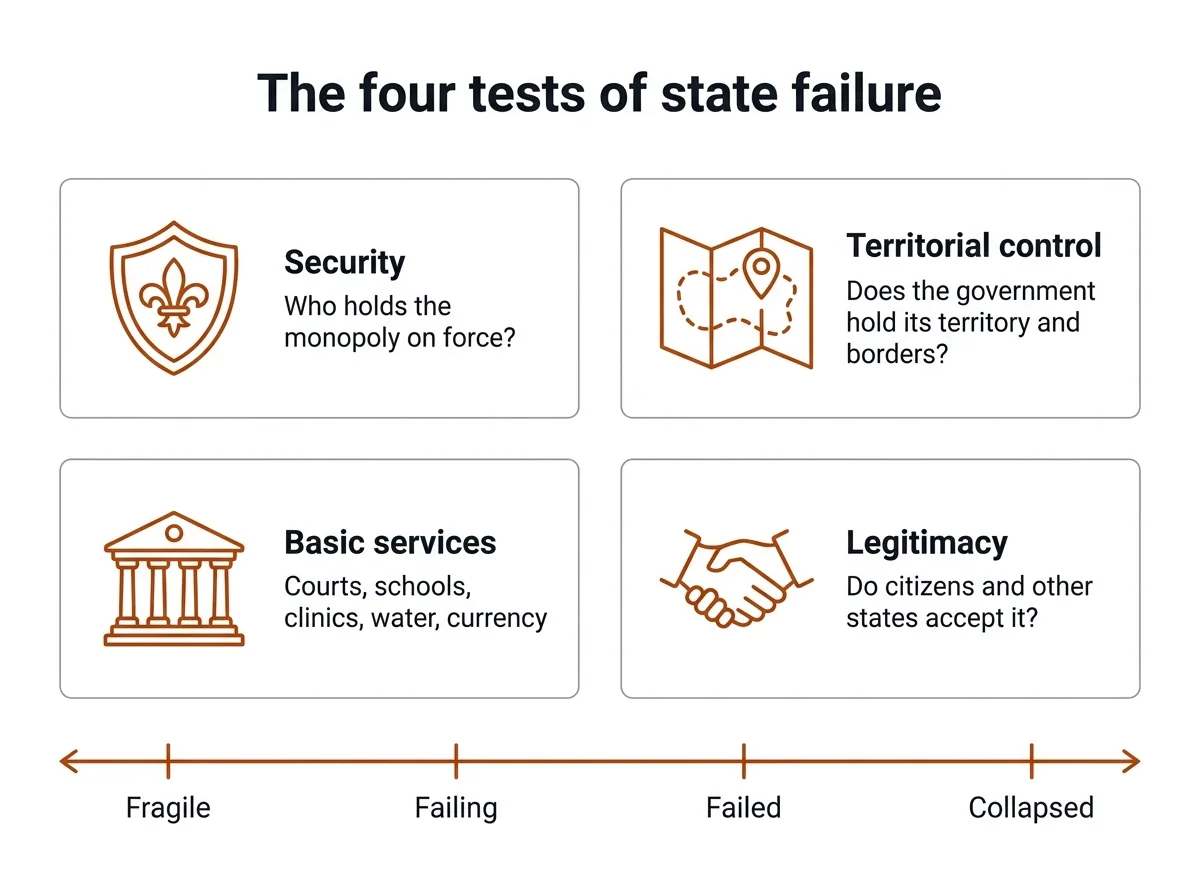
Most definitions combine four political functions. A government may fail one test and pass the others, which is why the label is so often disputed.
Test 1: Security
Does the government hold the monopoly on force? Where it has failed, non-state actors such as militias, insurgents, criminal gangs or warlords use violence without being stopped, and the army and police may split along factional lines.
Test 2: Territorial control
Does the government’s authority reach the whole territory and its borders? Losing a remote province is common. Losing large regions, or the capital itself, is a sign of collapse.
Test 3: Basic services
Does the state run courts, schools, clinics, roads, clean water and a working currency? Many failed states are marked by poverty and lack of basic services, and aid agencies, churches or armed movements often step in.
Test 4: Legitimacy
Do citizens accept the government’s right to rule, and do other states recognize it? Corruption, rigged elections and human rights abuses drain support at home. Recognition abroad may be withheld, as happened after the Taliban took power in Afghanistan in 2021.
| Test | Core question | Typical warning signs |
|---|---|---|
| Security | Who holds the monopoly on force? | Militias, gang rule, a split army, widespread violence |
| Territory | Does the government control the country and its borders? | Rebel-held regions, open borders, a lost capital |
| Services | Can the state deliver the basics? | Closed schools and clinics, a collapsed currency, dependence on aid |
| Legitimacy | Do citizens and other states accept the government? | Corruption, rival governments, no international recognition |
Fragile, failing, failed, collapsed
Researchers often treat state failure as a matter of degree. A fragile state is vulnerable to crisis but still governs. A failing state is losing ground on one or more of the tests. A failed state has lost large parts of its territory and functions. A collapsed state, in Zartman’s terms, is the rare case where central authority has almost disappeared, as in Somalia during the 1990s.
No single score marks where fragility turns into failure, so experts often disagree about the same country.
How state failure is measured
The best known measure is the Fragile States Index, published by the Fund for Peace, an independent research organization in Washington that has been studying conflict since the 1950s. It began in 2005 as the Failed States Index, published with *Foreign Policy*, and was renamed in 2014 to reflect that fragility is a spectrum. The Fund for Peace lists twelve indicators in four groups:
- Cohesion: security apparatus, factionalized elites, group grievance
- Economic: economic decline, uneven economic development, human flight and brain drain
- Political: state legitimacy, public services, human rights and rule of law
- Social and cross-cutting: demographic pressures, refugees and internally displaced persons, external intervention
Each indicator is scored from 0 to 10, so a country’s total runs from 0 to 120. The World Bank also publishes annual lists of fragile and conflict-affected situations, which it uses to steer lending and aid. These tools rank fragility. Neither declares a state officially “failed.”
Applying the framework: three examples
Somalia
After Siad Barre fell in 1991, Somalia had no functioning government for years and became the standard example of a failed state, having failed all four tests. A federal government was formed in 2012, yet it still contests large areas with the militant group al-Shabaab. In the north, Somaliland has run its own stable administration since 1991 without international recognition.
Haiti
After President Jovenel Moïse was assassinated in July 2021, armed gangs extended their control over much of Port-au-Prince. Haiti is an example of failure on security, territory and services, and interim governments have struggled for legitimacy.
Afghanistan
Afghanistan shows why each test has to be checked on its own. The Taliban government that took power in August 2021 holds nearly the whole territory and has reduced large-scale conflict, so it does better on the first two tests than its predecessor. It does poorly on services and lacks international recognition.
Competing views
The security view
After the September 11 attacks, the 2002 U.S. National Security Strategy declared that America was “now threatened less by conquering states than we are by failing ones.” On this view, failed states often give terrorist groups, pirates and traffickers a safe haven, as Afghanistan sheltered al-Qaeda before 2001, and the danger is global. Supporters see stabilization as self-defense.
The institutions view
Development scholars stress that collapse is above all a humanitarian disaster for the people who live through the conflict. Ashraf Ghani and Clare Lockhart, in *Fixing Failed States* (2008), argued that outsiders should help rebuild a state’s core functions rather than run parallel aid systems. Daron Acemoglu and James Robinson, in *Why Nations Fail* (2012), trace long-run failure to extractive political and economic institutions.
The critics
Other scholars think the label obscures more than it explains:
- Charles Call, in “The Fallacy of the ‘Failed State'” (2008), argued that the term lumps together very different problems, from civil war to poverty, and should give way to more precise categories.
- Stewart Patrick, in *Weak Links* (2011), found that most weak and failed states are not major sources of transnational terrorist threats.
- Postcolonial critics note that the yardstick is a Western model of the state, and that cases like Somaliland show order can exist without a recognized central government.
Common questions
What is the difference between a fragile state and a failed state?
A fragile state is at risk but still governs. A failed one has already lost core functions such as security and territorial control.
Can a country recover from state failure?
Yes. Sierra Leone and Liberia ended long civil wars in the early 2000s and rebuilt working governments, with help from UN peacekeepers and international aid.
Is Somalia still a failed state?
Somalia has a recognized federal government, but its writ does not run everywhere, and it remains near the top of the Fragile States Index.
Checklist: using the four tests
Before applying the label, ask:
- Does the government hold the monopoly on force, or do armed groups act freely?
- Does it control the capital, the major regions and the borders?
- Does it provide basic services and keep a working currency?
- Do most citizens accept it, and do other states recognize it?
- Which tests does it fail, and for how long?
- Would a narrower term, such as civil war, insurgency or contested government, describe the situation better?
A state that has failed all four tests for years fits the classic picture. One that fails one or two is better described as fragile or failing. Either way, naming the functions that have broken down tells a reader more than the label.
Sources
- Gerald B. Helman and Steven R. Ratner, "Saving Failed States", Foreign Policy 89 (Winter 1992-93)
- Max Weber, "Politics as a Vocation" (lecture, 1919)
- I. William Zartman (ed.), Collapsed States: The Disintegration and Restoration of Legitimate Authority (Lynne Rienner, 1995)
- Robert I. Rotberg (ed.), When States Fail: Causes and Consequences (Princeton University Press, 2004)
- Ashraf Ghani and Clare Lockhart, Fixing Failed States (Oxford University Press, 2008)
- Charles T. Call, "The Fallacy of the 'Failed State'", Third World Quarterly 29:8 (2008)
- Stewart Patrick, Weak Links: Fragile States, Global Threats, and International Security (Oxford University Press, 2011)
- Daron Acemoglu and James A. Robinson, Why Nations Fail (Crown, 2012)
- The White House, The National Security Strategy of the United States of America (September 2002)
- Fund for Peace, Fragile States Index: Indicators