Definition
A policy brief is a short, stand-alone document that explains one public problem, sets out the options for dealing with it and usually recommends a course of action. It is written for decision-makers who need the argument and the evidence in a few minutes, typically in two to four pages.

A policy brief is a short, stand-alone document that explains one public problem, sets out the options for dealing with it and usually recommends a course of action. It is written for policy makers who have little time and no specialist training, so it trades the length and caveats of a research paper for plain language and a clear argument.
Legislative staff, government agencies, think tanks, universities, advocacy groups and international organizations all use the format. The questions below cover where it came from, what goes in it and whether it can ever be neutral.
What is the purpose of a policy brief?
Its purpose is to help someone make a decision. A journal article is judged by whether it advances knowledge. A brief is judged by whether a busy official can read it in a few minutes and know what the problem is, what the evidence says and what could be done.
In practice a good one will:
- explain the issue and why it matters now;
- provide an overview of the realistic options and their trade-offs;
- say which option the author favors and why, or set out the criteria for choosing.
Policy briefs are written for a specific audience, and that audience shapes everything else. A committee staffer, a city council member and a ministry official want different information before they act, so the same findings may need three versions.
Where did the format come from?
There is no single inventor. It grew out of two older traditions: the internal memo that advisers have always written for presidents and ministers, and the policy analysis movement that took shape in the United States after the Second World War.
| Year | Development | Why it mattered |
|---|---|---|
| 1914 | Congress creates the Legislative Reference Service in the Library of Congress | A permanent staff began writing nonpartisan analysis for legislators |
| 1948 | The RAND Corporation becomes an independent nonprofit | Systematic policy analysis, later packaged as summaries for officials |
| 1951 | Harold Lasswell publishes “The Policy Orientation” | Gave the “policy sciences” a name and an agenda |
| 1970 | The service is renamed the Congressional Research Service | Its two-page “In Focus” products come close to a pure brief |
| 2000 | Eugene Bardach publishes *A Practical Guide for Policy Analysis* | His “eightfold path” became a common teaching template |
By the 2000s, funders and development agencies routinely asked grantees to turn findings into briefs. The Canadian Health Services Research Foundation popularized a “1:3:25” rule: one page of main messages, a three-page executive summary and a 25-page report. That one-page layer is, in effect, the brief.
What are the main parts?
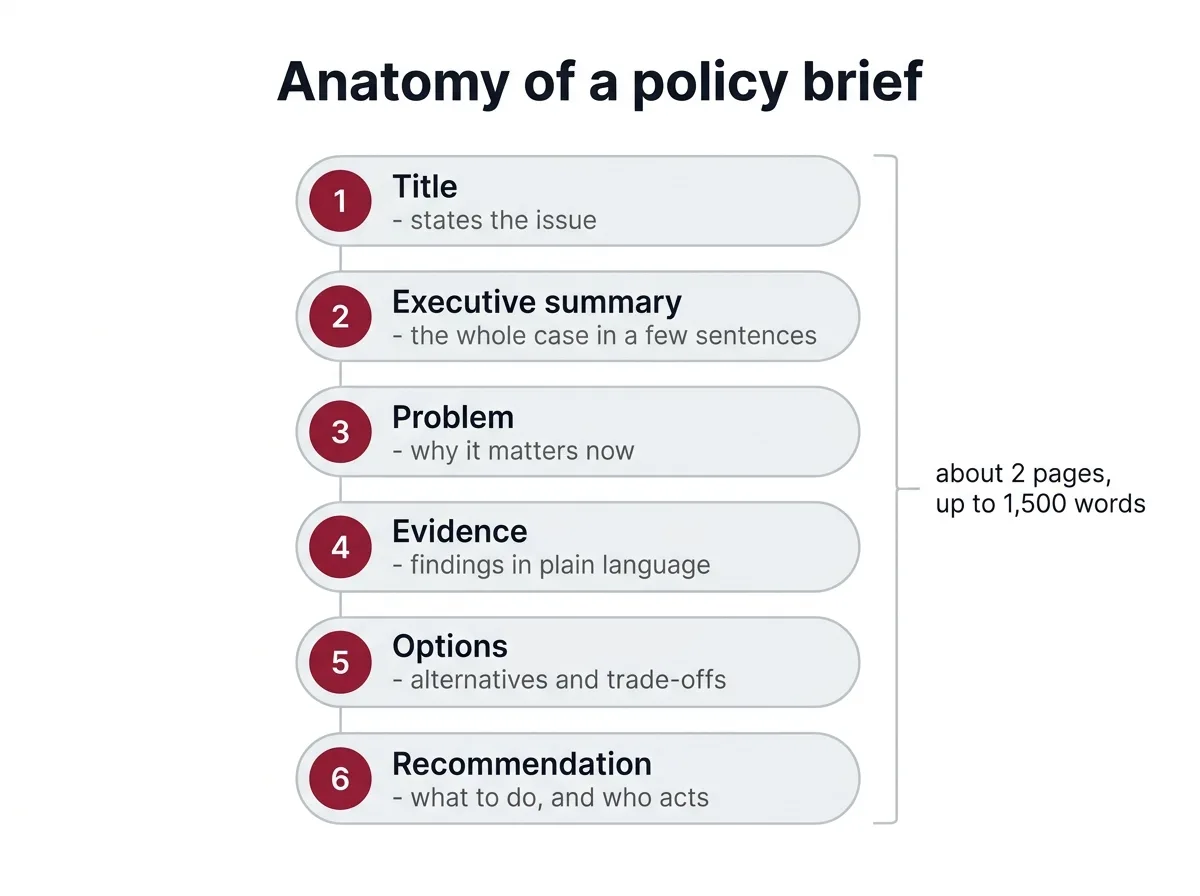
No template is fixed, but each section should move the reader from the problem and the evidence to a solution. A typical structure will include:
- Title: specific, so the issue is clear at a glance.
- Executive summary: the whole argument in a paragraph or a few bullet points. This section should stand on its own, which is why many writers draft it last.
- Problem statement: what is going wrong, for whom, and why it is urgent.
- Findings: describe the relevant evidence so the reader can understand the stakes, without long methods sections.
- Policy options and trade-offs: two to four realistic alternatives with costs, benefits and risks.
- Policy recommendations: concrete actions, ideally naming who should act. Most guides suggest only a handful.
- Sources and contact details, so staff can follow up.
Military and government writers often add a rule known as BLUF, “bottom line up front.” The conclusion goes in the first lines, not at the end.
How long should a policy brief be?
Most guidance puts it at two to four pages. The International Development Research Centre, a Canadian Crown corporation that funds research, tells grantees in its guide to writing policy briefs not to exceed 1,500 words or two pages, and to draft a new, purpose-driven document instead of cutting down an existing report.
Focus matters more than word count. A concise brief covers one topic. If you need ten pages, you probably have two topics, or you are writing a report.
How is it different from a policy memo?
The terms overlap, and many people use them interchangeably. The usual distinction is about audience and publication:
- A memo is usually internal and addressed to a named person (“To: the Secretary”). It can assume shared context and is often confidential.
- A brief is usually public, written for a wider group of stakeholders and designed to stand alone, often with charts and a publication date.
- A white paper or full report is longer, with the methods and appendices a brief leaves out.
Should a brief be neutral or take a side?
Here the people who write them genuinely disagree, and each position has serious defenders.
The first camp favors objective briefs. Some institutions, the Congressional Research Service the best-known example, write for members of every party. Their work lays out options and evidence without recommending one, so elected officials keep the decision. The political scientist Roger Pielke Jr., in *The Honest Broker* (2007), calls this role the “honest broker of policy alternatives”: an expert who widens the range of choices rather than narrowing it. Supporters say this protects the credibility of expertise, because nobody suspects the analysis was bent to fit a conclusion.
A second camp defends advocacy briefs. A brief without a recommendation, they argue, leaves the official exactly where they started. Think tanks, advocacy groups and many academics make a case for one policy. Defenders say this is more honest about the judgment that analysis always involves, and more useful, because decision-makers do ask experts what they would do. Pielke calls this role the “issue advocate” and treats it as legitimate, provided the author is open about it.
A third view questions how much any single paper changes. The sociologist Carol Weiss argued in 1979 that research mostly works through “enlightenment,” slowly shifting how officials think about a problem, rather than by being applied to one decision. John Kingdon’s work on “policy windows” adds that timing often beats polish: an idea lands when a problem, a workable proposal and political will happen to line up.
Whichever camp a brief comes from, check who wrote it, who funded it and whether it says openly that it is arguing for something.
How do you write an effective policy brief?

Most guides, and Bardach’s eightfold path, come down to a few steps. Your policy brief should be planned before you write a word:
- Define the problem in one or two sentences and name the decision your audience faces.
- Learn what your stakeholders already know, what information they need and how open they are to your recommendations.
- Present the strongest evidence and drop what does not serve your argument.
- Construct the options and state the trade-offs clearly, including costs.
- Write the recommendations, then the executive summary, then cut.
- Use headings, bullet points and one clear chart so the page can be scanned.
- Ask someone outside your field to read your policy brief and tell you the key points they took away.
Common questions
Who writes policy briefs?
Analysts at think tanks and research institutes, legislative and agency staff, academics sharing findings, nonprofits, and students in public policy programs, where it is a standard assignment.
Is it the same as an op-ed?
No. An op-ed is written for the general public and argues a view in a personal voice. Policy briefs can take a side too, but they are written for decision-makers and built around evidence and specific options.
Does it need citations?
Yes. Even a two-page brief should list its sources so anyone can check the evidence and recommendations against them.
Sources
- Eugene Bardach, A Practical Guide for Policy Analysis: The Eightfold Path to More Effective Problem Solving (2000)
- Roger A. Pielke Jr., The Honest Broker: Making Sense of Science in Policy and Politics (Cambridge University Press, 2007)
- Carol H. Weiss, "The Many Meanings of Research Utilization", Public Administration Review 39 (1979)
- John W. Kingdon, Agendas, Alternatives, and Public Policies (1984)
- Harold D. Lasswell, "The Policy Orientation", in The Policy Sciences (1951)
- International Development Research Centre: How to write a policy brief