The essay in brief
Roger Kaplan argued in 1999 that Allen Drury's Advise and Consent (1959) invented the modern Washington novel and remains the one book of the genre worth reading, because it is about how politics tests character. Drury's later novels, he wrote, slid into fictionalized commentary, and American politics, built on compromise, rarely yields great fiction.
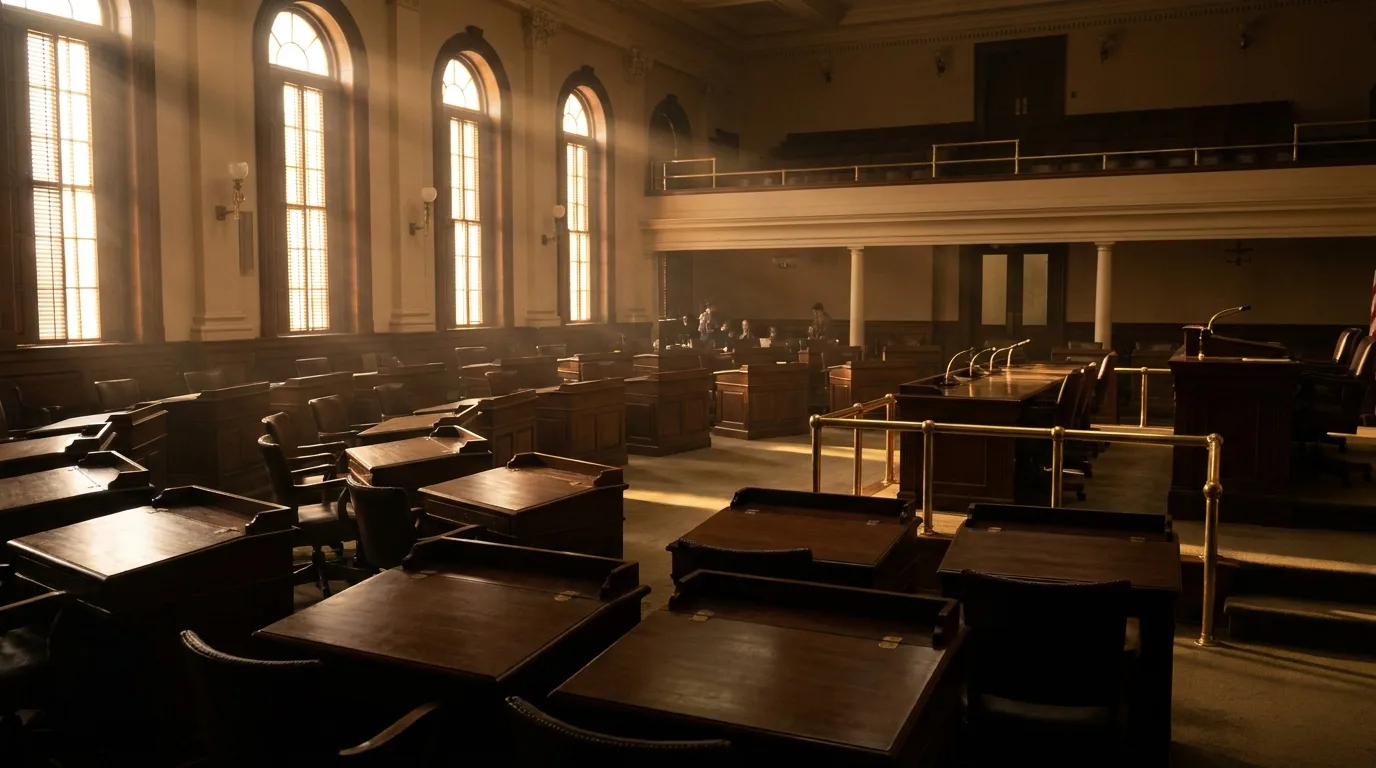
A president nominates a man for secretary of state. The nominee is polished, popular with the press, and has lied to a Senate subcommittee about a brief brush with communism in his past. An old senator from South Carolina, Seabright Cooley, decides to stop him. The confirmation fight that follows costs one senator his life and tests nearly everyone else in the Senate.
That is the plot of Allen Drury’s *Advise and Consent*, published in 1959. It won the Pulitzer Prize for Fiction in 1960, became a long-running bestseller and was filmed by Otto Preminger in 1962, with Henry Fonda as the nominee Robert Leffingwell and Charles Laughton, in his last film role, as Cooley. Forty years later, the journal *Policy Review* asked what made the novel last. Roger Kaplan’s essay “Allen Drury and the Washington Novel” is the answer, and it doubles as an argument about why the capital so rarely produces good fiction.
The argument in brief
Kaplan wrote a year after Drury died in September 1998, on his 80th birthday. His case runs in five steps:
- Drury invented a genre. Henry Adams and John Dos Passos had written about politics in Washington, but the modern form, built on intrigue that ideally mixes private scandal with foreign policy, starts with *Advise and Consent*.
- It is the one book of that genre worth reading. Kaplan treats it as the only novel of its kind a literary reader really needs.
- Its real subject is character. Drury cared about issues, yet his first novel works because it shows what political life does to the people who live it.
- The later books slipped. As current events took over his fiction, Drury drifted toward what Kaplan calls fictionalized commentary.
- The genre is rare for a reason. American politics is built on compromise and restraint, which makes it hard material for the extreme drama that great political novels need.
The context: a Senate that still mattered
Kaplan places the novel in a specific moment. Drury had spent years covering the Senate as a reporter, including for *The New York Times*, and the novel draws on what he saw there. In the late 1950s the city still felt like a small Southern town, the Senate still had prestige, and the huge executive power built up since the New Deal was a fact but not yet a settled habit.
The confirmation fight in the novel carries a constitutional question. Can a president run foreign policy as he likes, or does the Senate’s duty to advise and consent give it a real check? Kaplan notes that this question outlived the 1950s: presidents of both parties came into bitter disputes with the Senate over the foreign affairs of the United States, which is one reason the novel still reads as relevant. The clause itself is in Article II of the Constitution, which gives the president power to make treaties and appoint officers “by and with the Advice and Consent of the Senate.”
The Cold War setting matters too. The story is loosely inspired by the Alger Hiss case, and the Soviet Union appears to be pulling ahead in the space and arms race. Kaplan also reads it as settling old scores from the Roosevelt and Truman years.

Character over issues
The center of the essay is a claim about what fiction is for. Kaplan argues that Drury never wrote a roman à clef. Many assumed that Senate Majority Leader Bob Munson stood in for Robert Taft, but Drury’s Munson is anything but an isolationist. The demagogue of the novel, Senator Fred Van Ackerman, is a left-wing liberal, which Kaplan reads as Drury’s way of saying that demagoguery was not a monopoly of the right.
What Kaplan values most is that the political struggle serves as a test of the people involved. In *Advise and Consent* the issue Cooley seizes is honesty: a small lie, long past, that still reveals who Leffingwell is. In the first sequel, *A Shade of Difference* (1962), Drury follows Cullee Hamilton, a Black congressman from California pulled between his district, the civil rights movement, his family and his patriotism. Kaplan credits Drury with understanding race in political terms, though without the art of Faulkner or Ellison.
Where Drury went wrong
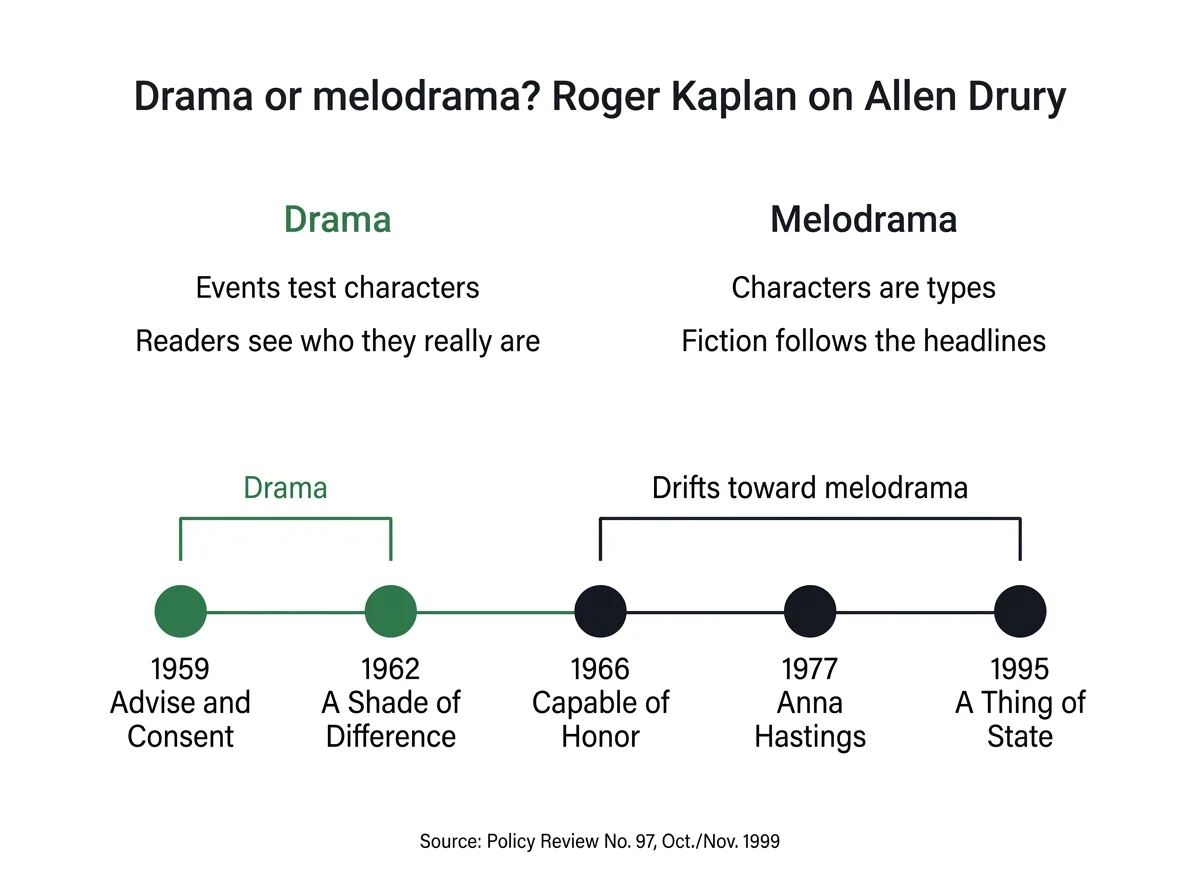
Kaplan is frank about Drury’s prose, which he finds grandiose and heavy. His sharper criticism concerns the later novels. In *Capable of Honor* (1966), *Anna Hastings* (1977) and *A Thing of State* (1995), Kaplan sees current events shaping the story so tightly that the novels become hard to follow for anyone who did not live through the period. He reads *Anna Hastings* in particular as a thinly veiled attack on The Washington Post.
| Book | Year | Kaplan’s verdict |
|---|---|---|
| *Advise and Consent* | 1959 | A lasting achievement; character tested by politics |
| *A Shade of Difference* | 1962 | Still strong; a serious treatment of race and loyalty |
| *Capable of Honor* | 1966 | Sharp political insight, more commentary than fiction |
| *Anna Hastings* | 1977 | An attack on the Washington press that needs footnotes |
| *A Thing of State* | 1995 | Pessimistic and tied to recent presidencies |
His distinction is between drama and melodrama. In drama, events test men and women and reveal who they really are. In melodrama, people are simply types. Kaplan argues that this explains both Drury’s decline and why good novels set in Washington are so scarce.
Why so few great Washington novels?
The last section of the essay asks the question its title implies. Kaplan considers and dismisses the idea that the city is simply too exciting, since plenty of exciting cities have produced great novels. The city’s culture is busy reacting to real events and policies, and the human stories behind them fade.
The deeper reason, he writes, lies in American politics itself. It is, as Drury’s best senators insist, about compromise and restraint. The great political novels Kaplan names, such as Arthur Koestler’s *Darkness at Noon*, Dostoevsky’s *The Possessed* and Ralph Ellison’s *Invisible Man*, deal with extreme situations and finally transcend politics. Robert Penn Warren’s *All the King’s Men* is great, but it is not set in Washington. A great novel about the capital, Kaplan concludes, has to rise above the city’s fascination with itself.
Reception and points of dispute
The essay appeared in *Policy Review* No. 97, October and November 1999, when the journal was still published by the Heritage Foundation. A literary appreciation written for a policy audience, it invites several objections:
- On the genre’s origin: Some readers would give more credit to Henry Adams’s *Democracy* (1880), which Kaplan himself mentions as a forerunner.
- On the conservative frame: Kaplan shares much of Drury’s anti-communism, so those who see the Cold War differently may weigh the politics of the novels less kindly.
- On compromise: The claim that American politics lacks extreme situations sits uneasily with the civil rights era, which Drury himself wrote about.
How the argument has held up
Two parts of the essay age well. The constitutional theme remains live: Senate confirmation battles over cabinet and Supreme Court nominees are still among the sharpest fights in American politics. The drama versus melodrama test also works for political fiction of any era, including the television dramas that have largely taken over the story of political Washington.
The claim that the capital cannot produce great fiction is harder to settle. It depends on what counts as a novel of the capital and on whether screen drama counts at all. Kaplan’s broader point, that political fiction lasts when it is about people rather than headlines, has proved durable.
Reader questions
Who wrote “Allen Drury and the Washington Novel”?
Roger Kaplan, in *Policy Review* No. 97 (October and November 1999).
Is Advise and Consent based on a true story?
Not directly. Kaplan stresses that Drury invented original characters, though the plot loosely echoes the Hiss case and Drury’s years covering the Senate.
What are the sequels to Advise and Consent?
*A Shade of Difference*, *Capable of Honor* and *Preserve and Protect*, followed by *Come Nineveh, Come Tyre* and *The Promise of Joy*.
Where to read the original
The full text of Kaplan’s essay is available in the Hoover Institution’s *Policy Review* archive: Allen Drury and the Washington Novel (Hoover Institution).
Sources
- Roger Kaplan, "Allen Drury and the Washington Novel", Policy Review 97 (1999)
- Allen Drury, Advise and Consent (Doubleday, 1959)
- Allen Drury, A Shade of Difference (Doubleday, 1962)
- U.S. Constitution, Article II, Section 2