Definition
Civil society is the space of voluntary, organized social life between the family, the market and the state. It includes churches, unions, charities, community groups, advocacy organizations and informal networks that people join by choice to pursue shared interests.

Civil society is the space of voluntary, organized social life between the family, the market and the state. It includes churches, unions, charities, community groups, advocacy organizations and informal networks people join by choice to pursue their shared interests.
The London School of Economics’ former Centre for Civil Society offered a definition many scholars still use: “the arena of uncoerced collective action around shared interests, purposes and values.” The definition is short, but the concept has a long and contested history, and several popular assumptions about it are wrong or only half right.
Myth 1: Civil society just means NGOs
Non-governmental organizations (NGOs) are the most visible part of civil society, especially in international development. The World Bank, for example, works with civil society organizations (CSOs) on global development projects, and the United Nations gives thousands of non-governmental organizations consultative status. Yet the term covers far more than the professional nonprofit sector.
Scholars usually list at least these kinds of organizations:
- Religious congregations and faith-based charities
- Labor unions and professional associations
- Civic and service clubs such as Rotary, the Elks or parent-teacher associations
- Advocacy groups working on human rights, the environment or particular policy issues
- Charities and foundations, from food banks to large grant makers
- Social movements and informal networks, including mutual aid among neighbors
- Independent media and cultural or recreational clubs
A bowling league and a human rights NGO belong to the same category because both are voluntary, self-organized and outside direct government control. A group can be part of civil society without any political agenda, which is why sports clubs and choirs make the list.
Myth 2: It is a new buzzword
The word is old. Roman writers used *societas civilis* to translate Aristotle’s *koinōnía politikē*, the political community of free citizens. For a long time “civil society” simply meant a society governed by law, as opposed to a state of nature. John Locke used it this way, and the Scottish philosopher Adam Ferguson published *An Essay on the History of Civil Society* in 1767.
The modern meaning took shape in the 19th and 20th centuries:
- G. W. F. Hegel, in his *Philosophy of Right* (1820), separated civil society from both the family and the state. For him it included the market, where people pursue their private needs.
- Alexis de Tocqueville, in *Democracy in America* (1835 and 1840), was struck by how readily Americans formed associations for every purpose. He saw them as schools where citizens learn self-government.
- Antonio Gramsci, writing in prison in the 1930s, treated it as the terrain where ruling ideas win consent through churches, schools and the press.
The term made its big comeback in the 1970s and 1980s. Dissidents in Central Europe, from Poland’s Solidarity movement to Václav Havel, used it to describe independent social life outside Communist party control. After 1989 it became a standard concept in political science and international development.
Myth 3: Civil society and government are natural enemies
Some advocates picture voluntary groups as a shield against the state, and sometimes they do play this role. Yet the two depend on each other in ordinary ways. Groups need a legal system which protects free assembly, contracts and property. In the United States, most charities operate under section 501(c)(3) of the tax code, and many receive government grants to provide services such as foster care, job training or housing.
Influence also runs the other way, as these cases show:
- Mothers Against Drunk Driving, founded in 1980, built public pressure which helped lead to the National Minimum Drinking Age Act of 1984.
- The Montgomery bus boycott of 1955 and 1956 was organized through Black churches and the Montgomery Improvement Association, years before federal civil rights law caught up.
- Local groups monitor elections, run town halls and file public records requests to hold officials to account.
In practice, the same group may work with the government on one program while lobbying against it, or suing it, on another.
Myth 4: Businesses are part of civil society
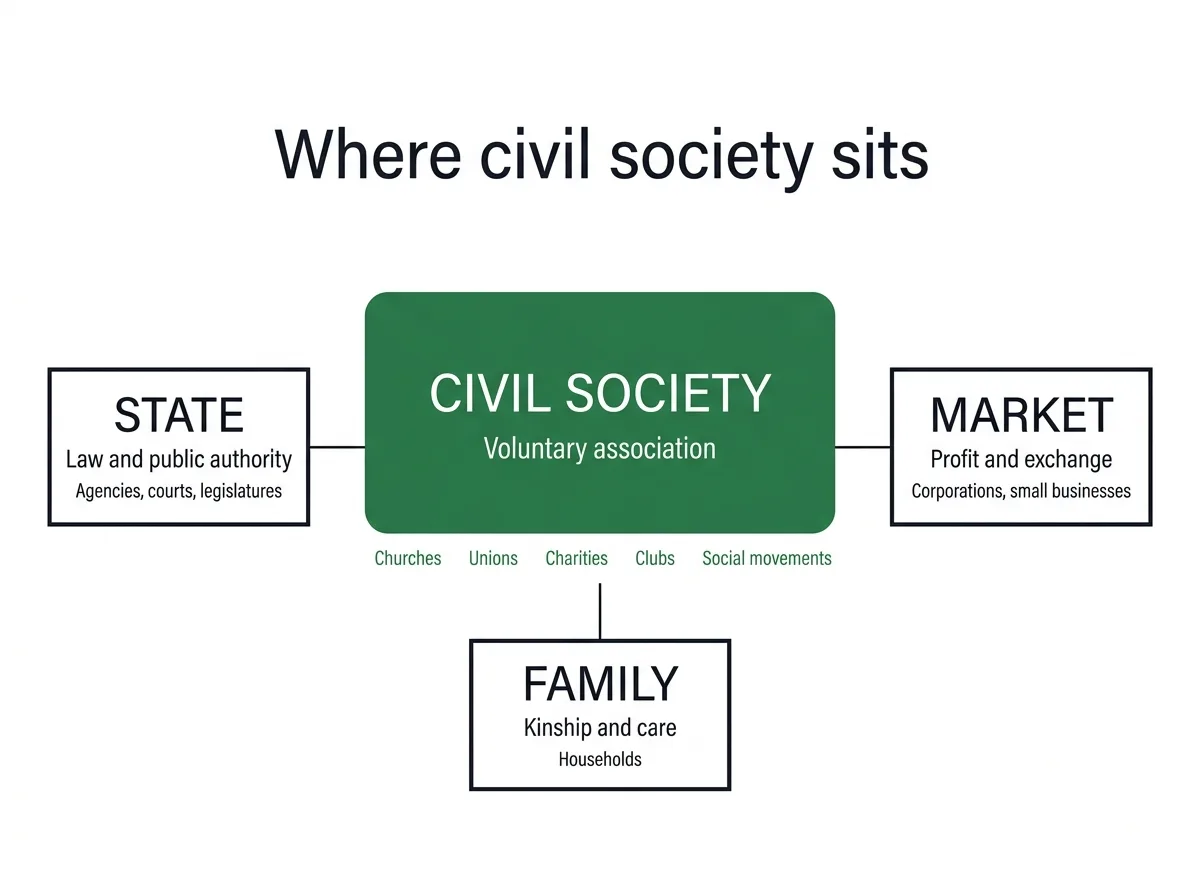
It depends on the definition. Hegel included the market, and some economists still do. Most contemporary definitions, including those of the UN and the World Bank, leave out for-profit firms and treat civil society as a “third sector” next to government and business.
| Sphere | Main logic | Typical examples |
|---|---|---|
| State | Law and public authority | Agencies, courts, legislatures |
| Market | Profit and exchange | Corporations, small businesses |
| Civil society | Voluntary association | Churches, unions, charities, clubs |
| Family | Kinship and care | Households, extended families |
The edges are blurry. A chamber of commerce is made up of businesses, yet it acts as a voluntary association and is usually counted on the civil side of the line.
Myth 5: More civic life always means more democracy
Tocqueville and later Robert Putnam argued that joining groups builds trust, civic skills and what Putnam called social capital. Many studies support a link between an active civic sector and responsive government.
The link is not automatic, though. Political scientist Sheri Berman showed in a 1997 article in *World Politics* that Weimar Germany had a dense network of clubs and societies, and the Nazi party used those networks to spread. In the United States, the Ku Klux Klan was also a voluntary membership organization. Scholars use the phrase “uncivil society” for groups which organize freely but work against equal human rights or pluralism.
Most researchers conclude that a strong civil society helps democracy when political institutions are also strong enough to channel conflict.
Myth 6: Americans have stopped joining
Putnam’s 1995 essay “Bowling Alone” and his 2000 book documented falling membership in many traditional organizations. Theda Skocpol added in *Diminished Democracy* (2003) that mass membership federations had given way to professionally managed advocacy groups with mailing lists instead of local chapters.
Much of the decline they describe is real. Still, Americans take part in large numbers. According to the U.S. Census Bureau and AmeriCorps civic engagement survey, 28.3% of people age 16 and older formally volunteered through an organization between September 2022 and September 2023, up from 23.2% in 2021. An estimated 54.2% helped neighbors informally, for example by running errands or lending tools.
What has changed over time is the form. Online groups, short volunteer stints and informal mutual aid now carry part of the load local lodges once did.
Competing views on the role of civil society
Political traditions do not value voluntary life for the same reasons, and they disagree about what government owes it.
- Conservative. Edmund Burke praised the “little platoons” of local life. In 1977 Peter Berger and Richard John Neuhaus argued in *To Empower People* that families, churches and neighborhoods are “mediating structures” that public policy should protect rather than replace.
- Classical liberal and libertarian. Voluntary cooperation shows people can solve many problems without coercion. On this view a smaller state leaves room for charity, mutual aid and private initiative.
- Progressive. Voluntary groups work best with public support and fair rules. Skocpol and others point out how many great American associations grew alongside government programs, while unequal resources give wealthier interests louder voices.
- Critical and Gramscian. This is where cultural power is built and contested, so movements hoping to change what a society takes for granted have to organize there first.
Common questions
What is civil society in simple terms?
It is the part of public life people organize themselves, outside government and business, through groups they choose to join and support.
Is civil society the same as NGOs?
No. NGOs are one part of it, next to religious groups, unions, clubs and social movements.
Who coined the term civil society?
No single person did. It comes from the Latin *societas civilis*, a translation of Aristotle. Hegel and Tocqueville gave it most of its modern meaning.
Why does civil society matter for public policy?
Its organizations identify new problems, provide services, support people in need, represent citizens with little political influence and hold officials accountable. Many major policy changes in the United States started as campaigns by voluntary groups.
Sources
- U.S. Census Bureau: Civic Engagement and Volunteerism (2024)
- Alexis de Tocqueville, Democracy in America (1835 and 1840)
- G. W. F. Hegel, Elements of the Philosophy of Right (1820)
- Adam Ferguson, An Essay on the History of Civil Society (1767)
- Peter L. Berger and Richard John Neuhaus, To Empower People: The Role of Mediating Structures in Public Policy (1977)
- Robert D. Putnam, "Bowling Alone: America's Declining Social Capital", Journal of Democracy 6 (1995)
- Sheri Berman, "Civil Society and the Collapse of the Weimar Republic", World Politics 49 (1997)
- Theda Skocpol, Diminished Democracy (University of Oklahoma Press, 2003)
- World Bank: Civil Society