Definition
Socialism is a system in which the means of production are owned or controlled by society as a whole, often alongside markets and democratic government. Communism is the further goal of a classless society with common ownership of all productive property, distribution by need and, in Marx's theory, no state.
Socialism is an economic and political system in which the means of production, such as factories, land and banks, are owned or controlled by society as a whole rather than by private individuals. Communism is the more far-reaching goal of a classless society with common ownership of all productive property and, in Marx’s theory, no government at all; in the socialism vs communism debate, the second is usually treated as the end point and the first as the road or the compromise.
The words have shifted meaning over two centuries, and movements that disagreed bitterly with each other have claimed both. Comparing them one question at a time, in six steps, keeps the terms apart.
Step 1: Start with the shared criticism of capitalism
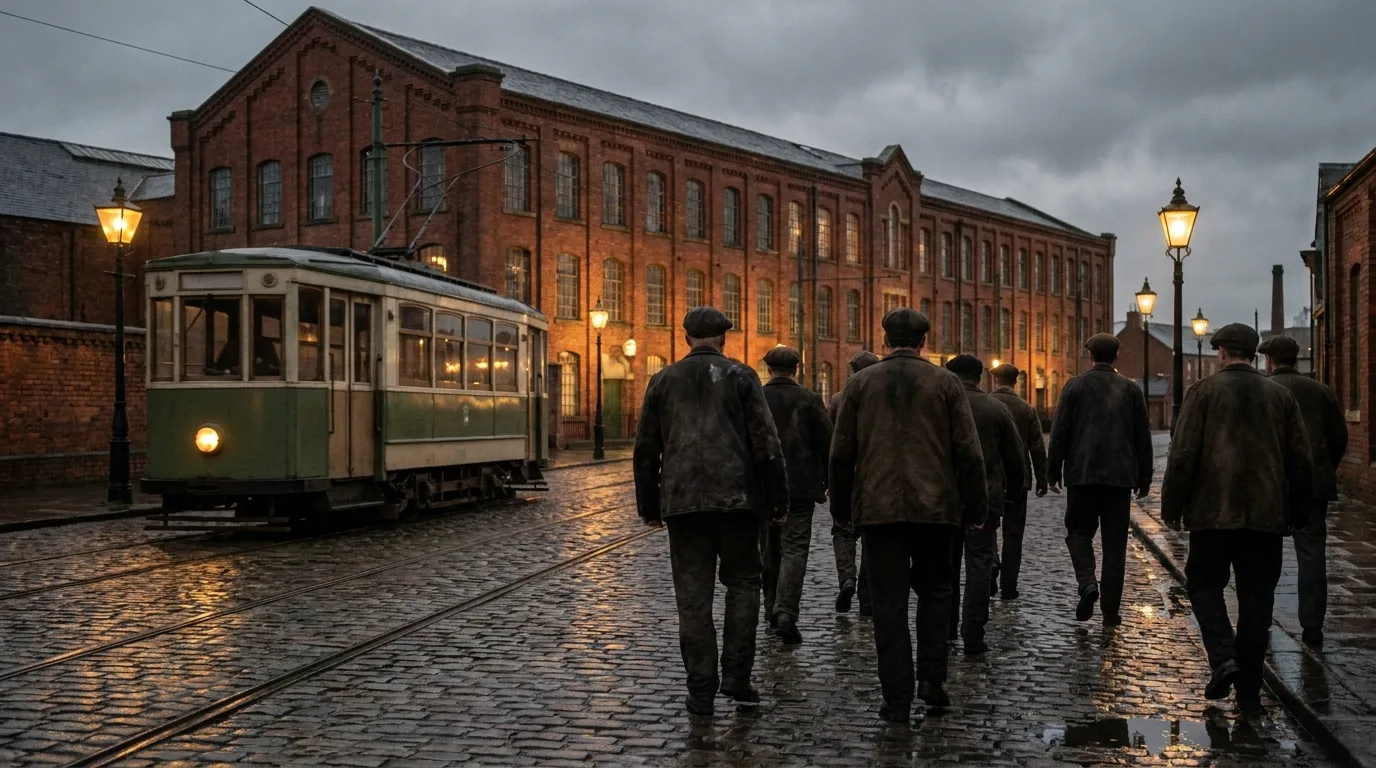
Both traditions began as answers to the same problem. The Industrial Revolution produced enormous wealth, but early factory workers in Britain and France faced long hours, child labor and crowded cities. Thinkers like Robert Owen in Britain and Henri de Saint-Simon in France argued that a capitalist society organized around profit would never share that wealth fairly. The word “socialism” spread in the 1820s and 1830s among their followers.
Karl Marx and Friedrich Engels gave the critique its most famous form in *The Communist Manifesto* (1848). In his preface to the 1888 English edition, Engels explained why they had not called it a socialist manifesto: in 1847, “socialism” suggested respectable middle-class reformers, while “communism” was the name working-class radicals used for themselves.
After step 1: the two share a diagnosis. Both say capitalism divides people into an owning class and the working class, and both want the economy to serve the many rather than the few.
Step 2: Ask who owns the means of production
The history of communism and socialism splits first over property.
- Socialism covers a wide range. Some socialists want public control of big industries like energy, rail and banking. Others favor worker cooperatives, or a market economy in which firms are owned by employees or the public. Small businesses, homes and personal goods usually remain in individual hands.
- Communism aims at common ownership of all productive assets. Marxists separate *private* property (a factory that earns its owner profit from other people’s labor) from *personal* property (your house, your clothes, your car). Communists want to abolish the first, not the second.
After step 2: socialist ownership is social but often partial and mixed. In the communist ideal, the means of production are held completely and collectively.
Step 3: Ask how goods and services are distributed
Marx drew the line himself in his *Critique of the Gotha Programme* (1875). He described two phases of a post-capitalist society:
- A lower phase, still marked by the old society, in which each worker receives goods and services in proportion to the labor he contributes.
- A higher phase, reached once production is abundant and work is no longer a burden, governed by the principle “from each according to his ability, to each according to his needs.”
Vladimir Lenin, in *The State and Revolution* (1917), called the first phase “socialism” and reserved “communism” for the second. That labeling became standard in the Soviet Union. Its 1936 constitution stated the socialist rule as “from each according to his ability, to each according to his work.”
After step 3: in Marxist usage, socialism pays people by contribution and communism distributes by need.
Step 4: Ask what happens to government
Most socialists see government as a tool. A democratic system can tax, regulate, run public services and own enterprises on behalf of citizens. For Marx, by contrast, the state was an instrument of class rule. Once classes disappeared, he expected it to lose its purpose; Engels wrote that it would “wither away.”
In practice, the countries ruled by communist parties built some of the most powerful governments of the twentieth century. Their leaders argued that a strong central authority was needed during the transition, under what Marx had called the dictatorship of the proletariat.
Step 5: Compare how socialist and communist movements seek change
This is the political line that separated the two movements after 1917.
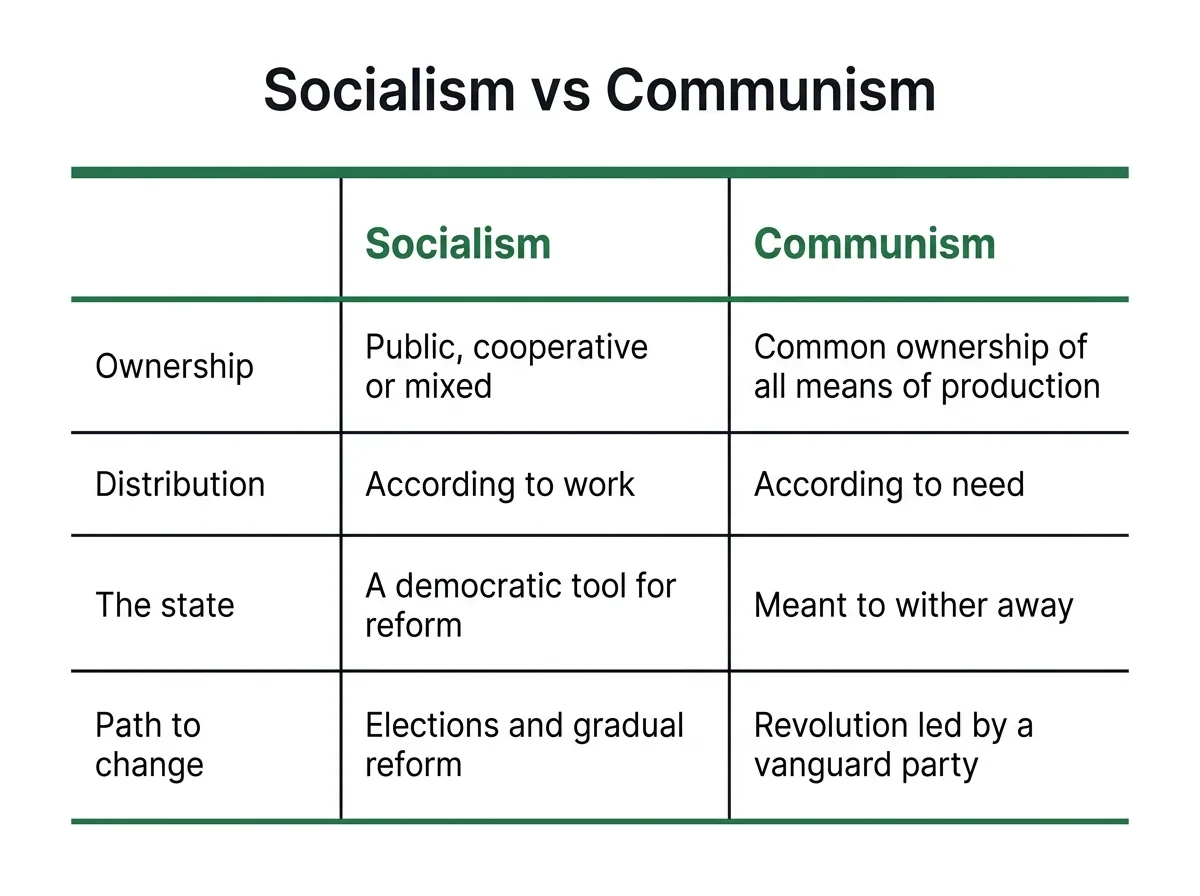
| Question | Socialism (democratic and social democratic forms) | Communism (Marxist-Leninist form) |
|---|---|---|
| Ownership | Public, cooperative or mixed; many firms stay in private hands | Common ownership of all means of production |
| Distribution | By contribution, plus a welfare system | By contribution in the transition, by need at the end |
| Government | A democratic tool for reform | Strong in transition, meant to wither away |
| Path to power | Elections, unions, gradual reform | Revolution led by a vanguard party |
| Political system | Multiparty democracy | One-party rule in practice |
| Examples | Nordic social democrats, the British Labour Party under its 1918 Clause IV | Soviet Union, Maoist China, Cuba, North Korea |
Eduard Bernstein, a German Social Democrat, argued in 1899 that socialism could be won gradually through elections and reform. Britain’s Fabian Society, founded in 1884, held a similar view. Lenin rejected this. After the Bolsheviks took power, they renamed their organization the Russian Communist Party in 1918 and founded the Communist International in 1919, partly to separate themselves from socialist parties that had backed their national governments in World War I.
After step 5: in modern political language, “socialist” usually signals democratic reform, while “communist” signals revolution and a single ruling party.
Step 6: Test the ideas against real countries
No country has ever declared that it achieved communism in Marx’s sense. The USSR described itself as a socialist country building toward communism. Stalin’s First Five-Year Plan, adopted in 1928, set out to build socialism through rapid industrialization and forced collectivization, at a huge human cost, as the Library of Congress exhibit on the Soviet archives documents.
Today there are five countries ruled by communist parties: China, Vietnam, Laos, Cuba and North Korea. China calls itself socialist and describes its mixed economy as “socialism with Chinese characteristics,” with a large private sector alongside enterprises that the government controls. Elsewhere, the word “socialist” appears in democratic constitutions: India added it to its preamble in 1976, and Portugal’s preamble speaks of opening “a path towards a socialist society.”

How each side makes its case
Four positions dominate the debate, and each has a serious argument.
- Democratic socialists argue that political democracy is incomplete without economic democracy. If workers have a vote in government, why not in the workplace? They point to public health systems, free education and strong unions as evidence that social ownership and markets can coexist.
- Communists argue that reform leaves the class system intact. As long as capital is held by a few, they say, owners will roll back every gain, so only a full transformation of the political and economic order ends exploitation.
- Social democrats accept capitalism but tame it with high taxes, welfare programs and collective bargaining. Many Nordic parties fit here, and their governments stress that they run market economies.
- Market liberal critics reject both. Ludwig von Mises (1920) and Friedrich Hayek (1945) argued that without market prices planners cannot know what the people need or how scarce resources are. Critics also note that putting economic power in the hands of government concentrates political power too, which they see as the lesson of the Soviet experience.
Common questions about socialism vs communism
Is socialism a step toward communism?
In Marxist theory, yes: socialism is the lower phase. Democratic socialists and social democrats reject that framing and treat socialism as a goal in itself, more modest than communism and compatible with elections.
What is democratic socialism?
It is a tradition that seeks social ownership and a strong welfare state through elections and civil liberties. In the United States, Eugene Debs won about 6 percent of the popular vote as the Socialist Party candidate in 1912.
Do socialists believe in private property?
Most accept personal property and many accept private firms. The debate concerns who should control the large productive assets of an economy.
Is China socialist or communist?
It is ruled by the Communist Party of China, calls itself socialist, and in practice runs a mixed economic system that blends markets with strong political control.
Sources
- Karl Marx and Friedrich Engels, The Communist Manifesto (1848), with Engels' preface to the 1888 English edition
- Karl Marx, Critique of the Gotha Programme (1875)
- Vladimir Lenin, The State and Revolution (1917)
- Eduard Bernstein, The Preconditions of Socialism (Evolutionary Socialism) (1899)
- Ludwig von Mises, "Economic Calculation in the Socialist Commonwealth" (1920)
- Friedrich A. Hayek, "The Use of Knowledge in Society", American Economic Review 35 (1945)
- Constitution of the USSR (1936), Article 12
- Library of Congress: Revelations from the Russian Archives, Internal Workings of the Soviet Union