Definition
Free trade is a trade policy under which governments do not restrict imports or exports with tariffs, quotas, subsidies or other barriers. Its main justification is David Ricardo's theory of comparative advantage; its critics stress concentrated job losses, infant industries and strategic dependence.
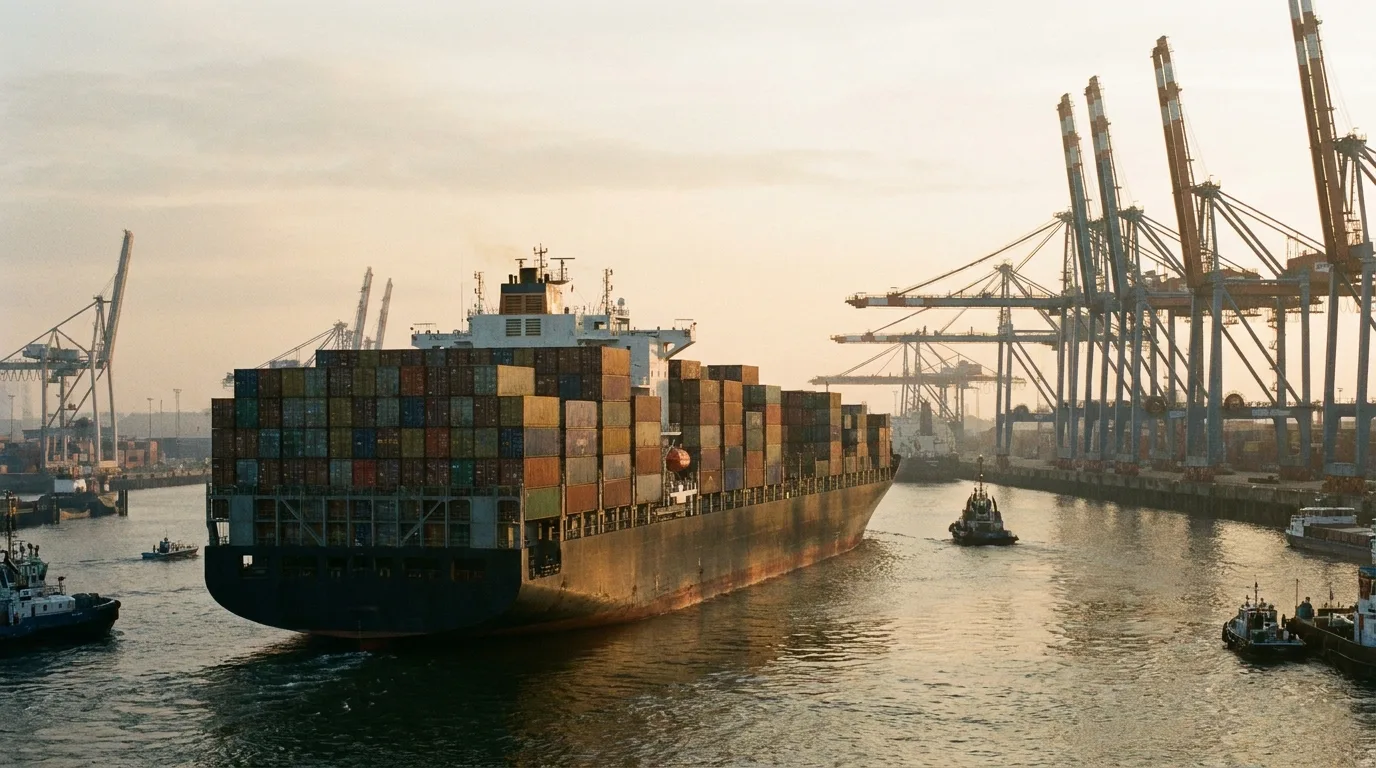
Free trade is a trade policy under which governments do not restrict imports or exports with tariffs, quotas, subsidies or other barriers. Goods and services then cross borders on the same terms as they move within a country, and prices on the world market decide what is bought and sold.
No country practices pure free trade. Almost all governments keep some tariffs, and many protect farming or strategic industries. Trade policy debates are about how far a country should move toward free trade and by which route: by cutting its own tariffs, by signing free trade agreements with partners, or by negotiating through the World Trade Organization.
Where the idea of free trade came from
In the 17th and 18th centuries, European governments mostly followed mercantilism, which treated exports as gains and imports as losses. The case for free trade began as an attack on that view.
- Adam Smith (1776). In *The Wealth of Nations*, Smith argued that a nation, like a household, should buy what others make more cheaply. “It is the maxim of every prudent master of a family, never to attempt to make at home what it will cost him more to make than to buy,” he wrote. This is the idea of absolute advantage.
- David Ricardo (1817). In *On the Principles of Political Economy and Taxation*, the economist David Ricardo went further. He showed that two countries can both benefit from trade even when one of them is better at producing everything. This is the theory of comparative advantage.
- Britain’s repeal of the Corn Laws (1846). Parliament abolished the tariffs on imported grain, and Britain became the leading open economy of the 19th century.
The idea had critics from the start. Alexander Hamilton’s *Report on Manufactures* (1791) argued that the young United States should protect new industries until they could compete. The German economist Friedrich List made the same case in 1841.
How comparative advantage works
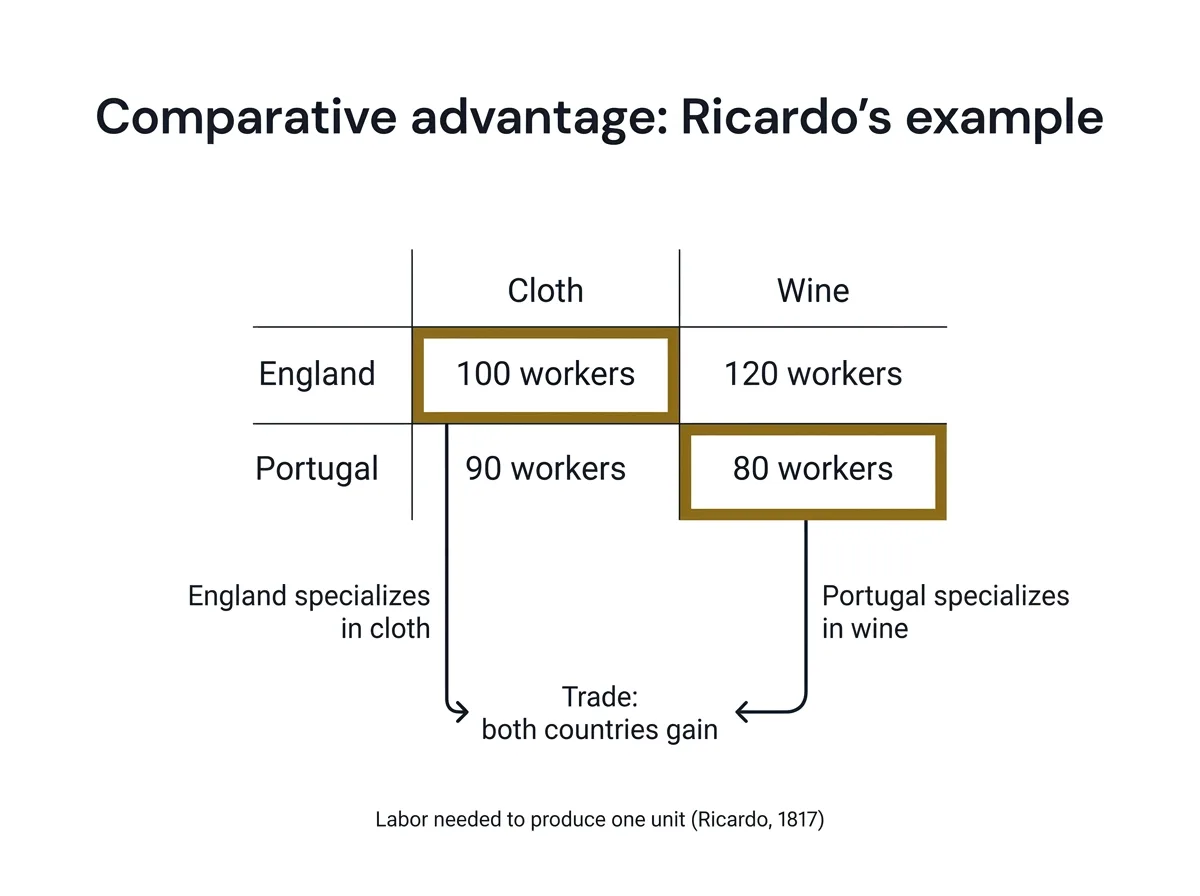
Ricardo’s example used England and Portugal, cloth and wine. He measured the labor each country needed to produce one unit of each good.
| Labor needed for one unit | Cloth | Wine |
|---|---|---|
| England | 100 workers | 120 workers |
| Portugal | 90 workers | 80 workers |
Portugal is more efficient at both goods. Yet its advantage is largest in wine, while England is least behind in cloth. If Portugal makes wine and England makes cloth, and the two trade, the two countries together produce more of both goods with the same labor.
Many people assume that the more efficient country has nothing to gain from trade. Ricardo showed that relative costs decide the pattern of trade. A poor country with low productivity in every sector can still benefit from trade, and so can a rich country that could make everything itself.
Free trade in practice: tariffs, agreements and the WTO
Modern U.S. trade policy took shape after the tariff wars of the 1930s. In 1930 Congress passed the Smoot-Hawley Tariff Act, which raised tariffs across the economy. Scholars still debate how much it deepened the Depression. Other countries adopted their own “beggar-thy-neighbor” policies, and world trade declined by some 66 percent between 1929 and 1934, according to the U.S. State Department’s Office of the Historian.
The United States changed course with the Reciprocal Trade Agreements Act of 1934. After the Second World War came the institutions that still shape international trade:
- GATT (1947). The General Agreement on Tariffs and Trade cut tariffs in a series of negotiating rounds.
- World Trade Organization (1995). The WTO replaced GATT and added rules for services, intellectual property and the settlement of disputes between members.
- Regional free trade agreements. NAFTA linked the United States, Canada and Mexico from 1994. The USMCA replaced it in 2020. The United States has free trade agreements in force with 20 countries.
Agreements differ in depth. A free trade area removes tariffs between members, but each member keeps its own tariffs toward the rest of the world. A customs union adds a common external tariff. A single market, like the European Union, also allows services, capital and people to move freely.
Free trade vs. protectionism vs. fair trade
Three broad positions show up in practice.
| Free trade | Protectionism | Fair or managed trade | |
|---|---|---|---|
| Core idea | Remove trade barriers and let markets decide | Shield domestic producers from foreign competition | Trade openly, but on conditions |
| Main tools | Tariff cuts, free trade agreements, WTO rules | Tariffs, quotas, subsidies, buy-domestic rules | Labor and environmental clauses, anti-dumping duties, targeted tariffs |
| Main goal | Efficiency, lower prices, economic growth | Jobs, industrial base, national security | Openness with protection against unfair practices |
| Who gains most | Consumers, exporters, firms using imported inputs | Workers and producers in protected sectors | Depends on the conditions written into the deal |
| Typical critique | Leaves displaced workers behind | Raises prices and invites retaliation | Conditions can become protectionism by another name |
“Fair trade” also has a second, narrower meaning. It can refer to product certification schemes that guarantee minimum prices to farmers in poorer countries for goods such as coffee or cocoa. That is a voluntary consumer label, not a government trade policy.
The case for free trade
Supporters argue from efficiency, from development and, in an older tradition, from peace.
- Lower prices and more choice. Imports compete with domestic products, which lowers prices for consumers.
- Specialization and growth. Countries that trade can focus on what they do best. Larger markets let firms grow and learn from foreign competitors.
- Development. Supporters point to economies such as South Korea and, after 2001, China, which grew fast while selling to world markets.
- Cooperation. Nineteenth-century liberals like Richard Cobden saw trade as a force for peace, because trading partners have a stake in each other’s success.
Most economists accept the basic case, including many who favor some government intervention: on average, trade raises national income.
The case against free trade
Most critics accept that trade creates gains overall. Their questions are about who receives those gains and who pays for them.
- Concentrated losses. The Stolper-Samuelson theorem of 1941 showed that trade can lower the real income of some groups even as the country as a whole gains. Research by David Autor, David Dorn and Gordon Hanson found that rising imports from China after 2001 hit American manufacturing regions hard, with job losses that lasted for years.
- Infant industries. Following Hamilton and List, some economists argue that new industries need temporary protection before they can compete with established foreign producers.
- Strategic and security concerns. Depending on foreign suppliers for medicines, semiconductors or energy can leave a country exposed in a crisis.
- Standards. Critics worry that open markets reward countries with weak labor or environmental rules.
Free traders reply that most of these problems are better solved by other policies, such as retraining and adjustment support for displaced workers. The United States created Trade Adjustment Assistance in 1962 for this purpose. Critics answer that such programs have often been too small to matter.
Common questions
What is the difference between free trade and protectionism?
One removes trade barriers. Protectionism uses tariffs, quotas and subsidies to favor domestic producers over foreign ones.
What is a free trade agreement?
It is a treaty in which countries agree to remove most tariffs and other trade barriers on goods traded between them. USMCA is one example.
Who benefits from free trade?
Consumers, exporters and firms that use imported parts tend to gain. Workers who compete with imports can lose, at least for a time.
Does free trade cost American jobs?
It shifts jobs between sectors and regions. Economists broadly agree that trade has little effect on the total number of jobs in the long run, but the losses in specific industries and towns can be large and lasting.
Sources
- Adam Smith, An Inquiry into the Nature and Causes of the Wealth of Nations (1776)
- David Ricardo, On the Principles of Political Economy and Taxation (1817)
- Alexander Hamilton, Report on Manufactures (1791)
- Friedrich List, The National System of Political Economy (1841)
- Wolfgang F. Stolper and Paul A. Samuelson, "Protection and Real Wages", Review of Economic Studies 9 (1941)
- David H. Autor, David Dorn and Gordon H. Hanson, "The China Syndrome", American Economic Review 103 (2013)
- Office of the Historian, U.S. Department of State: Protectionism in the Interwar Period
- Office of the U.S. Trade Representative: Free Trade Agreements