Definition
Keynesian economics is the theory, developed by John Maynard Keynes in his 1936 General Theory, that total spending (aggregate demand) drives output and employment in the short run. Because a slump can persist, it holds that government spending, taxes and monetary policy can stabilize the economy.
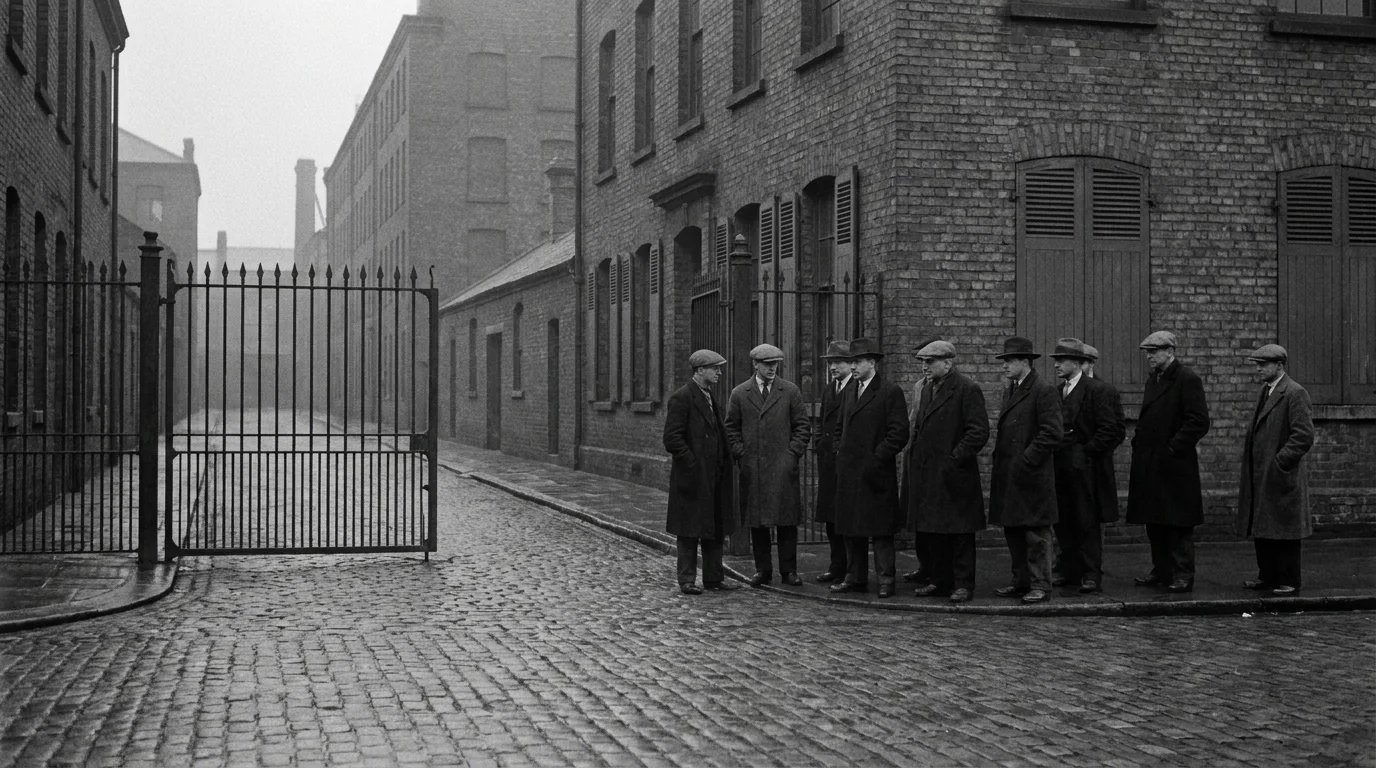
Keynesian economics is a theory that total spending in an economy, called aggregate demand, drives output and employment in the short run, and that demand can fall far enough to leave workers and factories idle for years. Because markets may not correct such a slump on their own, Keynesian economics holds that government intervention through fiscal policy and monetary policy can stabilize the economy.
The theory takes its name from the British economist John Maynard Keynes and his 1936 book, *The General Theory of Employment, Interest and Money*. He wrote it during the worst economic collapse of the industrial era.
A case study: the Great Depression
By the Federal Reserve’s account, the Great Depression began in August 1929, as the expansion of the Roaring Twenties came to an end. A stock market crash, regional bank panics and international financial crises followed. The downturn hit bottom in March 1933, when the commercial banking system collapsed. Roughly one worker in four had no job. A second recession struck in 1937, and full output and employment returned only during the Second World War, as the Federal Reserve History essay on the Great Depression records.
Classical economics had trouble explaining this. Its core rested on Say’s law, the idea that supply creates its own demand. If people lacked jobs, wages would fall until business hired them again. If households saved more, interest rates would fall and investment would rise to absorb those savings. The economy would find full employment by itself.
In the early 1930s that did not happen. Wages and prices fell, yet unemployment stayed high. Keynes argued that the classical theory described only a special case. His General Theory set out to explain an economy that settles at an equilibrium with mass unemployment and can stay there for a long time.
The Keynesian theory in five claims
The book is long and technical. Most textbook versions of the Keynesian theory reduce it to five claims:
- Aggregate demand sets output in the short run. Firms produce what they expect to sell, so if households, firms and the government together spend less, output and employment fall.
- Wages and prices are sticky. They do not fall quickly or evenly, and a wage cut also cuts incomes. A lower wage can deepen unemployment rather than cure it.
- Investment is unstable. It depends on expectations, which Keynes linked to “animal spirits” and to the marginal efficiency of capital. Pessimism can depress investment even at a low interest rate.
- Saving and investment do not automatically match. If every household tries to save more at once, spending and incomes drop, and total saving may not rise at all. This is the paradox of thrift.
- Cheap money may not be enough. If people prefer to hold cash, lowering interest rates may not increase the aggregate demand for goods. Later economists called this a liquidity trap.
How the multiplier works
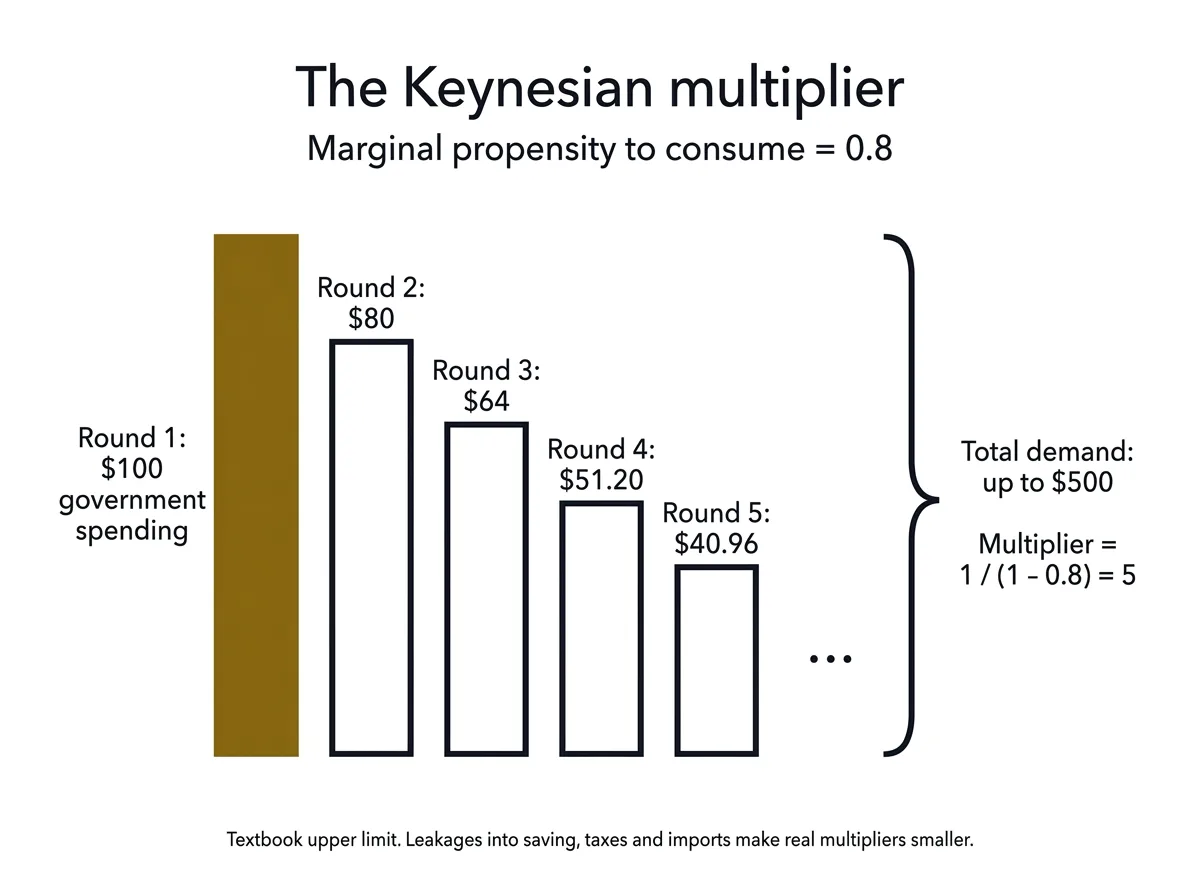
The multiplier ties these ideas together. Richard Kahn, a student of Keynes, worked out the concept in 1931. A dollar of new government spending becomes someone’s income. Part of that income is spent again and becomes another person’s income, and so on through the economy.
If households spend 80 percent of each extra dollar, the textbook multiplier is 1 / (1 – 0.8), which equals 5. Real estimates are far smaller, because some money leaks into imports, taxes and savings. Economists still disagree about its size, and the original textbook figure is best read as an upper limit.
In 1937 John Hicks turned these arguments into the IS-LM diagram of goods and money markets. For decades it was the standard way to teach Keynesian economics.
Fiscal policy, monetary policy and stimulus
The policy conclusion follows directly. If private demand falls, government spending can replace it for a while. If aggregate demand runs too hot and pushes up inflation, the state can cool it. The aim is to smooth the business cycle around full employment.
| Tool | Effect in a recession | Example |
|---|---|---|
| Government spending | Adds demand directly | Public works in the 1930s and in 2009 |
| Tax cuts and transfers | Leaves households more income to spend | Tax rebates, longer unemployment benefits |
| Automatic stabilizers | Move with the cycle without a new law | Tax receipts fall and benefit payments rise in a downturn |
| Monetary policy | Lowers interest rates and expands the money supply | Central bank rate cuts |
For deep slumps Keynes put more weight on fiscal tools than on monetary ones, because of the liquidity trap. He also had little patience for waiting. “In the long run we are all dead,” he wrote in 1923, aimed at economists who promised that markets would settle down eventually.
From the postwar consensus to 2008
After 1945 Keynesian ideas shaped economic policy in most Western countries, and governments accepted responsibility for employment. The 1970s broke this consensus. Many economies had high inflation and high unemployment at once, known as stagflation, and the simple Keynesian model had no easy answer. Monetarism and new classical economics gained ground, and central banks took over most of the work of stabilization.
The ideas returned in the financial crisis of 2007 to 2009. Central banks cut rates close to zero, and governments turned to fiscal stimulus. In February 2009 Congress passed the American Recovery and Reinvestment Act, which the Congressional Budget Office estimated at about $787 billion at enactment. Economists still argue over how many jobs it saved. The debate came back with the large fiscal response to the 2020 pandemic.

Critiques of Keynesian economics
Critics accept parts of the analysis and reject others. They disagree with each other almost as much as with Keynes.
- Monetarism. Milton Friedman and Anna Schwartz argued in 1963 that a collapse in the money supply turned an ordinary downturn into the Great Depression. From the fall of 1930 through the winter of 1933, the money supply fell by nearly 30 percent. On this view, steady monetary policy matters more than stimulus.
- New classical economics. Robert Lucas argued in 1976 that people change their behavior after policy changes, so models built on past data mislead policymakers. Under rational expectations, predictable stimulus has weaker effects.
- Ricardian equivalence. Robert Barro argued in 1974 that households may save a tax cut financed by borrowing, because they expect higher taxes later. Deficits then add less demand.
- The Austrian school. Friedrich Hayek saw a recession as the correction of malinvestment caused by cheap credit. Stimulus, in his view, delays that adjustment.
- Public choice. James Buchanan and Richard Wagner argued in *Democracy in Deficit* (1977) that politicians run deficits in bad years and avoid surpluses in good ones.
Keynesians have answered several of these points. New Keynesian economics, built from the 1980s onward, accepts rational expectations and explains sticky prices from the behavior of firms. Its models are widely used by central banks. Post-Keynesians such as Joan Robinson and Hyman Minsky stressed uncertainty and financial instability instead.
Common questions
What is Keynesian economics in simple terms?
It is the view that spending drives the economy in the short run, so higher government spending or lower taxes can offset a collapse in private spending.
How does it differ from classical economics?
Classical economists expect flexible wages, prices and interest rates to restore employment. Keynesians expect that adjustment to be slow or to fail, which gives fiscal policy an active role.
How does Keynesian economics differ from monetarism?
Both schools care about demand. Monetarists see the money supply as the main driver and prefer stable rules for the central bank. Keynesians give more weight to government budgets, especially when interest rates are near zero.
Is Keynesian economics still used today?
Yes, mostly in modified form. Central bank models are largely new Keynesian, and governments used stimulus in 2009 and 2020. The size of the multiplier and safe levels of public debt remain open questions.
Sources
- John Maynard Keynes, The General Theory of Employment, Interest and Money (Macmillan, 1936)
- John Maynard Keynes, A Tract on Monetary Reform (1923)
- Richard Kahn, "The Relation of Home Investment to Unemployment", Economic Journal 41 (1931)
- John Hicks, "Mr. Keynes and the 'Classics'", Econometrica 5 (1937)
- Milton Friedman and Anna J. Schwartz, A Monetary History of the United States, 1867-1960 (1963)
- Robert E. Lucas Jr., "Econometric Policy Evaluation: A Critique" (1976)
- Robert J. Barro, "Are Government Bonds Net Wealth?", Journal of Political Economy 82 (1974)
- James M. Buchanan and Richard E. Wagner, Democracy in Deficit (1977)
- Federal Reserve History: The Great Depression