Definition
Supply-side economics is the theory that an economy grows mainly by expanding its capacity to produce, so policy should raise the rewards for working, saving and investing. Its best-known prescription is lower marginal tax rates, often with deregulation, freer trade and stable money.

Supply side economics is the theory that an economy grows mainly by expanding its capacity to produce goods and services, so government policy should make it more rewarding to work, save and invest. Its best-known prescription is lower marginal tax rates, often paired with lighter regulation, freer trade and stable money.
Admirers credit supply-side economics with the boom of the 1980s. Critics call it a cover for tax cuts that widen deficits. Both camps repeat claims that do not survive a close look, so this guide covers the basics first and then takes five common myths one at a time.
Where the theory came from
Supply-side thinking grew out of the 1970s, when the United States had high inflation and high unemployment at the same time. That combination, called stagflation, was hard to explain with the demand-focused Keynesian models of the day. More spending was supposed to cure unemployment. Instead it seemed to feed inflation.
A small group of economists and writers offered another diagnosis. Robert Mundell and Arthur Laffer argued that high marginal tax rates, pushed higher as inflation moved households into upper brackets, discouraged work and investment. Journalist Jude Wanniski spread the ideas in the Wall Street Journal and in his 1978 book *The Way the World Works*. The economist Herbert Stein is usually credited with the label “supply-side,” which he used in 1976. In Congress, Jack Kemp and William Roth pushed for broad income tax cuts.
At a 1974 dinner in Washington, Laffer is said to have sketched his curve on a napkin for White House aides. A few years later President Ronald Reagan made these ideas the center of his first-year economic program.
How supply-side policy is meant to work
The logic runs through incentives at the margin. A worker deciding on extra hours, or a firm weighing a new plant, cares about how much of the next dollar earned it gets to keep. Supply-siders argue that lower tax rates on that next dollar raise the reward for effort and risk.
The usual policy levers:
- Lower marginal income tax rates, especially the top rates, to encourage work and entrepreneurship.
- Lower taxes on capital, such as corporate profits, dividends and capital gains, to encourage saving and investment.
- Deregulation, to cut the cost of starting and running a business.
- Freer trade, to widen markets and lower input costs.
- Stable money, often linked to Mundell’s case for tight monetary policy against inflation alongside tax cuts for economic growth.
If these measures work, more labor and capital flow into production and incomes rise. The tax base grows, which would offset some of the tax revenues lost to lower rates.
Myth 1: “It is only about tax cuts for the rich”
The original program was wider than tax cuts. Early supply-side writers cared as much about inflation, trade barriers and regulation as about income tax rates. They also argued that high rates on middle incomes pushed up by inflation did harm.
Cuts to top rates and capital taxes do deliver most of their direct savings to high earners, since they pay those taxes. Supporters answer that the gains are meant to reach workers through more investment, more jobs and higher wages. Whether that happens is an empirical question, and most of the dispute turns on it.
Myth 2: “Supply-siders say every tax cut pays for itself”
The Laffer curve makes a narrower claim. At a 0% rate the government collects nothing. At 100% it also collects nothing, because no one would earn taxable income only to hand all of it over. Somewhere in between sits a rate that maximizes revenue.
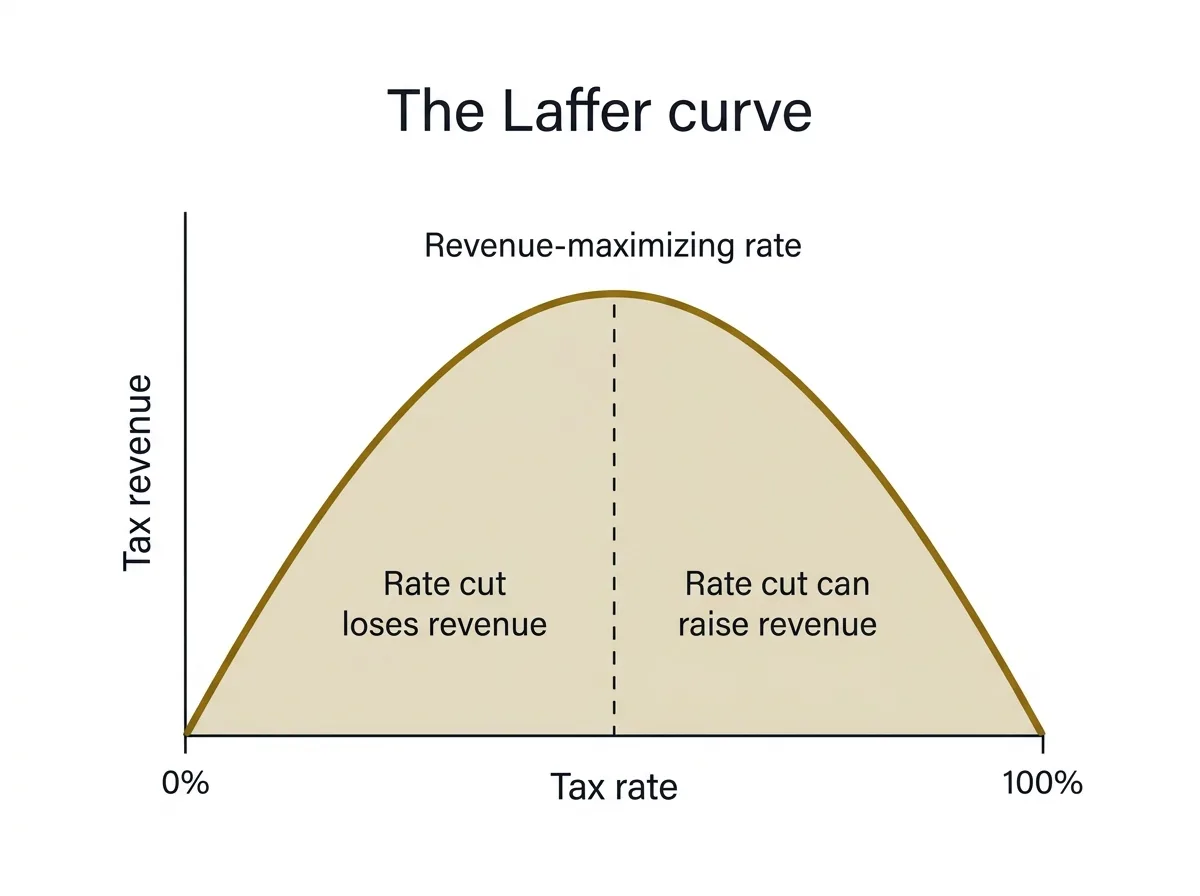
Only above that peak would a tax cut increase revenue. Below it, a cut loses revenue, although faster growth can recover part of the cost. Economists’ estimates of where the peak lies differ widely and depend on the tax being cut. Some politicians did promise that tax cuts would pay for themselves. Most supply-side economists made the more modest claim that the true cost is lower than a static estimate suggests.
Myth 3: “Supply-side and trickle-down are the same thing”
“Trickle-down” is a critic’s term, and it is older than the supply-side movement. It describes the theory as handing money to the wealthy and waiting for some of it to drip down, a picture supporters reject as a caricature.
Supply-siders describe their argument as one about incentives for everyone at the margin, not transfers to a group. Critics reply that the policies passed under the supply-side banner have concentrated benefits at the top. When someone says “trickle-down,” they are usually stating a verdict on that record.
Myth 4: “The Reagan record settles the question”
Both sides claim the 1980s. The Economic Recovery Tax Act of 1981 cut individual rates across the board, and the top rate fell from 70% to 50%. The Tax Reform Act of 1986 brought it down to 28%, as the IRS Statistics of Income historical table on tax rates shows. After a deep recession in 1981 and 1982, economic growth was strong for the rest of the decade.

Much else happened during the same years, which is why the record does not settle the debate:
| Development | Supporters’ reading | Critics’ reading |
|---|---|---|
| Strong growth after 1982 | Lower rates unleashed work and investment | Ordinary recovery plus large deficit spending |
| Inflation fell | Tax policy and tight money worked together | The Federal Reserve under Paul Volcker did the work |
| Federal deficits grew | Defense spending and recession were the cause | Tax revenues fell short of what was promised |
| Tax increases in 1982 and 1984 | Fine-tuning of a sound program | Evidence the original cuts went too far |
Later episodes add data but not a verdict. The tax cuts of President George W. Bush in 2001 and 2003 and the 2017 Tax Cuts and Jobs Act are read very differently by the two camps. So is Kansas, which cut income taxes sharply in 2012 and reversed much of the plan in 2017 after budget shortfalls.
Myth 5: “It rejects everything Keynes stood for”
Keynesian economics treats weak demand as the main cause of recessions and favors fiscal stimulus to fill the gap. Supply side economics focuses on long-run capacity and on how taxes change behavior.
The line has blurred since the 1980s. Mainstream economists accept that tax rates affect work, saving and investment, and the Congressional Budget Office now publishes dynamic estimates of fiscal policy that include such effects. Many supply-siders accept that demand matters in a downturn. What they still disagree about is size: how strongly people respond to lower rates.
Competing views in brief
- Supporters hold that higher tax rates distort choices, that economic growth is the best route to higher wages, and that lower rates on a broader base produce a healthier economy.
- Skeptical economists accept incentive effects but find them modest at current US rates. In their view broad tax cuts usually lose revenue and add to debt unless government spending falls.
- Distributional critics argue the gains have gone mostly to high earners while wages for typical workers grew slowly.
Common questions
Who created supply-side economics?
No single person. Robert Mundell, Arthur Laffer, Jude Wanniski, Paul Craig Roberts and Jack Kemp shaped it in the 1970s. Laffer pointed to older roots, including the 14th-century scholar Ibn Khaldun.
What is an example of supply-side policy?
The 1981 Reagan tax cut is the classic case. Cutting the corporate rate from 35% to 21% in 2017 was also defended on supply-side grounds.
Does supply-side economics work?
Few economists dispute that incentive effects exist. The open question is whether they are large enough at today’s rates to justify the revenue cost, and the evidence is mixed.
How is it different from demand-side economics?
Demand-side policy tries to raise spending in the short run. Supply-side policy tries to raise the economy’s capacity to produce over the long run.
Sources
- Jude Wanniski, The Way the World Works (1978)
- Jude Wanniski, "Taxes, Revenues, and the 'Laffer Curve'", The Public Interest (1978)
- Economic Recovery Tax Act of 1981
- Tax Reform Act of 1986
- IRS Statistics of Income: Historical Table 23, Individual Income Tax Rates