Definition
Direct democracy is a form of government in which citizens decide laws and policy questions themselves instead of leaving every decision to elected representatives. Its main tools are the referendum, the citizen initiative and the recall, usually combined with a parliament.
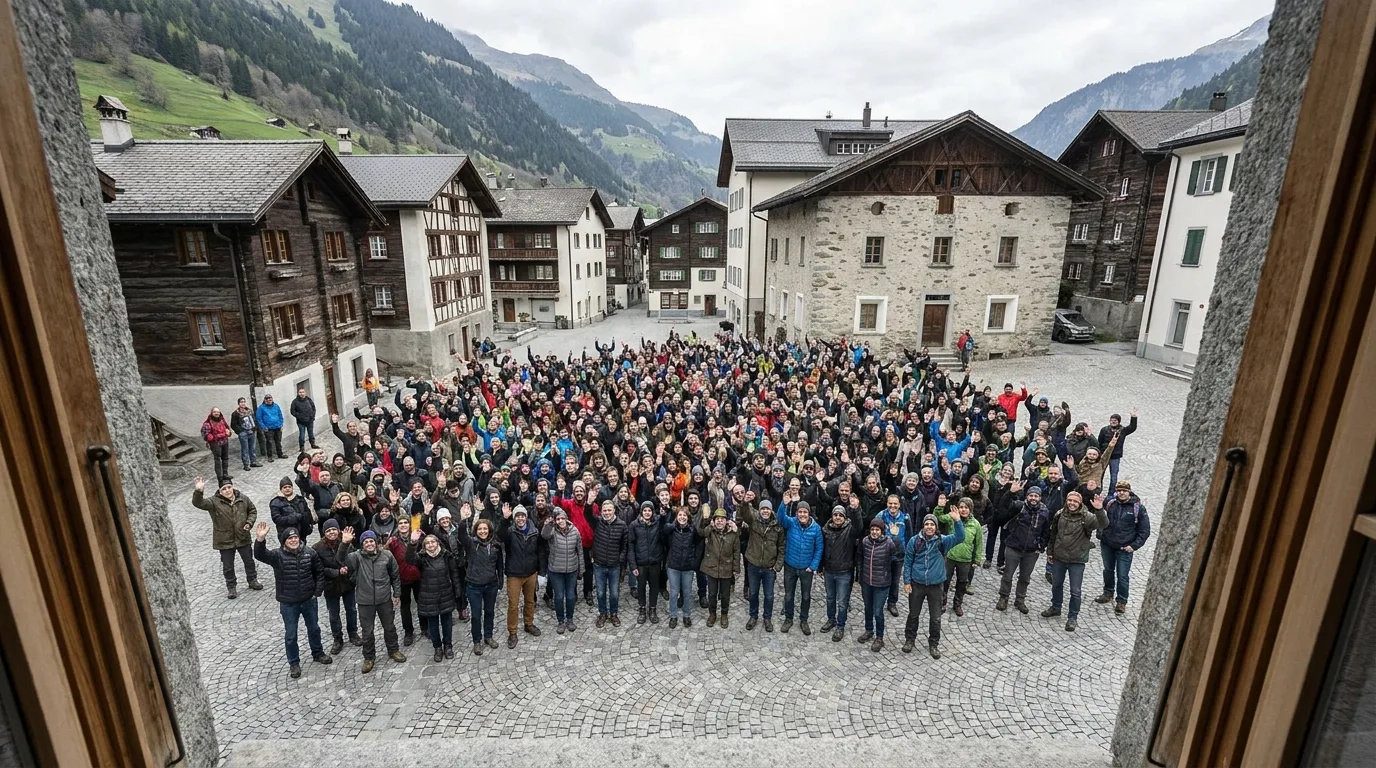
Direct democracy is a form of government in which citizens decide laws and policy questions themselves instead of leaving every decision to elected representatives. In practice it is rarely used alone: almost every political system that has it combines it with a parliament and representative democracy, so scholars speak of instruments of direct democracy rather than of a pure democracy.
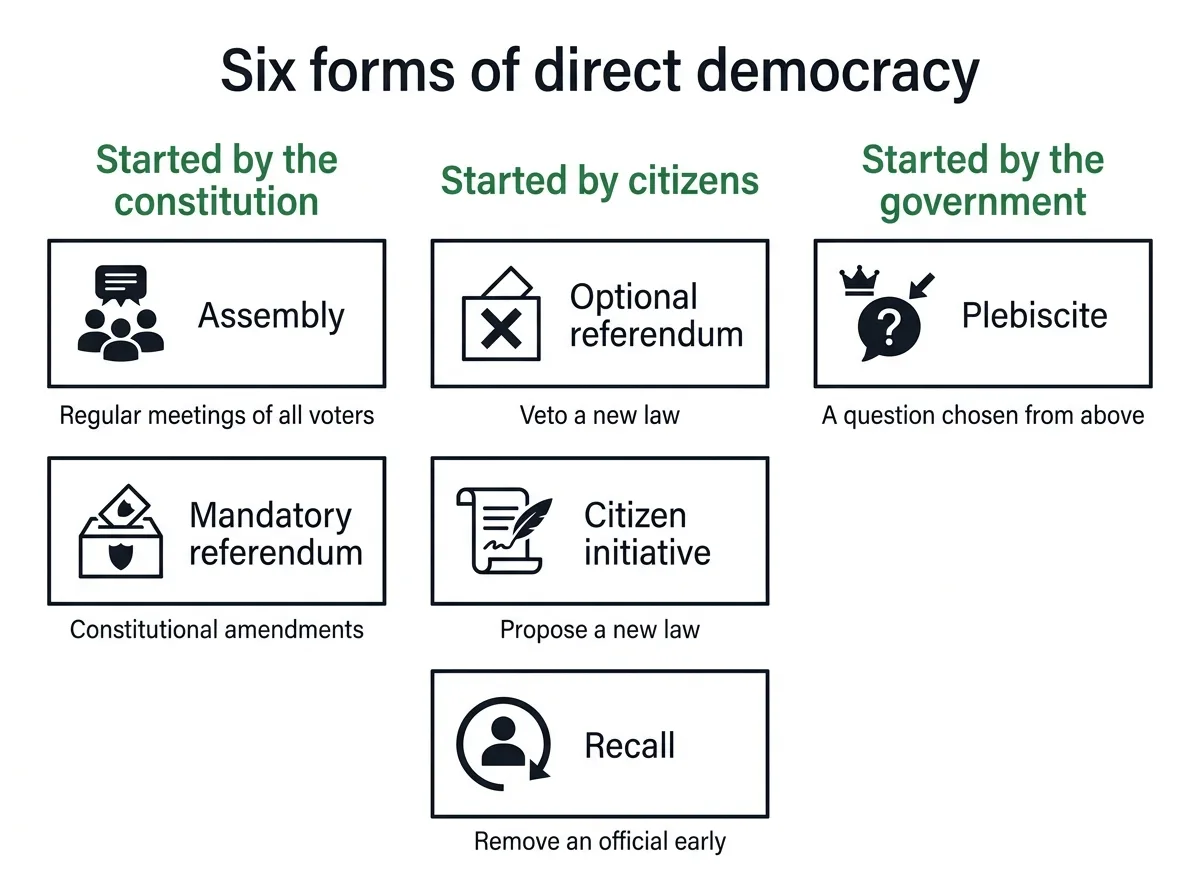
Its roots go back to Athens. The Athenian assembly, open to adult male citizens, debated war, taxes and public works and decided them by show of hands; women, slaves and resident foreigners were excluded. Modern forms of direct legislation took shape in the nineteenth century, when Swiss cantons and later American reformers wrote popular votes into their constitutions. Today the term covers several distinct tools, and each gives the people a different kind of power.
Six forms of direct democracy at a glance
| Form | Who starts it | What citizens decide | Example |
|---|---|---|---|
| Assembly | Law sets regular meetings | Local laws, budgets, officials | Glarus Landsgemeinde, Vermont town meetings |
| Mandatory referendum | Constitution | Constitutional amendments and other set questions | Swiss constitutional ballots, US state amendments |
| Optional referendum | Citizens, by petition | Whether a new law stands | Swiss challenge to a national law |
| Citizen initiative | Citizens, by petition | A law or amendment citizens drafted | California Proposition 13 (1978) |
| Recall | Citizens, by petition | Whether an official leaves office early | California governor recall (2003) |
| Plebiscite | Government | A question it chooses, binding or advisory | UK referendum on EU membership (2016) |
1. Assembly democracy: deciding face to face
The oldest form puts the entire electorate in one place, where people hear the arguments, propose amendments and decide by raised hands.
Two Swiss cantons, Glarus and Appenzell Innerrhoden, still hold a Landsgemeinde, an open-air assembly where voters pass cantonal laws and set taxes in a town square. In the New England states, many towns govern themselves through town meetings. Vermont’s Town Meeting Day falls on the first Tuesday in March, when residents approve town budgets, school spending and local officers.
Assemblies suit small communities, and they give up the secret ballot.
2. Mandatory referendum: when the constitution requires a vote
Some decisions cannot take effect until voters approve them. The constitution itself triggers the process, so neither the government nor the voters have to ask for it.
- In Switzerland, every amendment to the federal constitution goes to the people. It passes only with a double majority: most voters nationwide and most cantons.
- In 49 of 50 US states, amendments to a state constitution need voter approval. Delaware is the exception; its legislature can amend the state constitution on its own.
The public therefore keeps the final say over the basic rules of government.
3. Optional referendum: a veto from below
Here the legislature passes a law as usual, but opponents can force a ballot on it by collecting signatures. If most voters say no, the law fails.
In Switzerland, 50,000 signatures gathered within 100 days, or a request from eight cantons, are enough to put a law passed by the federal parliament to a referendum. The threat of the referendum changes the way legislation is written. Parliament tends to build broad compromises in advance, since any organized group able to collect signatures could otherwise block a result. The political scientist Leonhard Neidhart argued in 1970 that this pressure helped produce the consensus style of government in Switzerland.
Several US states offer a similar tool, the popular referendum, which lets voters overturn a measure that the state legislature has just passed.
4. Citizen initiative: lawmaking in Switzerland and US states
The initiative goes a step further. Citizens draft a proposal, gather a set number of signatures and place it on the ballot themselves, a process often called citizen lawmaking.
Swiss voters can propose a constitutional amendment initiative if they collect 100,000 valid signatures within 18 months, according to the Swiss Federal Chancellery. Most initiatives fail; historically only about one in ten has been approved. They still matter, because parliament often answers with a counter-proposal that takes up part of the idea.
South Dakota adopted the initiative and referendum in 1898, and Oregon followed in 1902 with what became known as the “Oregon System.” Today roughly half of all US states allow some form of statewide initiative or popular referendum. Perhaps the most famous case is California’s Proposition 13 of 1978, which capped property taxes and set off a wave of tax limits in other states.
US states have used two versions:
- Direct initiative: the measure goes straight to the ballot once enough signatures are verified.
- Indirect initiative: the proposal goes first to the legislature, who can adopt it, reject it or offer an alternative before voters decide. Massachusetts and Michigan use this route for statutes.
The United States has no initiative or referendum at the federal level; national law is made only by Congress and the president.
5. Recall: removing an official early
A recall lets voters end an elected official’s term before it runs out. A petition with enough signatures triggers a special election on whether that official stays.
Recall spread during the Progressive Era. Los Angeles wrote it into its city charter in 1903, and Oregon adopted it for state officials in 1908. In 1921, North Dakota voters recalled Governor Lynn Frazier, the first governor removed this way. In 2003, Californians recalled Governor Gray Davis and elected a replacement on one ballot. Today about 20 states allow recall of state officials, and many more allow it for local officials.
Switzerland has no recall at the federal level. Voters there decide issues, and officeholders serve out their terms.
6. Plebiscite: a question from the top
Sometimes the government or parliament decides on its own to put a question to the public. Such votes are often called plebiscites, and they may be binding or merely advisory.
Britain’s 2016 referendum on membership of the European Union is a recent example. Because those in power control the timing and the question, plebiscites give voters less control over the agenda than ballots they trigger themselves.
Is direct democracy better? Arguments on both sides
Supporters and critics often cite the same cases and weigh them differently.
Arguments in favor:
- Legitimacy: Jean-Jacques Rousseau held that sovereignty belongs to the people and cannot be represented. A popular decision carries a direct mandate.
- A check on elites: Progressive Era reformers in the American West backed initiative and recall to counter the power of railroads and party machines over state legislatures.
- Civic engagement: regular ballots give people a reason to follow public questions closely and push political parties to explain their positions.
Arguments against:
- Minority rights: James Madison warned in Federalist No. 10 that “a pure democracy” can “admit of no cure for the mischiefs of faction,” because a majority can act against everyone else. Critics point to the 2009 initiative in Switzerland banning new minarets, which 57.5% of voters approved, and to the fact that women there were not able to vote in federal elections until 1971.
- Complexity: many public policy questions do not reduce to yes or no.
- Money and organization: gathering signatures and running campaigns costs a lot, so well-funded groups can shape which questions reach a ballot.
Defenders reply that elected legislatures have also failed minorities, and that in Switzerland federalism and the double majority limit what a national majority can impose. Much of the remaining argument concerns which questions should go to voters and under which safeguards.
Other common questions
How does direct democracy differ from representative democracy?
In a representative democracy, the people elect officials who make the laws. In direct democracy, the voters decide some laws themselves. Most modern systems are a mix of both.
Does the United States have direct democracy?
Not at the federal level. But many states and cities use initiatives, referendums and recalls, and New England towns still govern through town meetings.
Which country is the clearest example?
Switzerland. Its voters decide federal questions several times a year, and cantons and municipalities hold ballots of their own.
What are the three classic forms of direct democracy?
The referendum, the citizen initiative and the recall. Assemblies and plebiscites are often added as related forms.
Sources
- Swiss Federal Chancellery: Popular initiatives
- ACE Electoral Knowledge Network: Direct Democracy
- James Madison, The Federalist No. 10 (1787)
- Jean-Jacques Rousseau, The Social Contract (1762)
- Thomas E. Cronin, Direct Democracy: The Politics of Initiative, Referendum, and Recall (Harvard University Press, 1989)