Definition
Judicial review is the power of a court to examine a law or a government action and set it aside if it conflicts with the constitution. In the United States it was established by Marbury v. Madison (1803).
Judicial review is the power of a court to examine a law or a government action and set it aside if it conflicts with the constitution. In the United States, federal and state courts all hold this power, which is the main legal check the judiciary has on the legislative and executive branches of government.
The text of the Constitution does not spell the power out, and its reach has been argued over since the early republic.
What is judicial review in simple terms?
A constitution is a higher law, and ordinary statutes must fit inside it. When a real dispute reaches a court and one side argues that a statute or an executive order breaks the constitution, the judges decide which rule controls. If the two conflict, the constitution wins and the lower rule is not enforced.
Lawyers usually separate two kinds:
- Constitutional review asks whether a law or act is consistent with the constitution itself.
- Administrative review asks whether an agency stayed within the powers a statute gave it and followed fair procedure.
A ruling against a law does not repeal it. The text stays on the books, but courts no longer apply it, and the decision binds lower courts through precedent.
Where does judicial review come from?
Article III vests “the judicial Power of the United States” in one Supreme Court and the inferior courts Congress creates. Article VI, the Supremacy Clause, makes the Constitution “the supreme Law of the Land” and binds judges to it. Supporters read the two clauses together as granting the power by implication, as part of the system of checks and balances.
In The Federalist No. 78, Alexander Hamilton called the judiciary “the least dangerous” branch, since it has “neither FORCE nor WILL, but merely judgment,” and argued that judges must prefer the Constitution to a statute that contradicts it. Before 1803 the justices had already considered whether federal laws were valid, for example in Hylton v. United States (1796), where they upheld a federal tax on carriages.
The Marbury v. Madison case
The decisive case came out of the bitter election of 1800. Before leaving office, President John Adams appointed William Marbury as a justice of the peace for the District of Columbia. His commission was signed but never delivered. The new President, Thomas Jefferson, had his Secretary of State, James Madison, withhold it. Marbury asked the Supreme Court to issue a writ of mandamus, an order forcing Madison to hand over his commission.
Chief Justice John Marshall split the case into three questions:
- Did Marbury have a right to his commission? Yes.
- Did the laws give him a remedy? Yes.
- Could the Court issue the writ of mandamus? No.
The problem was jurisdiction. Section 13 of the Judiciary Act of 1789 seemed to let Marbury go straight to the Supreme Court. Article III, however, lists the few cases where the Court has original jurisdiction and gives it appellate jurisdiction in the rest, and Congress could not add to that list by statute. “A Law repugnant to the Constitution is void,” Marshall wrote, and “it is emphatically the province and duty of the judicial department to say what the law is.”
According to the National Archives’ account of Marbury v. Madison, this was the first time the Court declared unconstitutional a law passed by Congress and signed by the President. No other act of Congress was struck down until the Dred Scott decision of 1857. Jefferson, who kept the commission from Marbury, objected to the principle that judges alone should settle such questions.
How does judicial review work in practice?
American courts do not give abstract opinions on whether a law is valid. Review happens only inside a concrete case: a person or company harmed by a law files suit, or raises the constitution as a defense, and the court rules on that dispute.
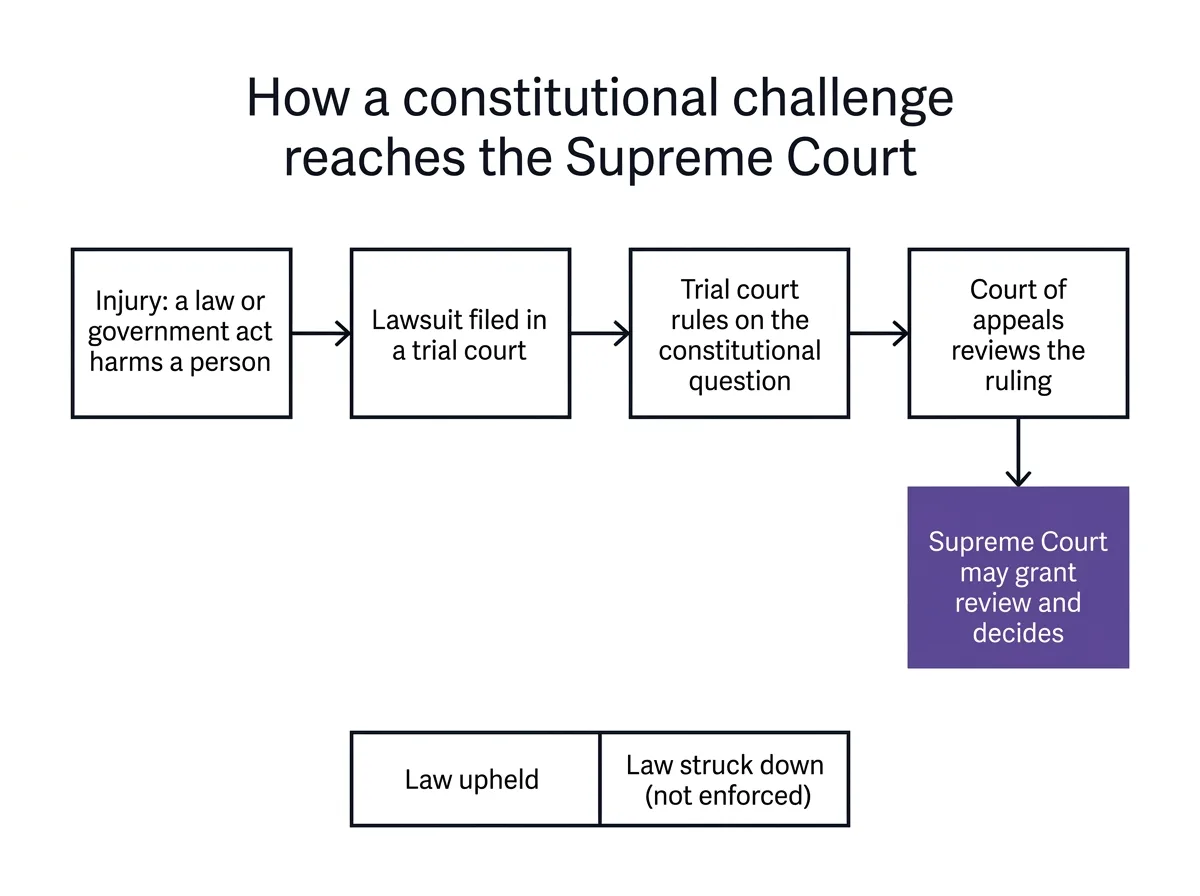
Some well-known examples show the range:
| Case | Year | What was reviewed | Result |
|---|---|---|---|
| Marbury v. Madison | 1803 | Section 13 of the Judiciary Act of 1789 | Provision void |
| Fletcher v. Peck | 1810 | A Georgia law revoking land grants | First state law struck down |
| Youngstown Sheet & Tube Co. v. Sawyer | 1952 | President Truman’s seizure of steel mills | Executive order invalid |
| Brown v. Board of Education | 1954 | State laws segregating public schools | Segregation unconstitutional |
Many challenges end with the law upheld. Judges presume that statutes are valid and often read an unclear law in a way which avoids a constitutional conflict.
What are the limits of judicial review?
Several doctrines keep the judiciary within bounds:
- Standing: the plaintiff must show a concrete injury caused by the law, not just disagreement with it.
- Case or controversy: federal courts do not issue advisory opinions, so there must be a live dispute.
- Political questions: some issues are left to the political branches, under the test set out in Baker v. Carr (1962).
- Deference: judges often accept the legislature’s factual judgments.
The other branches have their own answers. The amendment process can reverse a decision, as the Eleventh Amendment did after Chisholm v. Georgia (1793) and the Sixteenth after Pollock v. Farmers’ Loan & Trust (1895). Congress also shapes the courts’ jurisdiction, and the President appoints the justices with the consent of the Senate.
Is judicial review good for democracy?
The case for strong review
Defenders follow Hamilton and Marshall: a written constitution only limits power if someone outside the majority can enforce it. Courts protect minorities and individual rights that elected majorities might ignore. John Hart Ely, in Democracy and Distrust (1980), argued that review is most justified when it keeps the democratic process open.
The case for restraint
James Bradley Thayer argued in 1893 that judges should strike down a law only when its unconstitutionality is clear beyond reasonable doubt. Alexander Bickel named the “counter-majoritarian difficulty” of unelected judges overruling elected representatives. Originalists add that judges should follow the original meaning of the text so that review does not turn into policy making.
The case against strong review
Critics such as the legal philosopher Jeremy Waldron hold that reasonable people disagree about rights, and that such disagreements belong to legislatures accountable to voters. Abraham Lincoln voiced a version of this after Dred Scott, warning that if vital questions of policy were fixed by the Supreme Court, the people would cease to be their own rulers.
How does judicial review work in other countries?
The American model is “diffuse”: any court may decline to apply an unconstitutional law. Much of Europe follows a “centralized” model associated with the Austrian jurist Hans Kelsen, in which only a special constitutional court can strike down legislation.

| Country | Model | Main feature |
|---|---|---|
| United States | Diffuse | All courts can review; the Supreme Court has the final word |
| Germany | Centralized | Federal Constitutional Court (since 1951); citizens can file constitutional complaints |
| France | Centralized | Conseil constitutionnel; since 2010 it can also review laws already in force |
| United Kingdom | Weak form | Courts cannot strike down Acts of Parliament but can declare them incompatible with the Human Rights Act 1998 |
| Canada | Strong with override | Courts enforce the Charter, but legislatures may use the “notwithstanding clause” (section 33) |
| Netherlands | None for statutes | The constitution bars courts from reviewing Acts of Parliament against it |
In the UK, the term mostly means checking whether ministers and public bodies acted lawfully, rationally and fairly. Under parliamentary sovereignty, a statute itself cannot be set aside.
Common questions about judicial review
Is judicial review in the Constitution? Not in words. It is inferred from Articles III and VI and from the logic of a written constitution, and Marbury v. Madison established it as settled practice.
What is the difference between judicial review and an appeal? An appeal asks whether a lower court got the law or the facts wrong. Judicial review asks whether a law or government act is valid at all.
Who has the last word? On the federal Constitution, the Supreme Court claims it, most firmly in Cooper v. Aaron (1958). Whether the other branches must accept every reading the Court gives remains a live debate.
Sources
- Marbury v. Madison, 5 U.S. 137 (1803)
- Alexander Hamilton, The Federalist No. 78 (1788)
- James Bradley Thayer, "The Origin and Scope of the American Doctrine of Constitutional Law", Harvard Law Review 7 (1893)
- Alexander M. Bickel, The Least Dangerous Branch (1962)
- John Hart Ely, Democracy and Distrust (1980)
- Jeremy Waldron, "The Core of the Case Against Judicial Review", Yale Law Journal 115 (2006)
- LII Wex: Judicial review