The essay in brief
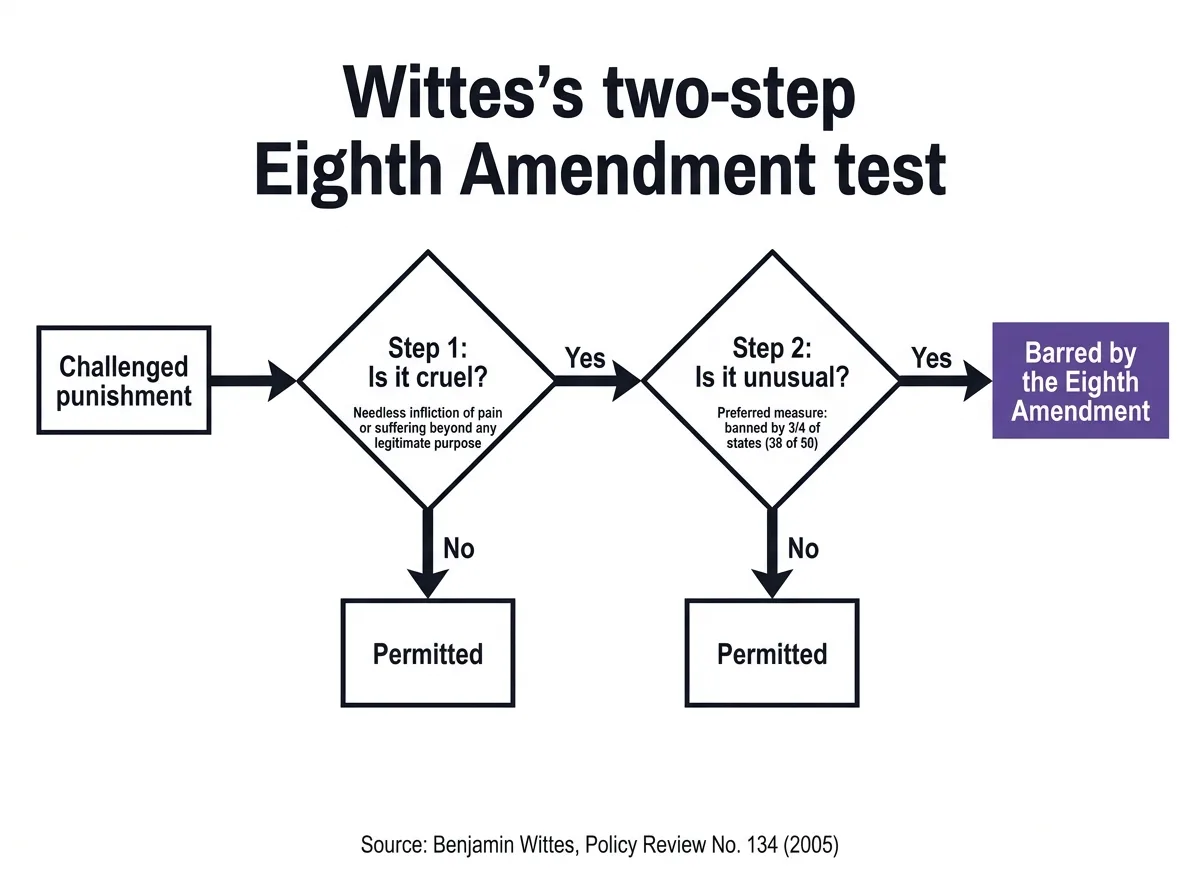
In a 2005 Policy Review essay, Benjamin Wittes argued that the Supreme Court's 'evolving standards of decency' test left the Eighth Amendment without a stable rule, while Justice Scalia's originalist reading was too narrow. He proposed a two-part test: a punishment is barred only if it is both cruel (needlessly painful beyond any legitimate purpose) and unusual, ideally meaning banned by three-quarters of the states.

What is cruel and unusual punishment? The Constitution of the United States never says. The Eighth Amendment, part of the Bill of Rights, states only that “excessive bail shall not be required, nor excessive fines imposed, nor cruel and unusual punishments inflicted,” and leaves the two key words undefined.
In the December 2005 and January 2006 issue of *Policy Review*, the legal journalist Benjamin Wittes took up that gap in an essay titled “What Is ‘Cruel and Unusual’?” Writing months after the Supreme Court decided *Roper v. Simmons*, he called the court’s Eighth Amendment case law a “jurisprudential train wreck.” His remedy was a test that neither the majority nor its conservative critics were using: read the words themselves.
What did Wittes argue, in brief?
Wittes made three moves, one per section of the essay.
- The court’s method has no stable rule. Since *Trop v. Dulles* (1958), the court has asked whether a punishment offends “the evolving standards of decency that mark the progress of a maturing society.” Wittes argued that this test gives judges no way to know how much change in state laws, public opinion or foreign practice is enough, so outcomes track the views of whoever is in the majority.
- Justice Antonin Scalia’s alternative is principled but too narrow. Scalia read the clause as banning only what it banned in 1791, mainly torturous methods, with no guarantee of proportionality. Wittes found this doubtful as a matter of text and history, and at odds with a century of what the court has said about the Eighth Amendment.
- The text itself offers a middle path. A punishment that is both *cruel* and *unusual*, each defined in a way judges can apply, would be unconstitutional. Anything else would stand.
He was candid that he found many recent results politically congenial. His complaint concerned how the court reached them, since judges should be bound by rules that others can predict.
Why was the essay written in 2005?
The court had just changed its mind twice on the death penalty. In 1989 it had upheld capital punishment for offenders with intellectual disabilities and for those who were 16 or 17 at the time of the crime. In *Atkins v. Virginia* (2002) and *Roper v. Simmons* (2005) it reversed course on both.
In *Roper*, Justice Anthony Kennedy’s majority opinion found a national consensus against the execution of juvenile offenders and then added the court’s “own independent judgment” on proportionality. Scalia’s dissent objected that nine lawyers had made themselves the nation’s conscience. Wittes used that exchange as his starting point.
He also pointed to sentencing cases that are hard to reconcile:
| Case | Year | Sentence at issue | Result |
|---|---|---|---|
| *Rummel v. Estelle* | 1980 | Life under a Texas recidivist law for about $120 in fraud | Upheld |
| *Solem v. Helm* | 1983 | Life without parole in South Dakota after a $100 bad check | Struck down |
| *Harmelin v. Michigan* | 1991 | Mandatory life without parole for cocaine possession | Upheld |
| *Lockyer v. Andrade* | 2003 | Two 25-to-life terms under California’s three-strikes law for stealing videotapes | Upheld |
To Wittes, law that produced this pattern could not tell legislatures in advance what constitutes cruel and unusual punishment.
Where did the “evolving standards” test come from?
Wittes traced the problem to *Trop*, where the court struck down loss of citizenship as a penalty for wartime desertion. Chief Justice Earl Warren’s plurality opinion supplied the decency language, and later decisions made it the governing test. In Wittes’s view, *Trop* swapped the constitutional words for a sociological question about how far society had matured, and left judges to answer it.
He did not think a dynamic reading was new or illegitimate. In *Weems v. United States* (1910), the court had already said the prohibition on cruel and unusual punishments was not fastened to the abuses of Stuart England and could gain meaning as public opinion changed. The annotated Constitution hosted by Cornell’s Legal Information Institute traces this line from Weems to Trop and the modern evolving standard. For Wittes, a century of precedent deserved respect. What was missing was a principle.
What does “cruel” mean in his test?
Wittes defined cruelty as the needless infliction of pain or suffering. Pain alone does not settle the question. A punishment that is reasonably tied to deterrence, or to keeping an offender from harming others, is not cruel, however harsh. Wanton violence, gross disproportion or degrading humiliation beyond any legitimate purpose would be.
He saw the weak point himself. Harsher sentences almost always deter more in theory, so deterrence could swallow the definition. His answer: the more extreme the punishment, the heavier the burden the government must carry, and cruelty is only the first step.
What does “unusual” mean in his test?
This was the harder word. Wittes weighed several definitions:
- A fixed numerical cutoff, such as a punishment authorized in five or fewer states. Simple, but arbitrary.
- Rarity in practice, measured by how often a jurisdiction uses a punishment for comparable crimes. Fair, but hard to measure, and it might push states to use cruel punishments more often.
- The amendment threshold, his preferred option: a cruel punishment becomes unusual once three-quarters of the states, currently 38, have banned it, the same number needed to ratify a constitutional amendment.
On that view, the clause works as a common-law shortcut to the amendment process. Judges could stop a holdout state only after a supermajority of states had already rejected the practice.
What did critics and later scholars say?
Each camp in the debate Wittes described has a reply to his proposal.
- Originalists can accept that the clause covers more than 1791 tortures and still reject rarity as the meaning of “unusual.” The law professor John Stinneford later argued that the word originally meant “contrary to long usage,” so a punishment is suspect when it is new and harsh, close to the opposite of a test that waits for 38 states.
- Supporters of the evolving standards approach argue that a 38-state threshold would leave the clause almost powerless, since by then the few remaining states rarely matter. They see independent judicial judgment as the point of reviewing punishments at all.
- Proportionality advocates note that his cruelty test still lets judges weigh disproportion, so the old sentencing puzzles would not vanish.

How has the essay held up?
The court did not adopt his test. It kept the existing Eighth Amendment framework and extended it for several years:
- *Kennedy v. Louisiana* (2008) barred the death penalty for the rape of a child where the victim did not die.
- *Graham v. Florida* (2010) barred life without parole for juveniles convicted of crimes other than homicide.
- *Miller v. Alabama* (2012) barred mandatory life without parole for juvenile offenders.
Since then the emphasis has shifted. In *Bucklew v. Precythe* (2019), Justice Neil Gorsuch’s majority opinion relied on the original understanding of both words, and in *City of Grants Pass v. Johnson* (2024) the court held that enforcing public camping laws against homeless people did not violate the clause. Both opinions read the clause through its history, closer to Stinneford than to Wittes’s rarity test. His central complaint, that the decency test has no stopping rule, is still a common charge against it.
Wittes later became a senior fellow at the Brookings Institution and co-founded the national security site Lawfare.
Questions readers often ask
Is the death penalty cruel and unusual?
Not as such, under current law. The court has limited who may face the death penalty and for which crimes, but executions as a form of punishment are still permitted.
Did Wittes oppose Roper v. Simmons?
He did not object to the outcome. He objected to the reasoning behind it.
Was Policy Review connected to the Hoover Institution?
Yes. The Hoover Institution published *Policy Review* from 2001 until it closed in 2013. This site is an independent reference and is not affiliated with Hoover.
Where to read the original essay
The full text of Benjamin Wittes, “What Is ‘Cruel and Unusual’?”, *Policy Review* No. 134 (December 2005 and January 2006), is in the Hoover Institution’s archive. See its footnotes for the cases he relied on.
Sources
- Benjamin Wittes, "What Is 'Cruel and Unusual'?", Policy Review 134 (2005)
- Constitution Annotated: Amdt8.3.2 Evolving Standard (Legal Information Institute)
- Roper v. Simmons, 543 U.S. 551 (2005)
- Trop v. Dulles, 356 U.S. 86 (1958)
- Weems v. United States, 217 U.S. 349 (1910)
- John F. Stinneford, "The Original Meaning of 'Unusual': The Eighth Amendment as a Bar to Cruel Innovation", Northwestern University Law Review 102 (2008)