Definition
Judicial activism is a label for judges who are more willing than others to strike down laws, overturn precedent or recognize new rights. The term was coined by Arthur Schlesinger Jr. in 1947 and is usually contrasted with judicial restraint.
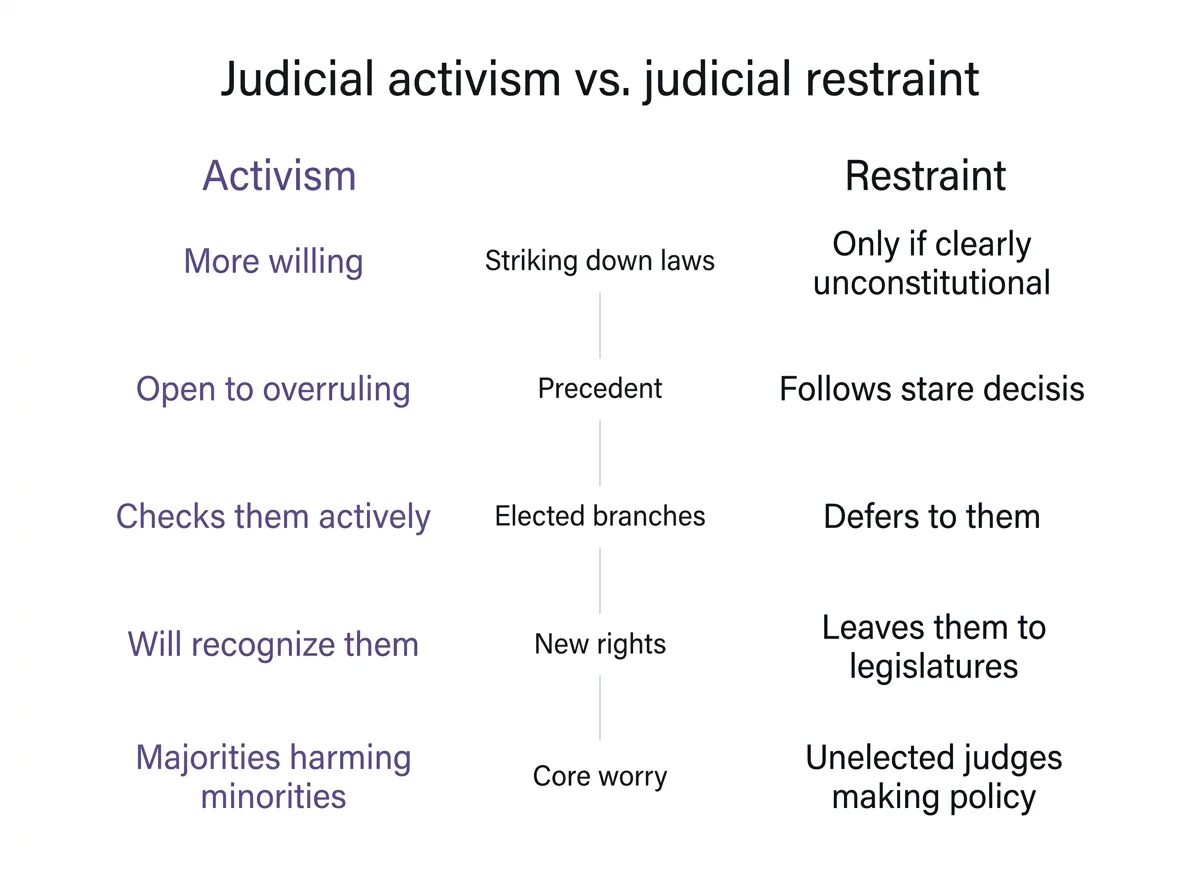
Judicial activism refers to judges who are more willing than others to invalidate laws, overturn precedent or read new rights into a constitution. The label usually carries a charge: that judges are deciding a case on their own policy views rather than an honest interpretation of the law.
That charge is where the trouble starts. Scholars use the word activism as a description, politicians use it as an insult, and the two uses rarely line up.
The problem: one term, many meanings
Ask five people what judicial activism is and you may get five answers. Some mean judicial power used against an elected legislature. Others mean a judge who goes beyond the text of the Constitution. Still others mean any decision that reached, in their view, the wrong result.
The legal scholar Keenan Kmiec traced the history of judicial activism in a 2004 California Law Review article and found at least five distinct senses:
- Invalidating the arguably constitutional actions of other branches of government.
- Failing to follow precedent.
- Judicial legislation, meaning decisions that look like lawmaking.
- Departing from accepted methods of interpretation.
- Result-oriented judging, where the outcome comes first and the reasoning follows.
These senses can point in opposite directions. A judge who overrules an old precedent to restore the original meaning of a clause shows activism under sense 2 and restraint under sense 4. Kermit Roosevelt III, in The Myth of Judicial Activism (2006), argued that in practice the word often means little more than “a decision I disagree with.”
Where the term came from
The phrase is younger than the debate. Historian Arthur Schlesinger Jr. coined it in a January 1947 article in Fortune magazine titled “The Supreme Court: 1947.” He sorted the justices into camps. Hugo Black, William O. Douglas, Frank Murphy and Wiley Rutledge were the “judicial activists,” who saw the bench as a tool for social welfare. Felix Frankfurter, Robert Jackson and Harold Burton were the “champions of self-restraint,” who believed judges should defer to elected officials.
The argument behind the label is far older. In The Federalist No. 78, Alexander Hamilton described the judiciary as the “least dangerous” branch, with “neither FORCE nor WILL, but merely judgment.” Once Marbury v. Madison (1803) settled that federal judges in the United States could exercise judicial review, the question became how often and how boldly to use it.
In 1893, the Harvard scholar James Bradley Thayer proposed a cautious answer: judges should set aside a statute only when its unconstitutionality is so clear that it is “not open to rational question.” Much of the later debate is a quarrel with Thayer.
How it works: examples of judicial activism
There is no official list. The Supreme Court decisions below are the ones critics and defenders argue about most, and they show that the charge has been aimed at both liberal and conservative majorities.
| Supreme Court case | Year | What the Court did | Why critics call it activism |
|---|---|---|---|
| Dred Scott v. Sandford | 1857 | Held that Congress could not ban slavery in the territories | Voided the Missouri Compromise on a contested reading of property rights |
| Lochner v. New York | 1905 | Invalidated a New York law limiting bakers’ hours | Read “liberty of contract” into the Fourteenth Amendment |
| Brown v. Board of Education | 1954 | Held school segregation unconstitutional | Overruled Plessy v. Ferguson (1896) |
| Roe v. Wade | 1973 | Recognized a constitutional right to abortion | Found a right not named in the text; overruled in Dobbs (2022) |
| Citizens United v. FEC | 2010 | Lifted limits on independent political spending by corporations | Overturned precedent and federal campaign finance law |
| Shelby County v. Holder | 2013 | Invalidated the Voting Rights Act coverage formula | Set aside a statute Congress had renewed by large margins |
| Obergefell v. Hodges | 2015 | Required states to license same-sex marriage | Overrode state laws and referendums |
Brown is the hardest example for anyone who treats activism as a simple vice. The National Archives notes that Chief Justice Earl Warren delivered a unanimous decision that ended the “separate but equal” precedent of Plessy v. Ferguson. By several of Kmiec’s tests it was activism. Few people today think it was wrong.
Lochner shows the reverse pattern. Justice Oliver Wendell Holmes wrote in dissent that “the Fourteenth Amendment does not enact Mr. Herbert Spencer’s Social Statics.” For decades, critics on the left used “Lochnerism” as shorthand for conservative judges imposing economic theory. The justices abandoned that line of cases in West Coast Hotel v. Parrish (1937).
Competing views
Each side of the debate has a serious case, set out below as its supporters would put it.
The case for judicial restraint
Supporters of judicial restraint say that unelected judges with life tenure should rarely override the choices of elected legislatures. Alexander Bickel called this the “countermajoritarian difficulty” in The Least Dangerous Branch (1962). When judges settle contested moral questions, the argument goes, they take them away from voters and harden political conflict. Restraint also protects the judiciary itself, whose authority depends on public trust. Chief Justice John Roberts gave a version of this view at his 2005 confirmation hearing, saying a judge’s job is “to call balls and strikes, and not to pitch or bat.”
The case for an engaged judiciary
Defenders of a more active role answer that the Constitution is law, and judges who fail to enforce it are abdicating their duty. Majorities can trample minorities, and judicial power exists for exactly those moments. John Hart Ely, in Democracy and Distrust (1980), argued that judges should step in hardest when the political system itself is broken, as when groups are shut out of voting. The idea traces back to footnote four of United States v. Carolene Products (1938). Some libertarian scholars prefer the phrase “judicial engagement” for the view that judges should test government power seriously rather than wave laws through.
A third view: drop the label
Many scholars side with Roosevelt and say the term now does more harm than good. It lets critics skip the real question, which is whether a ruling’s reading of the law is correct. Counting how often judges invalidate laws tells you something, but deference can be wrong and intervention can be right. Comparative work on other legal systems makes the same point: what counts as activism in one constitutional culture is routine in another.
Practical tips for judging a decision
If you want to decide for yourself whether a court case deserves the label, ask:
- Did the judges invalidate a statute, or only interpret one?
- Did they overrule their own precedent, and explain why?
- How closely does the reasoning follow constitutional text and history?
- Would the same method produce a result the judge might dislike?
- Who is making the accusation, and do they use it for rulings they like?
None of these settles the matter alone, but together they move the discussion from a slogan to the legal reasoning.

Common questions
What is judicial activism in simple terms?
It is a label for judges who are quick to overturn laws or precedent, often with the suggestion that personal policy views drove the outcome rather than the law.
What is the difference between judicial activism and judicial restraint?
Judicial restraint is the opposite tendency. A restrained judge defers to the elected branches, follows precedent and invalidates a law only when the conflict with the Constitution is clear.
Is judicial activism liberal or conservative?
Neither. The Warren Court of 1953 to 1969 drew charges of liberal activism. Critics of the Roberts Court point to Citizens United, Shelby County and the overruling of Roe as conservative activism. The label follows whoever holds a majority.
Who coined the term?
Arthur Schlesinger Jr., in his 1947 Fortune article on the Supreme Court.
The takeaway
Judicial activism is less a legal doctrine than a recurring argument about the role of judges in a democracy and the pace of social change they should lead. A more useful test asks whether the court read the law correctly, and whether the call was the court’s to make.
Sources
- Arthur M. Schlesinger Jr., "The Supreme Court: 1947", Fortune (January 1947)
- Keenan D. Kmiec, "The Origin and Current Meanings of 'Judicial Activism'", California Law Review 92 (2004)
- Kermit Roosevelt III, The Myth of Judicial Activism (Yale University Press, 2006)
- Alexander Hamilton, The Federalist No. 78 (1788)
- James Bradley Thayer, "The Origin and Scope of the American Doctrine of Constitutional Law", Harvard Law Review 7 (1893)
- Alexander M. Bickel, The Least Dangerous Branch (1962)
- John Hart Ely, Democracy and Distrust (1980)
- National Archives: Brown v. Board of Education (1954)
- LII Wex: Judicial activism