Definition
Textualism is a theory of statutory interpretation that holds the meaning of a law is fixed by its text, as an ordinary, informed reader would understand it, rather than by what its drafters intended.

Textualism is a theory of statutory interpretation that holds the meaning of a legal text is fixed by its words, as an ordinary, informed reader would have understood them. A textualist judge asks what the text says, not what the legislators privately hoped it would do.
It now shapes how American courts interpret statutes and, in modified form, the Constitution, and it has serious critics.
What is textualism in simple terms?
Imagine a city rule that says “no vehicles in the park.” Is a bicycle a vehicle? A war memorial built from an old army truck? A textualist answers by looking at the ordinary meaning of the term and the surrounding text. Evidence of what the city council intended is not the starting point, and often it is not used at all.
The core commitments are short:
- The enacted text is the law. Only what passed the legislature and was signed carries legal force.
- Meaning is objective. The test is how a reasonable reader would understand the text, not what one lawmaker had in mind.
- Context counts, but it is the context of the statute itself: the whole act, related laws, grammar and settled legal usage.
- Legislative history gets little or no weight, because committee reports and floor speeches are not the law.
Justice Scalia, the best known modern textualist, put it this way in *A Matter of Interpretation* (1997): “We are governed by laws, not by the intentions of legislators.”
Where did textualism come from?
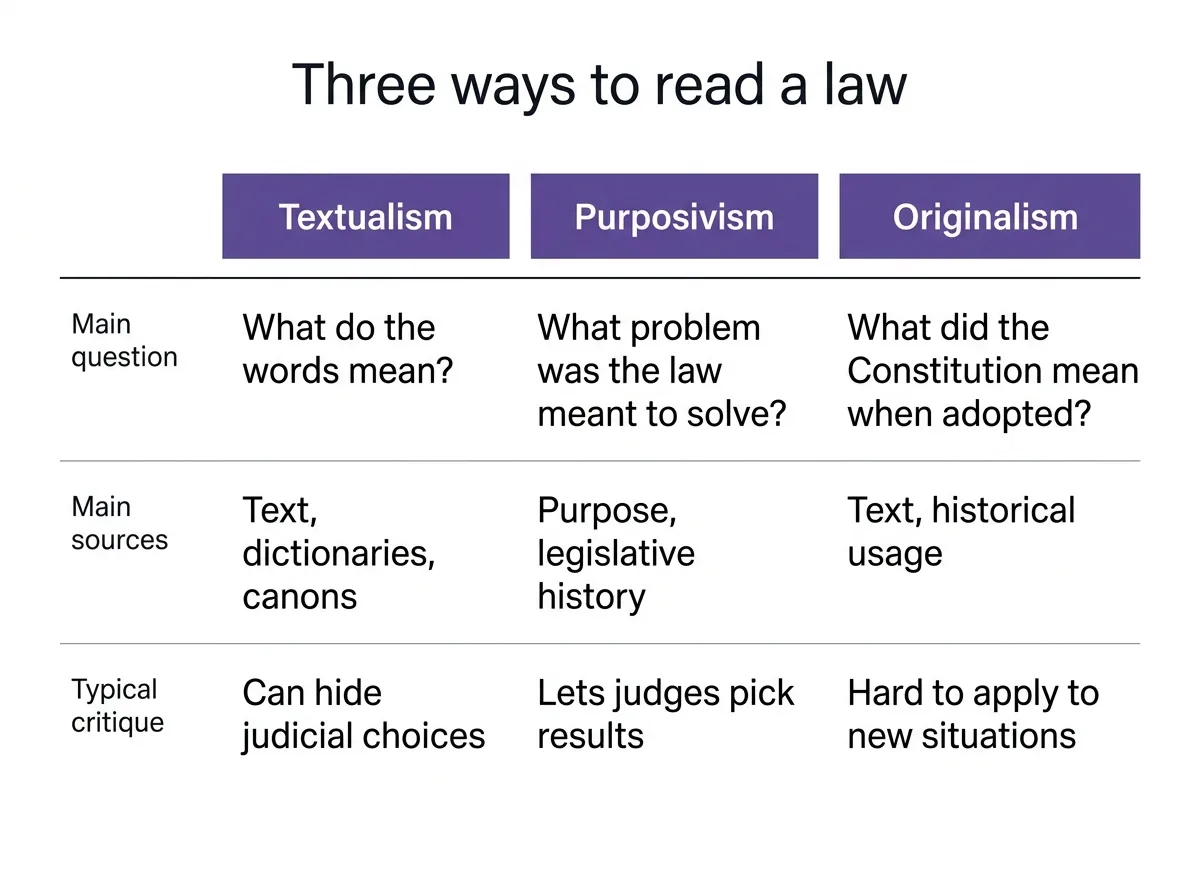
The plain meaning rule is old: if the text of a statute is clear, the inquiry ends there. Through much of the twentieth century, though, American courts moved toward purposivism, which interprets a statute in light of the problem it was meant to solve.
A classic statement of that view is *Church of the Holy Trinity v. United States* (1892). The Supreme Court held that a ban on contracts to bring foreign workers into the United States did not cover a church that hired an English pastor, because “a thing may be within the letter of the statute and yet not within the statute, because not within its spirit.”
The modern revival began in the 1980s. Supreme Court Justice Antonin Scalia and Judge Frank Easterbrook of the Seventh Circuit argued that courts were using legislative history to reach results the text did not support. William Eskridge called the movement “the new textualism” in a 1990 article. By 2015 the shift was large enough that Justice Elena Kagan said in a lecture at Harvard Law School that “we’re all textualists now.”
How do textualists interpret a statute?
The main tools are canons of construction, rules of thumb about how language usually works. Justice Scalia and Bryan Garner collected 57 of them in *Reading Law: The Interpretation of Legal Texts* (2012).
| Canon | What it says | Simple example |
|---|---|---|
| Ordinary meaning | Terms carry their everyday sense unless context shows a technical one | “Vehicle” means what a normal reader would call a vehicle |
| Whole-text canon | Read each provision in light of the entire statute | A defined term means the same thing throughout the act |
| Surplusage canon | Avoid an interpretation that makes some clauses pointless | Every clause should do some work |
| Ejusdem generis | A general term after a list takes its meaning from the list | “Cars, trucks and other vehicles” suggests motorized road vehicles |
| Expressio unius | Listing some items implies others are left out | A tax exemption for churches and schools does not cover hospitals |
| Rule of lenity | Genuinely unclear criminal statutes favor the defendant | Doubt about a penalty goes to the accused |
Dictionaries from the time of enactment are a common source, along with grammar and earlier judicial use of a legal term. There is also a narrow absurdity doctrine: a court may depart from the literal text when applying it would produce a result no reasonable person could have intended.

Why do textualists reject legislative history?
Legislative history covers committee reports, hearings, floor debates and earlier drafts. Textualists distrust it for three reasons.
- The constitutional argument. Article I, Section 7 says a bill becomes law only after it passes both houses of Congress and is presented to the President. A committee report goes through neither step.
- The collective intent problem. Congress has 535 members who vote for a bill for many different reasons, so there is often no single legislative intent to discover.
- The manipulation risk. Staff and lobbyists can insert helpful language into reports, and a judge can then pick the passages that suit a preferred result.
What is the difference between textualism and originalism?
The two are related and often confused.
- Textualism is a method of statutory interpretation, though it applies to any legal text. Its focus is the text and its ordinary meaning.
- Originalism is a theory of constitutional interpretation. It holds that the Constitution’s meaning was fixed when it was adopted.
Most originalists today follow original public meaning, which is close to textualism applied to the Constitution with a historical lens: what the text meant to the public in 1788, or in 1868 for the Fourteenth Amendment. Justice Scalia was both. A judge can still interpret statutes as a textualist while rejecting originalism.
What are some famous textualism cases?
In real cases the plain meaning of a term does not always settle a dispute, and textualists often disagree with each other.
- *Smith v. United States* (1993). A man offered to trade a gun for drugs. The Court said he “used” a firearm in a drug crime. Justice Scalia dissented: to use a gun, in ordinary speech, means to use it as a weapon.
- *Yates v. United States* (2015). A fisherman threw undersized fish overboard. Was a fish a “tangible object” under a law aimed at shredded financial records? The plurality said no, interpreting the term by its neighbors. Justice Kagan, joined by Justice Scalia, said a fish is plainly a tangible object.
- *Bostock v. Clayton County* (2020). Writing for the majority, Justice Neil Gorsuch held that Title VII’s ban on firing someone “because of” sex covers firing a worker for being gay or transgender. Justice Alito, joined by Justice Thomas, dissented, and so did Justice Kavanaugh, each arguing from the text. Alito wrote that the opinion “sails under a textualist flag.” The full Bostock opinion with both dissents shows the internal debate.
What do critics say about textualism?
The objections fall into three families, and textualism has a reply to each.
The purposivist critique
Judges such as Stephen Breyer, in *Active Liberty* (2005), and Robert Katzmann, in *Judging Statutes* (2014), argue that Congress legislates through committees and that legislative history is how it explains what it means. On their view, a court that ignores that record ends up less faithful to Congress. A 2013 survey of 137 congressional staffers by Abbe Gluck and Lisa Schultz Bressman found that many drafters treat legislative history as a central tool and were unfamiliar with many canons by name.
The discretion critique
Legal text is rarely self-applying. Dictionaries disagree, canons may point in opposite directions, and choosing among them takes judgment. Critics argue that textualism can hide value choices behind an appearance of neutrality.
The dynamic critique
Eskridge and others argue that old statutes meet situations their authors never imagined, so courts should keep present-day purposes in view.
The textualist reply
Defenders answer that every method of interpretation requires judgment, but anchoring it in public text limits it best. Textualism also gives Congress a clear rule: if you want a different result, write a different statute. There is a democratic point here as well, since unelected judges should not substitute their own sense of good policy for the law that was passed.
Common questions about textualism
Is textualism conservative?
It is associated with conservative judges, though it is a method of interpretation rather than a list of outcomes. *Bostock* is a prominent case where it produced a result many liberals welcomed.
Who is the most famous textualist?
Antonin Scalia, who served as a Supreme Court justice from 1986 to 2016. Justices Clarence Thomas, Neil Gorsuch and Amy Coney Barrett are also widely described as textualists.
Does textualism mean literalism?
No. Textualism reads a term in context, the way a fluent speaker would. In Scalia’s words, a text “should not be construed strictly, and it should not be construed leniently; it should be construed reasonably.”
Sources
- Bostock v. Clayton County, 590 U.S. 644 (2020)
- Antonin Scalia, A Matter of Interpretation: Federal Courts and the Law (Princeton University Press, 1997)
- Antonin Scalia and Bryan A. Garner, Reading Law: The Interpretation of Legal Texts (2012)
- William N. Eskridge Jr., "The New Textualism", UCLA Law Review 37 (1990)
- Abbe R. Gluck and Lisa Schultz Bressman, "Statutory Interpretation from the Inside", Stanford Law Review 65 (2013)
- Robert A. Katzmann, Judging Statutes (2014)
- Stephen Breyer, Active Liberty (2005)
- LII Wex: Textualism