The essay in brief
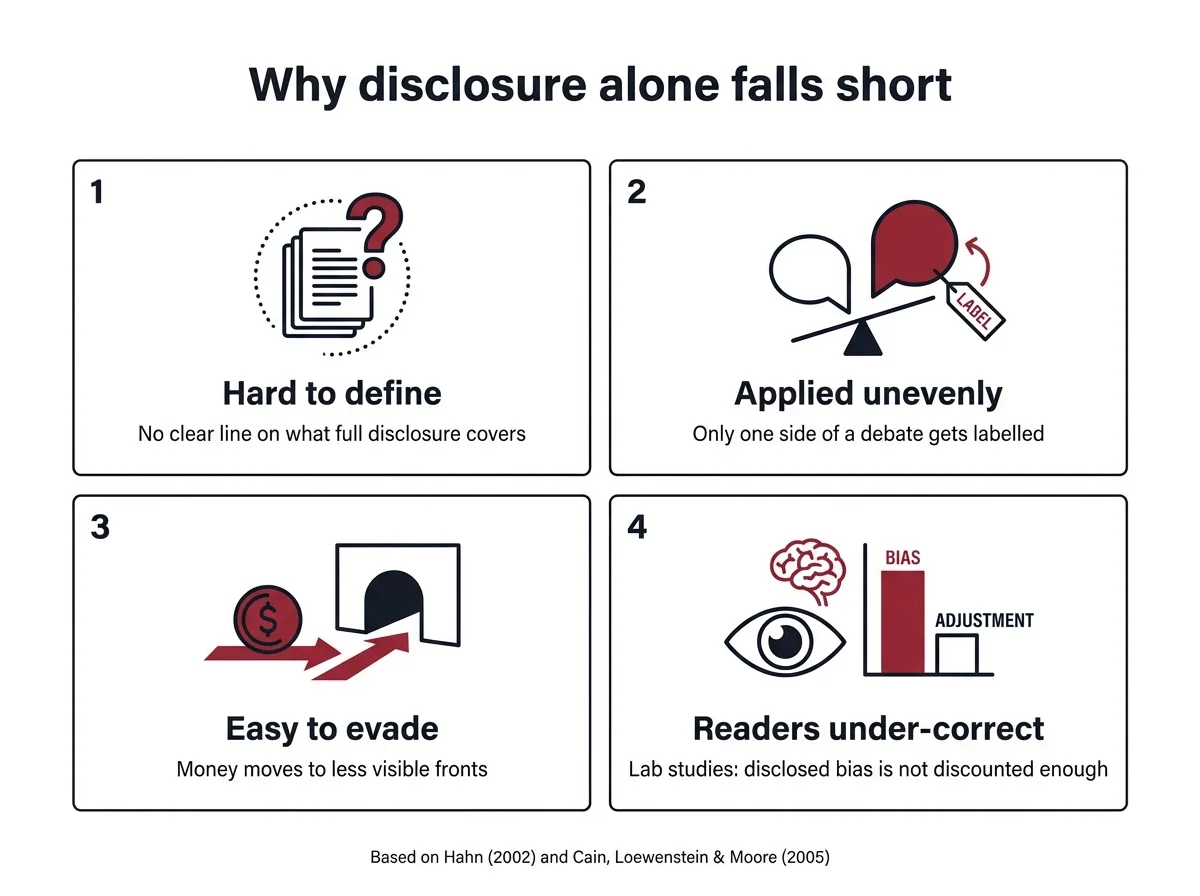
In a 2002 Policy Review essay, economist Robert W. Hahn argued that 'full disclosure' of conflicts of interest is hard to define, is applied unevenly and invites evasion. He did not oppose disclosure, but urged the press and the public to rely less on it and to judge experts and their arguments directly.
When a pundit turns out to have been paid by a company he writes about, the usual remedy is simple: make him say so. In the October and November 2002 issue of *Policy Review*, economist Robert W. Hahn argued that conflict of interest disclosure was far weaker than it looked. His essay, “The False Promise of ‘Full Disclosure’,” appeared months after Enron collapsed.
Hahn was then director of the AEI-Brookings Joint Center for Regulatory Studies and a consultant to business and government, and he said so up front. His conclusion: disclosure gives the public some useful information, but the press and readers too often use it as a substitute for judging the work itself.
Why did Hahn write it in 2002?
The trigger was a quarrel among commentators. Paul Krugman, by then a *New York Times* columnist, had served on an Enron advisory board before joining the paper and had been paid $50,000 for it, as had other well-known figures. Krugman said he had followed the paper’s rules. Andrew Sullivan replied that he should also have named the amount, since readers had a right to know.
Hahn used that exchange to ask a broader question. What should academics, think tank scholars and journalists have to tell the public about their financial ties? He drew on Richard Posner’s book *Public Intellectuals* (2001), which complained that almost no one checks the quality of what university professors say in public.
Myth 1: “Full disclosure” is a clear standard
Hahn’s first point was that no one can say where full disclosure ends. Should a writer list past clients, family ties, prizes, speaking fees, or the way media visibility affects his pay? Each item could matter to some reader. A rule that tries to cover all of them is impossible to follow and to check.
Since most people work for a living, he wrote, nearly everyone carries potential conflicts of interest. The sensible test was the one already in use: disclose those ties an average reader would find suspicious if they came out later.
Myth 2: An expert with no paid ties is “clean”
Hahn spent most of the essay here. He described a radio debate on the Microsoft antitrust case in which the host named him as a Microsoft consultant but said nothing about the other guest’s paid work for a rival. Listeners were left to treat one side as neutral.
He listed several kinds of interest that ordinary rules miss:
- Future benefits: signing a well-known statement or brief can raise a scholar’s market value, even when no one paid for it.
- Advocacy salaries: staff at public interest groups are paid to hold positions, yet the press rarely treats this as a conflict.
- Refused offers: rules ask about clients you took, never about clients you turned down on principle, which may say more about you.
- Institutional money: think tanks and universities depend on business, foundations or government, and each funder expects something.
When disclosure is applied to only one side of a debate, he argued, it tilts the debate toward whoever looks clean.
Myth 3: Stricter rules produce better information
Tougher requirements, Hahn argued, would change the incentive each expert faces. Some would simply stop taking part in public debate. Others would ignore the rules and hope not to be caught. The more enterprising would set up “fronts,” organisations that hide where the money comes from.
He gave Posner’s example of Exxon after the *Valdez* spill. Academics it paid to write on punitive damages disclosed the payment in their articles, but Exxon later cited those articles in court without saying it had funded them. Stricter standards, Hahn wrote, “would actually do more harm than good” if they shrank the pool of experts and pushed money into less visible channels. In his view, disclosure may help in one situation and mislead in the next.
Myth 4: Journals and peer review already solve the problem
Hahn did not see academic gatekeeping as a safe fallback. He cited a 1986 study in the *American Economic Review* which found that published papers often could not be replicated and that authors frequently would not share their data. He also mentioned a review of biomedical journal articles in which about a third of papers had an author with a related financial interest, and none of those authors disclosed it.
Journal rules, in other words, did not guarantee compliance. That gap has drawn a lot of work since. The International Committee of Medical Journal Editors now publishes a standard disclosure form, last updated in 2021, which many medical journals ask their authors to complete.

Myth 5: Hahn wanted less transparency
He did not argue for scrapping disclosure. His five suggestions were aimed at the people who use the information:
| Suggestion | What it asks for |
|---|---|
| 1. Rely less on disclosure as a signal | Also check reputation and how colleagues view the expert |
| 2. Apply the same rules to everyone | Scrutinise advocates and officials as well as consultants |
| 3. Check real expertise | Give no pass to commentators who merely sound confident |
| 4. The media should think harder | Hire staff who can judge technical work |
| 5. We all should think harder | Teach critical thinking more widely |
He was not optimistic about any of this. The press and the public seemed content with the status quo, and he ended with a dry “Don’t hold your breath.”
Critics read the essay less kindly. PR Watch, a project of the Center for Media and Democracy, called it a mix of frank admissions and rationalisations, and pointed out that the Joint Center Hahn ran was largely funded by corporations. Hahn had listed where to find his funders in a footnote, but the objection stuck: an industry-funded scholar was arguing against tougher rules for industry-funded scholars.
Myth 6: Once a conflict is disclosed, people adjust
Hahn argued mainly from experience and anecdote. Experimental research soon tested a related claim. In 2005 the *Journal of Legal Studies* published “The Dirt on Coming Clean: Perverse Effects of Disclosing Conflicts of Interest” by Daylian Cain, George Loewenstein and Don Moore. In their lab study, advisers who had to disclose a conflict gave more biased advice, and the people receiving it did not discount it enough.
That finding fits Hahn’s warning that disclosure can create false comfort, though from a different angle. He worried about who discloses and who gets labelled; the experiments looked at how advice and trust change between adviser and recipient once a conflict is out in the open. Later studies have been mixed, and results depend on the setting. In 2007 Archon Fung, Mary Graham and David Weil published *Full Disclosure: The Perils and Promise of Transparency*, a wider study of when disclosure policies work.
How has the essay held up?
Some of it reads well today. Arguments over undisclosed funding of experts and think tanks have not gone away, and the research above supports his view that disclosure is no cure-all. His advice to judge the argument rather than the funder is now standard in media literacy teaching.
Other parts are weaker. His evidence was mostly personal, and he said little about how reporters with limited time should do the harder evaluation he asked of them.
Questions readers ask
What is the “false promise” of full disclosure?
Hahn meant the belief that a list of financial ties tells the public how far to trust an expert. He thought it shows only part of the picture and can mislead.
Did Hahn oppose conflict of interest disclosure?
No. He accepted the existing norm of disclosing what a reasonable reader would expect to know, and opposed open-ended “full” disclosure rules.
Does disclosing a conflict reduce bias?
Not reliably. Experiments since 2005 suggest disclosure can sometimes increase bias in advice, and that audiences under-correct.
Who was the essay really about?
It opened with Krugman, but Hahn said the real subject was how the press treats experts in general.
Where to read the original
Robert W. Hahn, “The False Promise of ‘Full Disclosure’,” *Policy Review* No. 115 (October and November 2002), is in the Hoover Institution’s archive. Its footnotes list the studies he cited.
Sources
- Robert W. Hahn, "The False Promise of 'Full Disclosure'", Policy Review 115 (2002)
- ICMJE: Disclosure of Interest form
- Daylian M. Cain, George Loewenstein and Don A. Moore, "The Dirt on Coming Clean: Perverse Effects of Disclosing Conflicts of Interest", Journal of Legal Studies 34 (2005)
- Archon Fung, Mary Graham and David Weil, Full Disclosure: The Perils and Promise of Transparency (Cambridge University Press, 2007)
- Richard A. Posner, Public Intellectuals: A Study of Decline (Harvard University Press, 2001)