Policy Analysis
The craft itself: what public policy is, and how briefs, memos and evaluations are made.
3 concepts explained · 1 essay guides
Left: closer to domestic politics. Up: closer to theory. Placement is orientation, not judgement.
Placement: Policy Review editors, reviewed October 2026.
Concepts in this field
- What Is a Policy Brief? Purpose, Parts and the Debate Over Neutrality A policy brief is a short, stand-alone document that explains one public problem, sets out the options for dealing with it and usually recommends…
- What Is a Think Tank? A Step-by-Step Look at How They Work A think tank is an organization that researches public policy and works to get its findings in front of decision makers. Most US think…
- What Is Public Policy? A Plain-English Guide Public policy is what a government decides to do, or decides not to do, about a public problem. It takes the form of laws,…
Essay guides in this field
Policy analysis is the systematic study of what governments do, or could do, about public problems. It asks which of several policy alternatives has the best chance of reaching a goal, at what cost and for whom. Harold Lasswell called for a set of “policy sciences” in 1951. Over time, policy analysts became a profession of their own, working in planning offices, budget bureaus, universities and the new schools of public policy.
There are many definitions; none of them settles much. A better way into the field is through its working ideas. There are seven that explainers and essay guides on these pages return to again and again.
1. Analysis for policy and analysis of policy
Scholars usually split the work into two sides:
- Analysis for policy is prescriptive. An analyst inside an agency, a legislature or a research institute compares options and recommends one. The product is often a memo or a policy brief.
- Analysis of policy is descriptive. Researchers, mostly at a university, explain how a policy came about, how the policy process shaped it and whether it worked.
In practice there is a lot of overlap. You cannot recommend a sound reform without knowing why current policy looks as it does. Studies of past policies have more value when they tell decision makers something about their next policy choice.
2. The eightfold path
One widely taught approach is Eugene Bardach’s “eightfold path,” set out in *A Practical Guide for Policy Analysis: The Eightfold Path to More Effective Problem Solving*. Bardach wrote it as a checklist for analysts working with a deadline:
- Define the problem.
- Assemble some evidence.
- Construct the alternatives.
- Select the criteria.
- Project the outcomes.
- Confront the trade-offs.
- Decide.
- Tell your story.
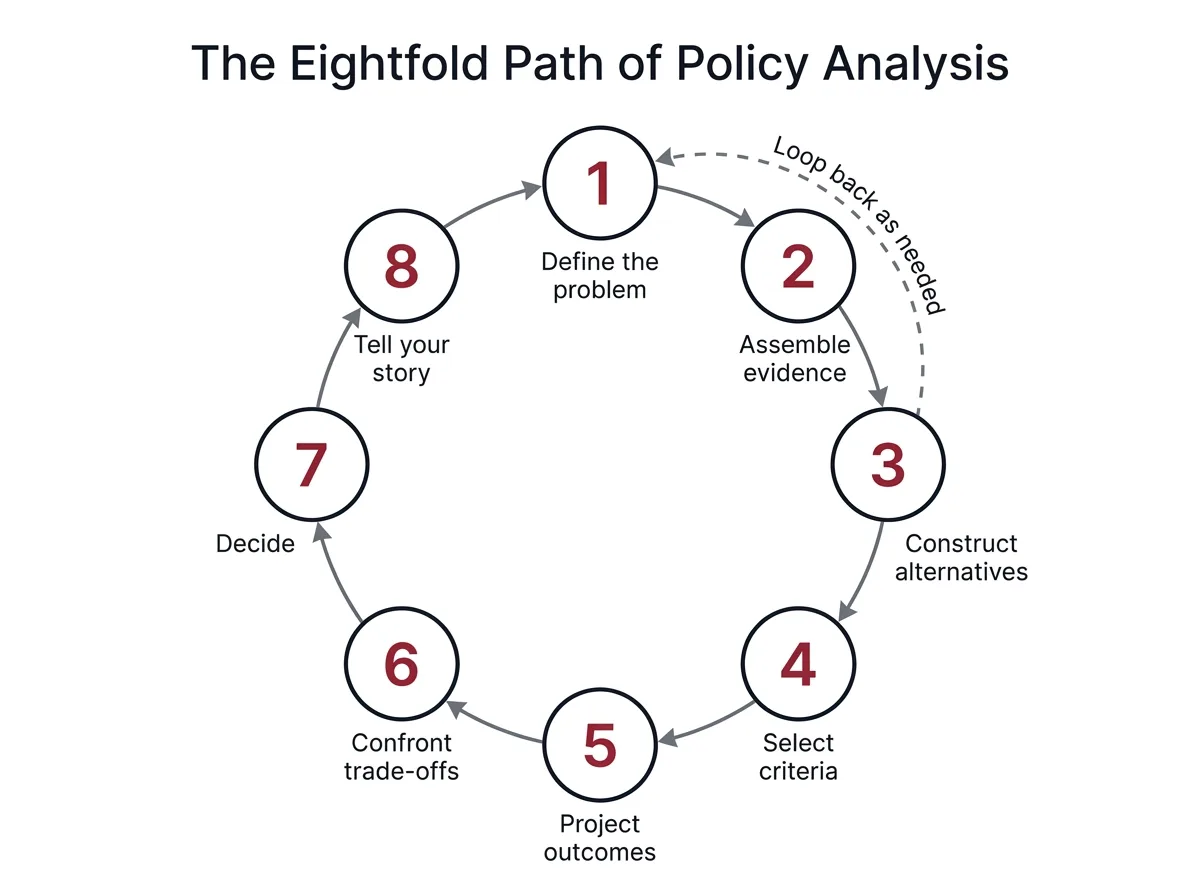
Bardach himself says the order is not fixed. Analysts may loop back, redefine a policy problem when new data come in, or drop alternatives that turn out to be impractical. The last step matters: if nobody can follow the analysis, it changes nothing.
3. Criteria decide the outcome
Step four is where many disagreements between analysts live. The same evidence can point to different choices depending on how criteria are weighted. Criteria used in practice include:
| Criterion | Question it asks |
|---|---|
| Effectiveness | Does it actually move outcomes we care about? |
| Efficiency | Are benefits worth costs, compared with other options? |
| Equity | Who gains, who pays, and is that distribution fair? |
| Political feasibility | Will it pass and survive a change of leaders? |
| Administrative feasibility | Does an agency have enough staff and data for it? |
In the United States, one of these criteria is written into federal rules. Executive Order 12866 requires agencies to assess costs and benefits of significant regulations. OMB Circular A-4, issued in 2003, tells them how to measure and report them. Such reviews cover environmental, energy, health and safety rules alike. The circular also warns against doing a regulatory analysis “according to a formula” and calls for professional judgment.
4. The rational model and cost-benefit analysis
The rational-comprehensive model asks an analyst to state goals, list every alternative, predict consequences and pick a winner. For many years it has been the default in policy textbooks. Its main tool is cost-benefit analysis, rooted in welfare economics. In this approach, a first question is whether a market failure, such as pollution or missing information, justifies public action at all.
Supporters argue that putting costs and benefits in one ledger makes visible trade-offs that politics would rather hide. A program unable to show benefits above its costs should face hard questions, whatever its intentions.
5. Incrementalism and “muddling through”
In 1959 Charles Lindblom published “The Science of ‘Muddling Through’.” He argued that no one has the time to survey every alternative or to agree on ranked goals in advance. Real decision makers compare a few options differing only slightly from the current policy, then correct course as they go. Herbert Simon’s idea of bounded rationality points in a similar direction.
For incrementalists, small policy steps are a strength, since mistakes stay small and reversible. Amitai Etzioni later proposed “mixed scanning” as a middle path: a broad look at all choices, followed by detailed study of the most promising ones.
6. Government failure, the public choice lesson
Public choice economists, led by James Buchanan and Gordon Tullock in *The Calculus of Consent* (1962), turned the methods of economic analysis on the state itself. Voters, legislators and bureaucrats respond to incentives just as buyers and sellers do. Out of this came a theory of government failure to set beside market failure.
Before assuming a regulation will fix social problems, ask how its agency may behave in practice. Ask, too, who will lobby to shape it.
7. Framing, evidence and limits
Two newer strands of analysis have pulled in different directions.
The argumentative turn doubts whether analysis is able to stand outside politics. Deborah Stone’s *Policy Paradox* and essays collected by Frank Fischer and John Forester in *The Argumentative Turn in Policy Analysis and Planning* (1993) treat problem definitions, numbers and categories as arguments. How you frame a social problem, they say, largely decides which solution looks reasonable. Analysts should therefore state their values openly, bringing affected people into the policy process.
Evidence-based policy puts its faith in testing. Randomized trials, natural experiments, evaluation studies and other methods try to test whether a program works before money is scaled up. A well-known public health example is the Oregon Health Insurance Experiment. In 2008 Oregon could add about 10,000 low-income adults to Medicaid and used a lottery to choose them from a much larger waiting list. Researchers found coverage raised use of health care, reduced financial strain and lowered rates of depression, but showed no significant change in measured blood pressure, cholesterol or blood sugar over the study period.
When supporters and skeptics of expanding Medicaid read the results, they weighed them against different criteria. Good data narrowed the policy dispute without settling it. Critics of trials add a further point: an answer from one state may not hold in another.

Key concepts in this section
Guides here build a vocabulary for public policy analysis step by step. They start with what public policy is and how laws, regulations, budgets and court rulings all count as policy. Further guides cover policy briefs, an analyst’s standard written format, and think tanks, institutions producing much policy research outside the state.
What are the concepts that recur across these essays? Four stand out:
- Policy cycle: agenda setting, formulation, adoption, implementation and evaluation.
- Agenda setting: John Kingdon’s multiple streams model, in which problems, politics and policies must meet in a “policy window.”
- Unintended consequences: effects nobody planned, a recurring theme in critiques of large public programs.
- Implementation: a gap that may open between a law as passed and a program as delivered, with the agency in the middle.
How the field connects to other fields
This field supplies a method of analysis. Other sections of the site supply much of its subject matter, and the relevant links run both ways.
- Economy and society: debates over Keynesian economics, supply-side economics, free trade and the welfare state are arguments about economic growth, costs, and who bears them.
- Law: courts shape policy through judicial review. Theories such as textualism decide how much room judges leave to legislators and agencies.
- Security and foreign policy: deterrence, alliances and sanctions are policies too, open to questions about goals, alternatives and risk.
- Ideas: political ideologies shape which criteria you weigh most heavily, for example liberty, equality, order or tradition.
Policy analysis can rarely end a disagreement, but it shows where a disagreement lies. Citizens and officials are then free to argue over values with facts in front of them.