The essay in brief
In 2003 P. W. Singer asked whether private military firms should take over peacekeeping when governments will not send troops. He saw real gains in speed, capability and cost, but warned of contract failures, weak accountability, legal gaps and lost legitimacy, and argued that U.N. reform and firm rules had to come first.
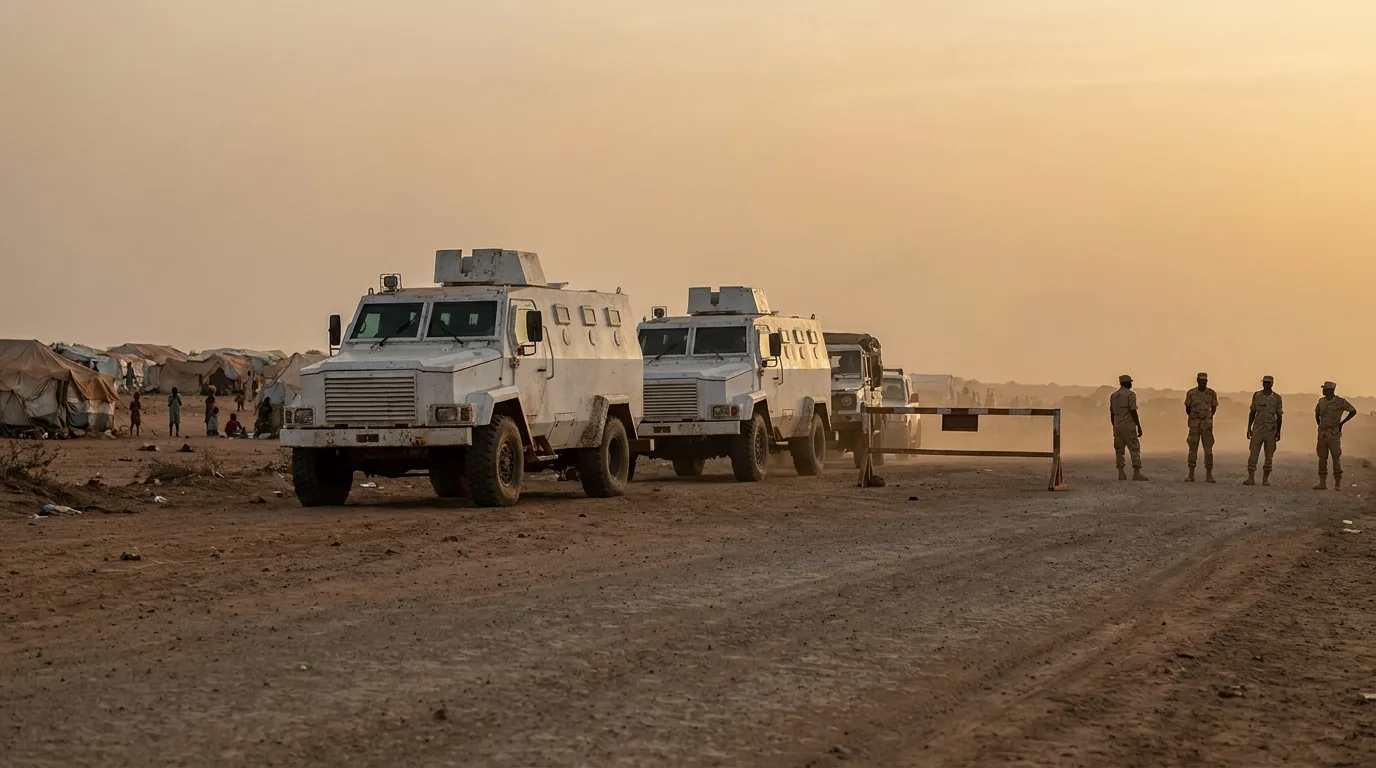
Suppose a small state collapses, civilians are killed by the tens of thousands, and no government will put its own troops on the ground. Then a private company offers to set up protected safe havens for a fee. Should the international community accept? P. W. Singer put that dilemma at the center of “Peacekeepers, Inc.,” published in *Policy Review* No. 119 (June & July 2003). It was one of the first serious treatments of privatized peacekeeping.
The argument in brief
Singer, then a fellow at the Brookings Institution, weighed the case for private military firms against the case against them. His argument runs in five steps:
- The United Nations depends on member states volunteering troops, and those with the most capable armies, the United States among them, rarely send them where they have no strategic interest.
- A privatized military industry has grown up that sells almost every military capability on the private market, from logistics to combat units.
- Hired units might be faster, better equipped and cheaper than many blue helmet contingents.
- Contracts, accountability and legitimacy all get harder when the people with guns work for a company.
- So the international community should reform U.N. peacekeeping now and, if it will not pay for capable public troops, write rules for private ones.
Singer himself thought peacekeeping “would best be left to the real generals.” But if the public sector would not get its house in order, he expected the private sector to offer itself anyway.
The context: 2003
The essay appeared weeks after the invasion of Iraq, where private military contractors provided logistics and maintenance services on a large scale. Singer counted more than 3,000 Defense Department contracts with U.S.-based military firms between 1994 and 2002. His book *Corporate Warriors: The Rise of the Privatized Military Industry* (Cornell University Press, 2003) had just described the wider industry. In the essay he put it at several hundred companies operating in more than 100 countries.
The 1990s weighed on the debate. In Rwanda in 1994 the genocide unfolded without outside intervention. In Sierra Leone, Singer argued, a private company did what a later international mission struggled to do. In a 1998 lecture, U.N. Secretary-General Kofi Annan recalled considering a private firm for the refugee camps in Goma and concluded that the world “may not be ready to privatize peace.”
Singer’s framework: three sectors, three scenarios
Singer sorted the industry into three business sectors by how close employees come to the fighting.
| Sector | What the companies do | Example services |
|---|---|---|
| Military provider firms | Operate at the front line; employees fight | Assault infantry, combat helicopters |
| Military consultant firms | Advise and train | Strategy, training of national armies |
| Military support firms | Work in the rear | Logistics, transport, technical support |
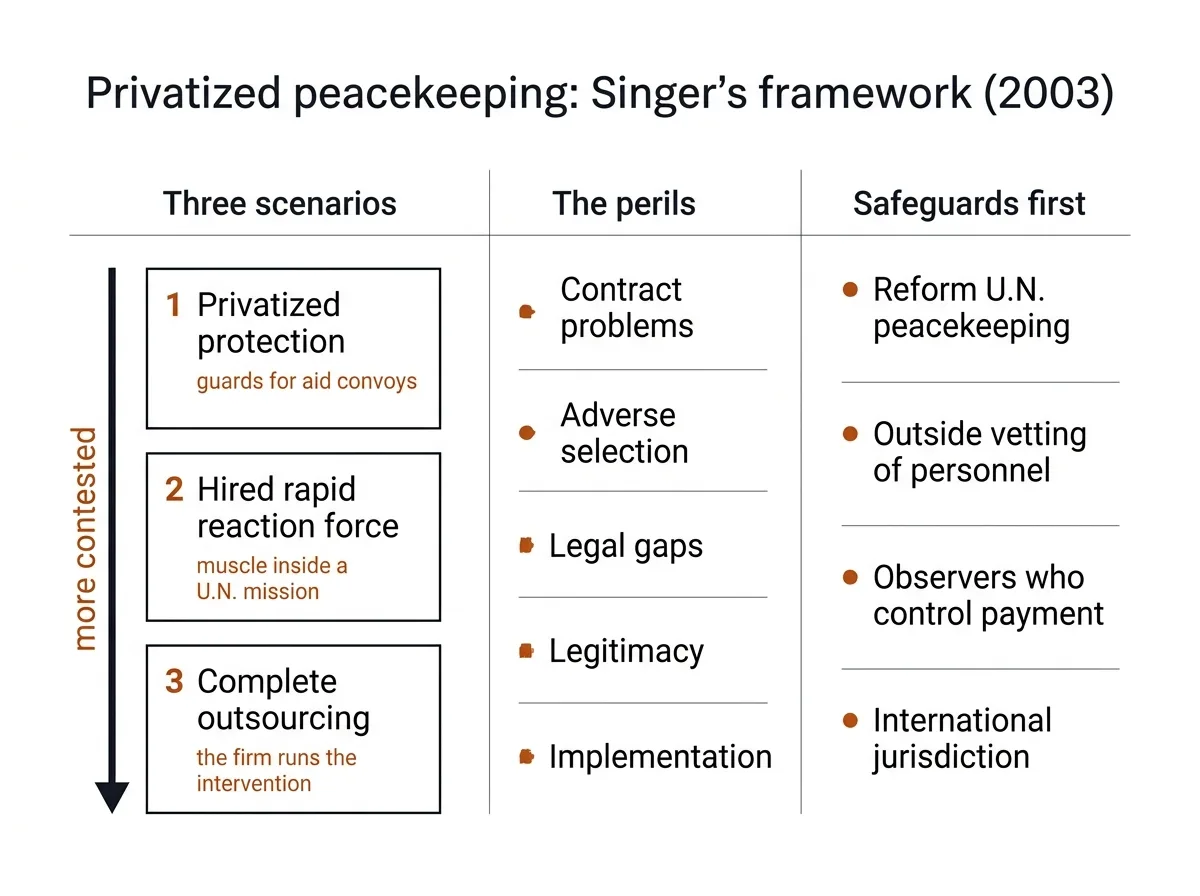
He then sketched three ways the private military sector could enter peacekeeping operations, each more contested than the last:
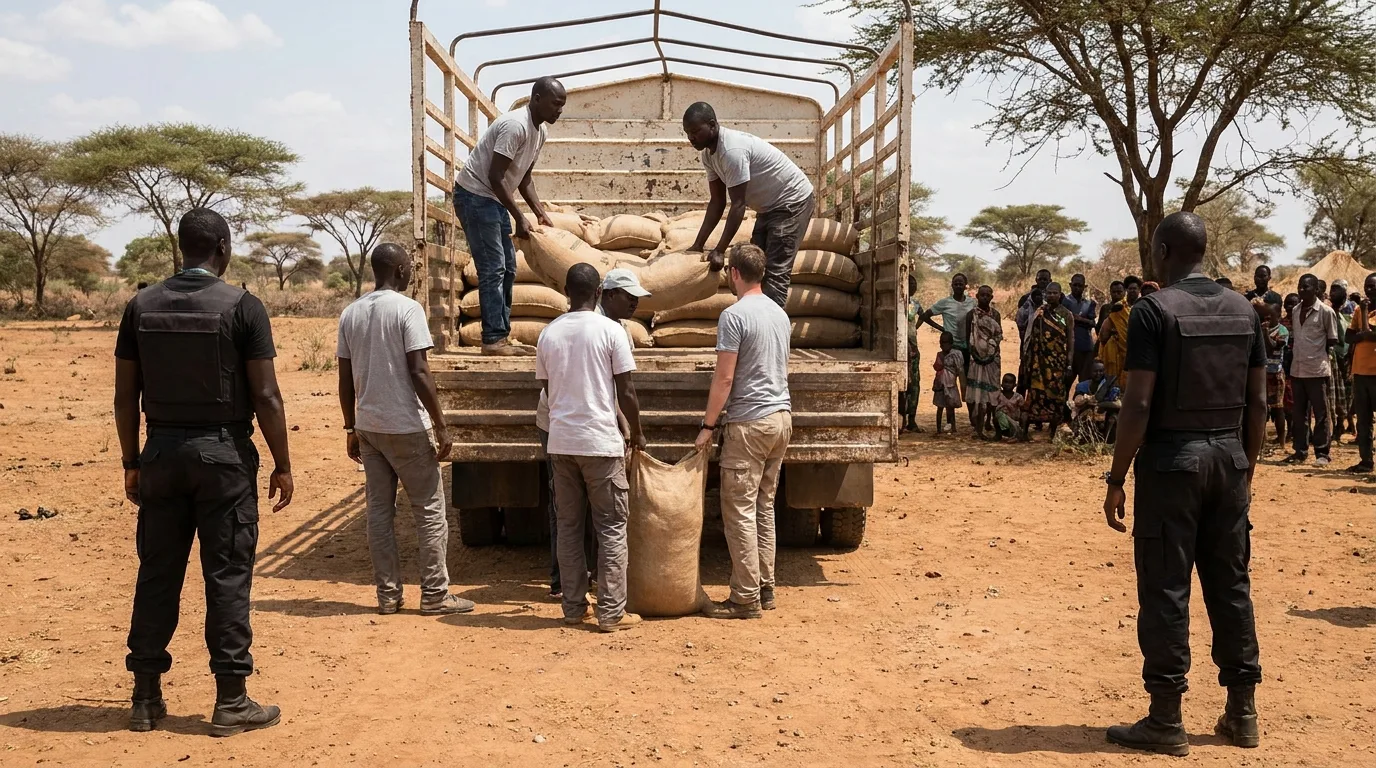
- Privatized protection. Companies guard aid convoys, warehouses and offices. Singer noted that more Red Cross workers than U.S. Army personnel were killed in the 1990s.
- A hired rapid reaction force. A small private unit inside a larger U.N. mission supplies the muscle when a local party breaks an agreement.
- Complete outsourcing. When no government will act, the company deploys, protects refugees and later hands over to regular troops. Singer reported that the U.N. and the U.S. National Security Council discussed this for eastern Zaire in 1996, and dropped it over the question of who would pay.
The promise: faster, better, cheaper
The case for hiring rested on capability. A company can recruit experienced soldiers and buy the right equipment, and it avoids the procedural weight of a multinational mission.
Sierra Leone was the standard example. In 1995 the government, close to defeat by the RUF rebels, hired Executive Outcomes, a South African company staffed largely by veterans of the apartheid-era army. A unit in the low hundreds, with helicopters, pushed the rebels back within weeks, and the country held elections. When the contract ended, the war resumed. The later U.N. operation, Singer pointed out, had a budget and personnel nearly 20 times larger and still needed years and a British rescue to reach similar results.
He also reported an internal Executive Outcomes plan for Rwanda in 1994: more than 1,500 soldiers deployed within six weeks, at about $150 million for six months. Singer presented these as the company’s own figures.
The perils Singer listed
Singer gave the risks more space than the promise:
- Contract problems. Companies have incentives to overcharge and hide failures, and they or their employees can walk away when the operation turns dangerous or unprofitable.
- Adverse selection. Firms recruit for effectiveness, and some recruits came from abusive units of the Soviet and apartheid regimes. Singer cited DynCorp employees in Bosnia implicated in sex trafficking, none of whom were prosecuted.
- Legal gaps. Law on mercenaries was written for individuals, the host country usually had no working courts, and home governments could rarely monitor companies abroad.
- Legitimacy. Durable peace requires returning control of force to public authorities. A hired unit may keep order without rebuilding the local social contract, and it may teach that security belongs to those who can pay.
- Implementation. Who hires the company, who commands it and who watches it were all unresolved.
Reception and criticism
Humanitarian groups and many U.N. officials held that peacekeeping depends on neutrality and consent, and that a unit working for profit cannot carry that role. Industry advocates, among them the International Peace Operations Association, which Singer mentions offering a “security curtain” in eastern Congo, argued that regulated companies could provide capabilities the U.N. lacked at a fraction of the cost.
Another objection was that renting force lets wealthy countries avoid sending their own soldiers and weakens the pressure to fix public peacekeeping. Singer shared part of this worry, which is why U.N. reform came first in his remedies.
How the argument has held up
Full outsourcing of a peace operation never happened. The U.N. has kept to the principle that military contingents come from member states, though it uses private contractors for security and logistics.
Several later developments match parts of his analysis. The contractor presence in Iraq and Afghanistan grew far beyond 2003 levels, and the 2007 Nisour Square shooting in Baghdad by Blackwater guards is often cited as the best-known case of the accountability gap he described. Governments answered with soft law. The 2008 Montreux Document set out legal obligations and good practices for states, and the Montreux Document Forum reports that 61 states and four international organisations now support it.
The essay said little about companies that serve one government’s foreign policy. Russia’s Wagner Group, active in several conflicts in Africa, is often described as a different type of private force, one serving state policy rather than neutral peacekeeping.
Readers’ questions
Did the U.N. ever hire a private army for peacekeeping?
No. It has used private companies to guard facilities and provide logistics and transport, which matches Singer’s first and least contested scenario.
Are private military companies mercenaries?
Singer noted that the legal definition of a mercenary was written for individuals and does not fit registered corporations working under contract. Critics answer that the label still fits what some of them do.
A checklist of conditions
Singer’s remedies add up to a test for any privatized peacekeeping arrangement. In his view, a mandating body would first need to confirm that:
- public options are exhausted, including U.N. reform along the lines of the 2000 Brahimi Report.
- it is settled who may hire the company and on whose behalf.
- standardized contracts set performance standards and penalties for walking away.
- every employee is vetted by an outside body.
- independent observers control payment, not only reporting.
- contract clauses place personnel under the jurisdiction of international tribunals.
- there is a plan to hand security back to legitimate local authorities.
Where to read the original
“Peacekeepers, Inc.” by P. W. Singer appeared in *Policy Review* No. 119, June & July 2003. The full text is preserved in the Hoover Institution’s Policy Review archive. Policyreview.org is an independent reference and is not affiliated with the Hoover Institution.
Sources
- P. W. Singer, "Peacekeepers, Inc.", Policy Review 119 (2003)
- P. W. Singer, "Peacekeepers, Inc.", Brookings
- P. W. Singer, Corporate Warriors: The Rise of the Privatized Military Industry (Cornell University Press, 2003)
- Montreux Document Forum