Definition
Realpolitik is an approach to politics and foreign policy guided by the actual distribution of power and by concrete national interests, rather than by moral principle or ideology alone. The term was coined by Ludwig von Rochau in 1853 and is most closely linked with Otto von Bismarck and Henry Kissinger.
Realpolitik is an approach to politics and foreign policy guided by the actual distribution of power and by concrete national interests, rather than by moral principle or ideology alone. The German word joins *real* (actual, practical) to *Politik* (politics), and in English it describes a statesman who asks what is achievable before asking what is right.
The term has a contested history. A liberal coined it, a conservative made it famous, and in the United States it became attached to a diplomat who rejected the label. Most accounts start with those two figures.
September 1862: Otto von Bismarck and “iron and blood”
In September 1862 Otto von Bismarck, newly appointed minister-president of Prussia, faced a parliament that refused to pay for an army reform. He told its budget committee that the great questions of the day would not be decided by speeches and majority votes, “that was the great mistake of 1848 and 1849”, but by iron and blood.
The line shocked his opponents. Over the next nine years Prussia fought three short wars and unified Germany:
- Denmark, 1864: Prussia and Austria together took the duchies of Schleswig and Holstein.
- Austria, 1866: Prussia defeated its former partner, then offered a mild peace without annexing Austrian land, so that Vienna could become an ally again.
- France, 1870 to 1871: The war ended with the proclamation of the German Empire at Versailles in January 1871.
He also knew when to stop. After 1871 the chancellor called Germany a “satiated” power and spent two decades building alliances to keep the new order in place: the Dual Alliance with Austria-Hungary (1879), the League of the Three Emperors and the secret Reinsurance Treaty with Russia (1887). At home he worked with whichever parties were useful, and he introduced universal male suffrage for the Reichstag because he judged it would help him. Politics, in a phrase usually attributed to him, was “the art of the possible.”
July 1971: Kissinger’s secret trip to Beijing
A century later the word crossed the Atlantic. As national security adviser to President Richard Nixon, and from 1973 Secretary of State, Henry Kissinger became the figure most associated with realpolitik in the late twentieth century. In July 1971 he flew secretly to Beijing. The opening rested on a cold calculation: Communist China and the Soviet Union were rivals, and a working relationship with Beijing would give Washington leverage over Moscow.
Nixon visited China in February 1972, and the two governments issued the Shanghai Communiqué, which stated their differences openly while laying the basis for diplomatic ties. The Office of the Historian at the U.S. State Department describes the secret channel, both 1971 trips and the communiqué. In the same year Washington and Moscow signed SALT I and the ABM Treaty, the core of détente.
Kissinger had studied this kind of statecraft before practicing it. His early book *A World Restored* (1957) dealt with Metternich and Castlereagh, and *Diplomacy* (1994) has long chapters on Bismarck. Yet he does not fit the caricature: he rejected the label and argued that a lasting order needs legitimacy as well as a balance of power. Commentators have since used the word for other presidents too, Barack Obama among them.
What realpolitik meant in the original
The word is older than both men. The German journalist Ludwig von Rochau coined it in *Grundsätze der Realpolitik* (Principles of Realpolitik) in 1853, with a second volume in 1869. Rochau had watched the revolutions of 1848 fail. His lesson for fellow reformers was that law and good arguments do not rule a state by themselves. Force does, and an idea matters politically to the degree that it wins support and can be turned into strength.
Historian John Bew, in *Realpolitik: A History* (Oxford University Press, 2015), argues that the original concept was not cynical. Rochau wanted his side to reach its goal, a unified and constitutional Germany, by taking the forces around it seriously. In the late 19th century writers such as Heinrich von Treitschke reshaped the term, and by the First World War British and American commentators used it as a synonym for amoral power politics. That narrower meaning has been the common one in English ever since.
How realpolitik works in practice
Whatever the definition debate, practitioners tend to share a set of working rules:
- Interests come first. A state’s security, territory and prosperity set the agenda, and ideology is one factor to weigh.
- Capabilities have to be measured. Armies, economies, geography and alliances decide what a state can actually do.
- There are no permanent friends. Former enemies can become partners when interests line up, as Austria did in 1866 and China did for Nixon.
- Restraint follows success. Overreach invites a coalition against the strongest state, so gains are consolidated.
- A policy is judged by its consequences more than by how virtuous it sounds.
These rules overlap with the balance of power, which many realist thinkers treat as the basic mechanism of order in the world.
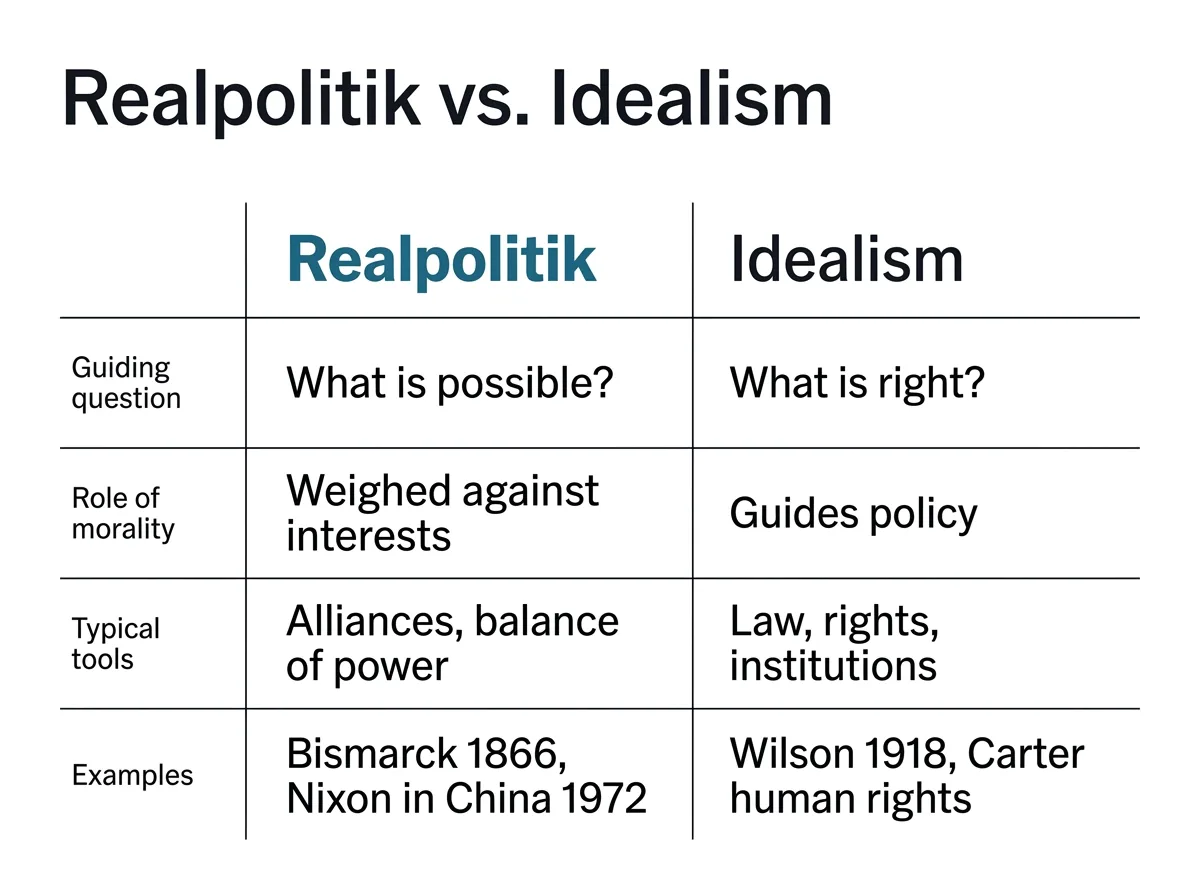
Realpolitik, realism and idealism compared
Realpolitik is often confused with realism. The two are related but sit at different levels. Realism is a theory of international relations developed by scholars such as Hans Morgenthau, whose *Politics Among Nations* appeared in 1948, and George Kennan, and later recast by Kenneth Waltz. Realpolitik is a practice of statecraft. A realist scholar explains why states behave as they do; a practitioner of realpolitik decides what one state should do next.
| Realpolitik | Realism | Idealism | |
|---|---|---|---|
| What it is | A style of governing and diplomacy | An academic theory | A tradition of foreign policy and theory |
| Key figures | Bismarck, Kissinger | Morgenthau, Kennan, Waltz | Woodrow Wilson, Jimmy Carter |
| Central question | What can be achieved with the means at hand? | Why do states compete for security? | How can law, rights and institutions change world politics? |
| Role of morality | Weighed against interests and consequences | Prudence as the highest political virtue | Moral principle should guide policy |
The critics, in their own terms
The strongest criticisms of realpolitik are themselves practical:
- Moral costs are real costs. Critics point to Nixon and Kissinger’s support for Pakistan during the 1971 Bangladesh crisis, the policy toward Chile in 1973 and the bombing of Cambodia as cases where interest-driven policy carried heavy human costs and later damaged American credibility.
- Legitimacy is a form of strength. Liberal internationalists argue that alliances built on shared values, open trade and human rights last longer than bargains among rulers. Jimmy Carter’s human rights policy and the Helsinki Final Act of 1975 grew out of this view.
- Bismarck’s system did not outlive him. It depended on his own skill, and within a generation of his dismissal in 1890 Europe had split into rival blocs that went to war in 1914.
Defenders reply that statesmen rarely choose between good and evil, only between imperfect options, and that a foreign policy cut loose from the means available tends to promise more than it can deliver.
Common questions about realpolitik
Who coined the term realpolitik?
Ludwig von Rochau, a German writer and politician, in his 1853 book *Grundsätze der Realpolitik*.
What is an example of realpolitik?
The mild peace with Austria in 1866 and Nixon’s opening to Communist China in 1971 and 1972 are the standard cases. Both put strategic interest ahead of hostility.
Did Bismarck use the word realpolitik?
He is the figure most closely tied to the concept, but the word came from Rochau and was not Bismarck’s own.
Is realpolitik immoral?
Not necessarily. Its defenders argue that stability and the avoidance of war are moral aims in themselves. Its critics argue that it too easily excuses support for repressive governments. The answer depends on whether policy is judged by its intentions, its principles or its results.
What is the opposite of realpolitik?
Usually idealism: a foreign policy led by principles such as democracy, human rights or international law.
Sources
- Ludwig von Rochau, Grundsätze der Realpolitik (1853; second volume 1869)
- John Bew, Realpolitik: A History (Oxford University Press, 2015)
- Henry Kissinger, A World Restored (1957)
- Henry Kissinger, Diplomacy (Simon & Schuster, 1994)
- Hans J. Morgenthau, Politics Among Nations (1948)
- Office of the Historian, U.S. Department of State: Rapprochement with China, 1972