Definition
The balance of power is the idea that states stay secure when power in the international system is spread out, so that no single state can dominate the rest. When one country grows too powerful, others arm themselves or form alliances against it until a rough equilibrium returns.
The balance of power is the idea that states stay secure when power in the international system is spread out, so that no single state can dominate the rest. When one country grows too powerful, others build up their own strength or join forces against it until a rough equilibrium returns.
The term does two jobs in international relations. It describes a pattern that scholars have claimed to see across the centuries, and it names a principle of foreign policy that governments have followed on purpose. Britain, for example, spent much of the eighteenth and nineteenth centuries trying to keep any one power from controlling the European continent.
The core idea: power, security and anarchy
The starting point is anarchy, in the technical sense used in international politics: there is no world government that can enforce rules or protect states from one another. Each state has to look after its own security. Under those conditions a very powerful neighbor is a danger even if it has no hostile plans today, because intentions can change faster than military capabilities.
This reasoning belongs to political realism, which is often described as the oldest tradition in the theory of international relations. Hans Morgenthau, in *Politics Among Nations* (1948), described world politics as a struggle for power among nations pursuing their national interests, and he treated the balance as a basic feature of that struggle. Kenneth Waltz took the argument further in *Theory of International Politics* (1979). He argued that balances form again and again whether or not leaders intend them, simply because countries that fail to balance tend to lose their independence. For Waltz, the theory explains the outcomes of the system, not the choices of any one government.
These are the three claims at the center of the realist version of balance of power theory:
- Power, above all military and economic power, is what makes a state able to threaten others.
- Concentrated power invites resistance, because other governments fear what a hegemon would do with it.
- Over time the result is equilibrium, which tends to protect the status quo, rather than permanent domination by one state.
Mechanisms: how balancing works in practice
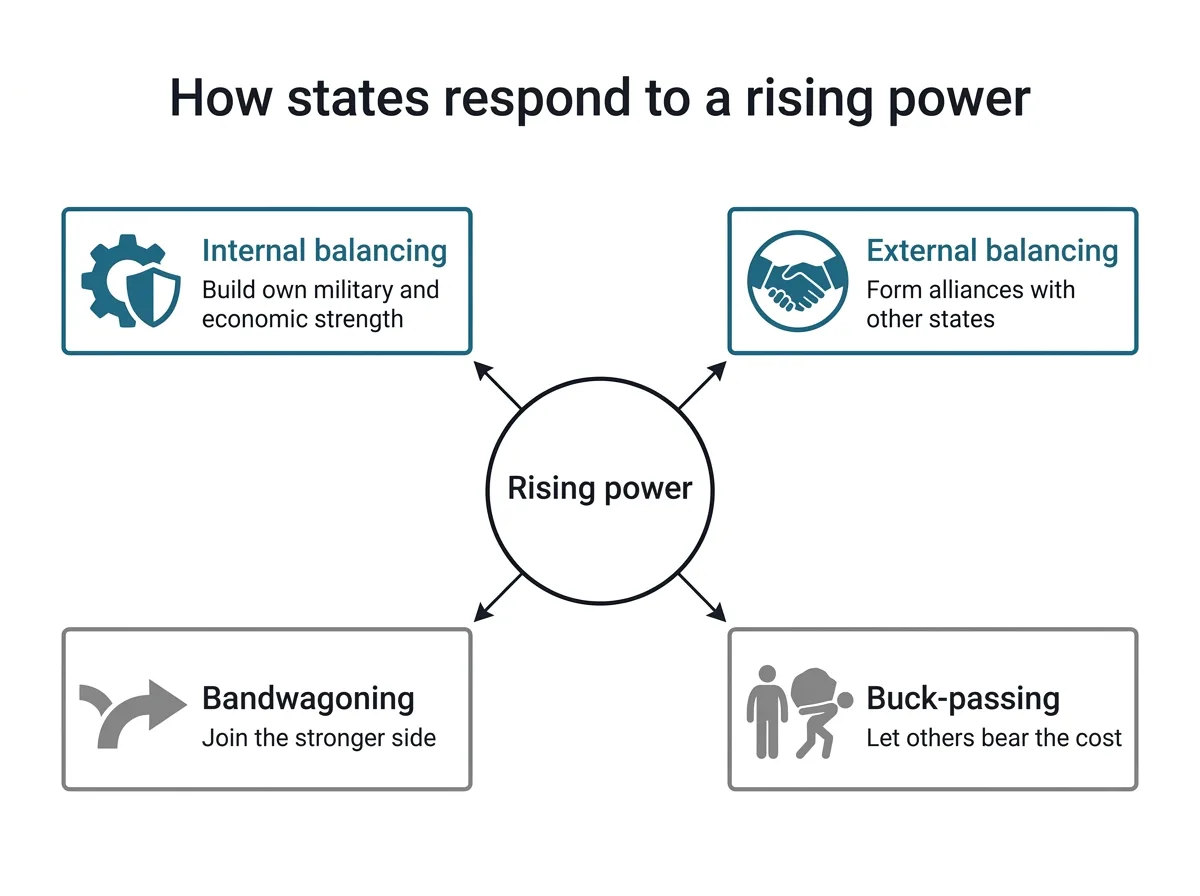
A government facing a rising rival has a short list of options. Political scientists usually group them like this.
| Strategy | What the state does | Typical example |
|---|---|---|
| Internal balancing | Builds its own strength: armed forces, industry, technology | A naval arms race, a defense budget increase |
| External balancing | Forms or tightens alliances with other countries | NATO’s founding in 1949 |
| Soft balancing | Uses diplomacy, institutions and economic tools to restrain a more powerful state without open military rivalry | Coordinated votes against a great power at the UN |
| Bandwagoning | Joins the dominant side instead of opposing it | Small states aligning with a nearby great power |
| Buck-passing | Waits and lets others carry the cost of balancing | Hoping a neighbor confronts the threat first |
Waltz introduced the distinction between internal and external balancing, and it has been standard in international relations theory ever since. Internal balancing is slower but more reliable, since a state controls its own army. External balancing is faster, but it depends on partners whose interests may change and who may defect.
Bandwagoning is the main alternative. Stephen Walt, in *The Origins of Alliances* (1987), found that governments balance far more often than they bandwagon, although weak and isolated countries are more likely to bandwagon. Walt also refined the theory: in his view governments respond to threats, and power is only one source of threat. Randall Schweller later argued, in “Bandwagoning for Profit” (1994), that some states join a rising power to share in the gains, not only out of fear.
Some writers also describe a “balancer”: a great power that stays outside the main alliances and throws its weight to whichever side is weaker. Britain is the classic example from the European past.
Historical cases from Athens to the Cold War
The concept has a long record in diplomatic history, and these cases appear in almost every international relations textbook:
- Ancient Greece: Thucydides explained the Peloponnesian War by the growth of Athenian power and the fear this caused in Sparta.
- Utrecht, 1713: The peace treaties that ended the War of the Spanish Succession named an “equal balance of power” as their aim, which made the phrase part of European treaty language. David Hume’s essay “Of the Balance of Power” (1752) treated the practice as common sense and prudent politics.
- Vienna, 1815: After the Napoleonic Wars, the great powers redrew the map so that no single country could dominate Europe again. The Concert of Europe that followed held for decades without a general war among the great powers.
- Before 1914: The rival blocs of the Triple Alliance and the Triple Entente show the darker side of the system. Balancing produced two armed camps, and a regional crisis turned into the First World War.
- The Cold War: During the Cold War the United States and the Soviet Union balanced each other through arms buildups and alliances, with NATO on one side and the Warsaw Pact on the other. Nuclear weapons raised the stakes, and the historian John Lewis Gaddis called the result a “long peace” between the two.
- Nixon and China, 1972: The opening to Beijing during the Cold War is a standard example of external balancing across ideological lines. The U.S. State Department’s Office of the Historian notes that rapprochement was meant in part to increase U.S. leverage against the Soviet Union.

Critics and competing views
Realism has never had the field to itself. Several schools of thought have criticized balance of power theory, each with its own reading of the record.
Liberal internationalism
Woodrow Wilson blamed the old European system for the First World War. In his 1917 “Peace without Victory” address he called for “not a balance of power, but a community of power,” a vision that led to the League of Nations. Liberal scholars today argue that trade, democracy and international institutions can make security less dependent on counting armies, and that shared interests would hold states together where fear could not.
Hegemony and power transition
A second group of theorists argues that stability comes from preponderance: one clearly dominant power keeps order. A. F. K. Organski’s power transition theory (1958) holds that war is most likely when a rising challenger nears parity with the dominant state. William Wohlforth argued in 1999 that the unipolar world after the Cold War was stable precisely because no state could hope to balance the United States.
Historians of diplomacy
The historian Paul Schroeder argued that states in European history often did not balance. They hid, bandwagoned or tried to work out shared rules, and the long peace after 1815 rested on agreed norms as much as on the fact that power was evenly spread. However, Colin and Miriam Fendius Elman replied in 1995 that neorealism makes no claims about single foreign policy decisions.
Constructivism
Constructivists such as Alexander Wendt hold that anarchy is “what states make of it.” Whether a powerful state looks threatening depends on identity and history. Britain does not try to counter the United States, for example, even though American military power is far greater.
Common questions
What is the balance of power in simple terms?
It is the idea that peace is safer when no country is powerful enough to dominate all the others, and that states act to keep it that way.
What is the difference between balancing and bandwagoning?
Balancing means opposing the most powerful or most threatening state. Bandwagoning means joining it.
What is the balance of threat theory?
It is Stephen Walt’s refinement of the classic theory of international relations. States balance against threats, which depend on power, geography, offensive capabilities and perceived intentions.
Is the balance of power theory still relevant today?
Most realists say yes. They point to rising military spending in Asia, new security partnerships and debates over China’s rise as signs that balancing is back in world politics. Critics reply that globalization, nuclear deterrence and international institutions have changed how nations pursue security in the new century.
Sources
- Hans J. Morgenthau, Politics Among Nations: The Struggle for Power and Peace (Knopf, 1948)
- Kenneth N. Waltz, Theory of International Politics (Addison-Wesley, 1979)
- Stephen M. Walt, The Origins of Alliances (Cornell University Press, 1987)
- Randall L. Schweller, "Bandwagoning for Profit: Bringing the Revisionist State Back In", International Security 19:1 (1994)
- Paul W. Schroeder, "Historical Reality vs. Neo-realist Theory", International Security 19:1 (1994)
- Alexander Wendt, "Anarchy is What States Make of It", International Organization 46:2 (1992)
- William C. Wohlforth, "The Stability of a Unipolar World", International Security 24:1 (1999)
- David Hume, "Of the Balance of Power", Political Discourses (1752)
- Office of the Historian, U.S. Department of State: Rapprochement with China, 1972