Definition
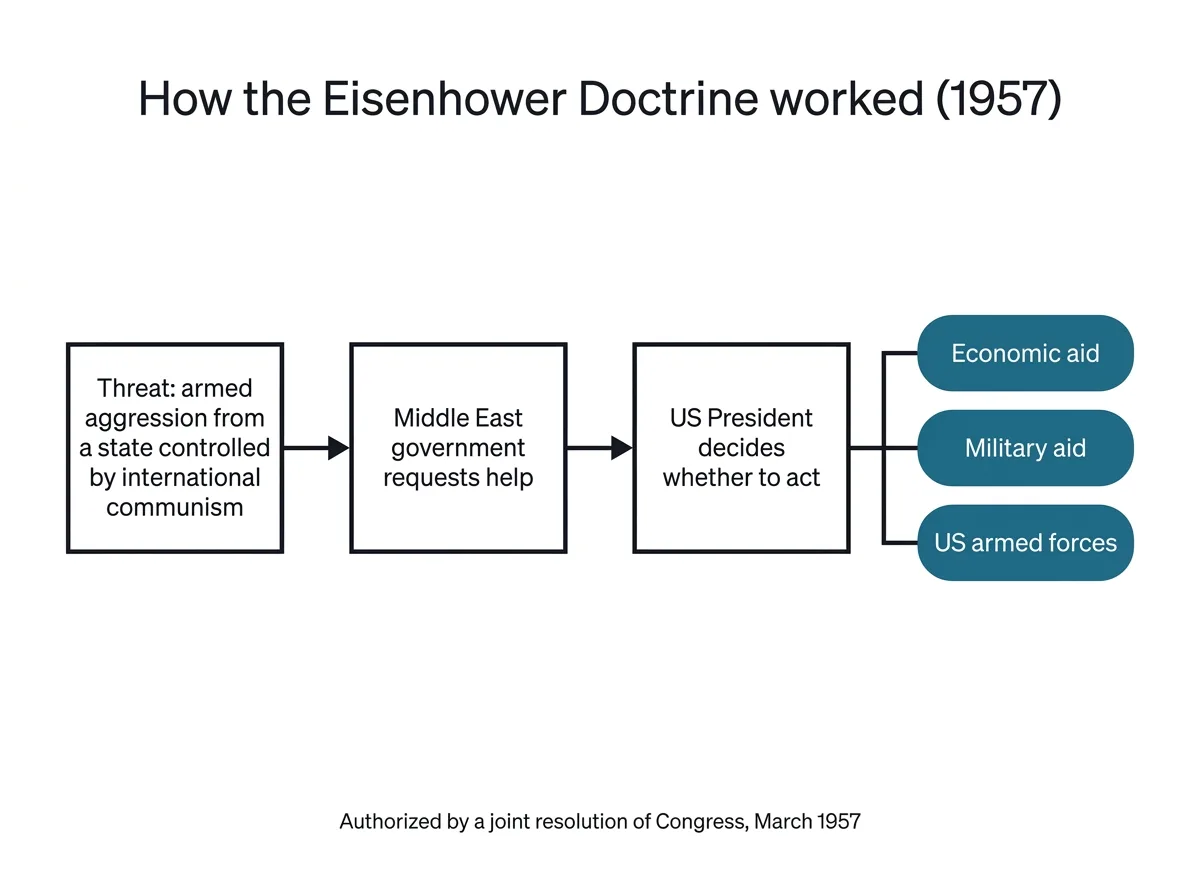
The Eisenhower Doctrine was a 1957 Cold War policy under which the United States offered economic aid, military assistance and, on request, US armed forces to Middle East countries threatened by armed aggression from a state controlled by international communism. Congress approved it in March 1957, and its best known test was the US landing in Lebanon in July 1958.

The Eisenhower Doctrine was a 1957 Cold War policy under which the United States offered economic aid, military assistance and, if asked, American armed forces to any Middle East country threatened by armed aggression from a state “controlled by international communism.” President Dwight D. Eisenhower set it out before Congress on January 5, 1957, and Congress approved it in March of the same year.
It is often remembered in a single line: the Cold War policy that sent the Marines to Lebanon. The record is more tangled than that, and several common beliefs about it do not hold up.
The 1957 policy at a glance
| Details | |
|---|---|
| Announced | January 5, 1957, in a message to a joint session of Congress |
| Legal form | A joint resolution of Congress, signed on March 9, 1957 |
| Region | The general area of the Middle East |
| Offer | Economic aid, military aid and, on request, US armed forces |
| Trigger | Overt armed aggression from a nation controlled by international communism |
| Money | Up to $200 million from existing foreign aid funds |
| Main tests | Jordan and Syria in 1957, Lebanon in 1958 |
Where it came from: Suez and the “vacuum”
The policy grew out of the Suez Crisis of 1956. Britain and France, together with Israel, had moved against Egypt after Gamal Abdel Nasser nationalized the Suez Canal, and the United States pressed all three to withdraw. Nasser came out stronger, while Britain and France lost much of their standing in the Middle East.
Eisenhower and his Secretary of State, John Foster Dulles, read the result as a power vacuum. They worried that Soviet influence, already growing in Egypt and Syria through arms deals, would fill it, and that radical nationalism and communism might combine against Western interests. The administration’s answer was to put the United States, rather than Britain, in the role of guarantor.
Myth 1: “It was a treaty or an alliance”
Fact: it was never a treaty. It was a unilateral American statement, backed by a joint resolution of Congress, the “Joint Resolution to Promote Peace and Stability in the Middle East.” No Middle Eastern country had to sign anything to be covered, and none was automatically protected.
Help depended on a request. A government had to ask, and the president then decided whether to act. That set it apart from NATO, where an attack on one member is treated as an attack on all, and from the Baghdad Pact of 1955, which Washington backed without joining as a full member.
Myth 2: “It was aimed only at the Soviet Union”
Fact: the wording was broader. According to the Office of the Historian at the U.S. Department of State, Eisenhower asked for authority to commit US forces “to secure and protect the territorial integrity and political independence of such nations, requesting such aid against overt armed aggression from any nation controlled by international communism.”
That phrase could cover Moscow, but also a regional state that Washington judged to be under communist control. During the Cold War, US foreign policy often drew that line broadly. In practice the administration’s concerns reached further still, to the pan-Arab movement led by Nasser. Many Arab leaders and commentators therefore saw the plan as an attempt to contain Arab nationalism and extend Western influence, whatever its formal target.
Myth 3: “It was a copy of the Truman Doctrine”
Fact: the two policies share a logic, but they differ in scope and method.
| Truman Doctrine (1947) | Eisenhower Doctrine (1957) | |
|---|---|---|
| Region | Greece and Turkey | The whole Middle East |
| Threat named | Armed minorities and outside pressure | Armed aggression from communist-controlled states |
| Main tool | $400 million in aid | Aid plus a standing offer of US troops |
| Congress’s role | Approved an appropriation | Gave advance approval for the use of force |
The Truman Doctrine of 1947 promised to support “free peoples” in general terms and funded one program. The 1957 policy went further by naming a region and authorizing military action in advance. Some historians see it as a forerunner of the Carter Doctrine of 1980, which declared the Persian Gulf a vital US interest.
Myth 4: “Lebanon in 1958 was a formal use of the doctrine”
Fact: Lebanon was its best known test, but Eisenhower never formally invoked it there.
The tests came in this order:
- Jordan, April 1957: During a political crisis in Amman, King Hussein faced pressure from pro-Nasser officers and politicians. The United States sent the Sixth Fleet to the eastern Mediterranean and gave the king emergency funds.
- Syria, 1957: Washington feared a Soviet-aligned government in Damascus. Turkey massed troops on the border, Moscow warned Ankara, and the crisis passed without any request for US troops.
- Lebanon, July 1958: In February 1958 Egypt and Syria had merged into the United Arab Republic. On July 14 a coup overthrew the pro-Western monarchy in Iraq. The next day, at the request of Lebanese President Camille Chamoun, US Marines began landing near Beirut in Operation Blue Bat.
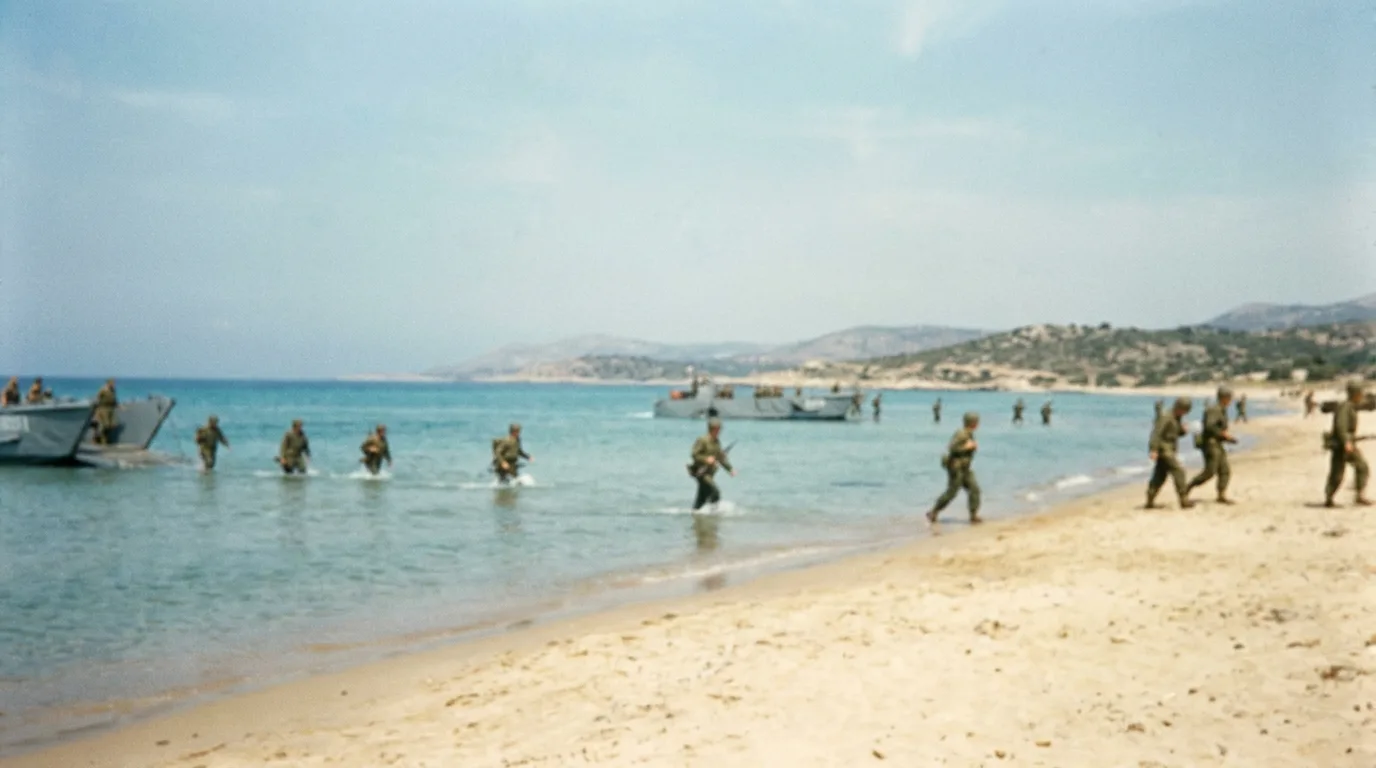
The threat in Lebanon was not an invasion. Chamoun was fighting a Lebanese revolt led by rivals, some with ties to Syria and Egypt, during a dispute over whether he would seek a second term. The landing was meant to support his government and to show the Soviet Union that the United States would defend its position in the region. American troops left in October 1958, after the Lebanese parliament had elected army commander Fouad Chehab as president.
Myth 5: “It was a clear success, or a clear failure”
Fact: historians still disagree, and each side makes a serious case.
The case for the doctrine, in its defenders’ terms:
- It made the US commitment plain during the Cold War, at a moment of real uncertainty after Suez.
- Jordan and Lebanon stayed independent and aligned with the West.
- The Lebanon operation ended with few casualties and a political settlement.
The case against it, in its critics’ terms:
- It treated Arab nationalism as if it were communism and so misread the main force in regional politics.
- Its open hostility to Nasser gave him a cause and arguably pushed Cairo and Damascus closer to Moscow.
- Few Arab governments endorsed it in public, and the revolution in Iraq in 1958 showed that aid and warships could not prevent internal upheaval.
A third view concerns Congress. Some legislators objected that a resolution approving force in advance handed the president a broad grant of war powers. Later debates over the Gulf of Tonkin Resolution of 1964 returned to the same question.
Common questions about the Eisenhower Doctrine
What was the main purpose of the Eisenhower Doctrine?
To keep Soviet influence out of the Middle East after the Suez Crisis by promising economic and military support, and if necessary US troops, to governments that asked for help.
Why was the Eisenhower Doctrine created?
The administration believed the decline of British and French power after 1956 had left a vacuum. It feared that the Soviet Union, working through Cairo and Damascus, would fill it.
How did Arab countries react?
Lebanon welcomed it, and Iraq’s monarchy was sympathetic. Egypt and Syria rejected it as a tool of Western interference, and much of Arab public opinion agreed with them.
Was the Eisenhower Doctrine successful?
In the short term it helped keep Jordan and Lebanon in the Western camp. In the longer term it did little to stop the rise of Arab nationalism or Soviet ties with Cairo and Damascus, and later administrations relied on other tools.
What was Operation Blue Bat?
The code name for the US landing in Lebanon in July 1958, the largest American military action of the Lebanon crisis and of the policy as a whole.
Sources
- Dwight D. Eisenhower, Special Message to the Congress on the Situation in the Middle East, January 5, 1957
- Joint Resolution to Promote Peace and Stability in the Middle East, Public Law 85-7 (March 9, 1957)
- Salim Yaqub, Containing Arab Nationalism: The Eisenhower Doctrine and the Middle East (University of North Carolina Press, 2004)
- Office of the Historian, U.S. Department of State: The Eisenhower Doctrine, 1957