Definition
Foreign policy is the set of goals, strategies and actions a country uses to manage its relationships with other nations and international bodies. It ranges from diplomacy and trade agreements to foreign aid, alliances and, at the far end, the use of force.
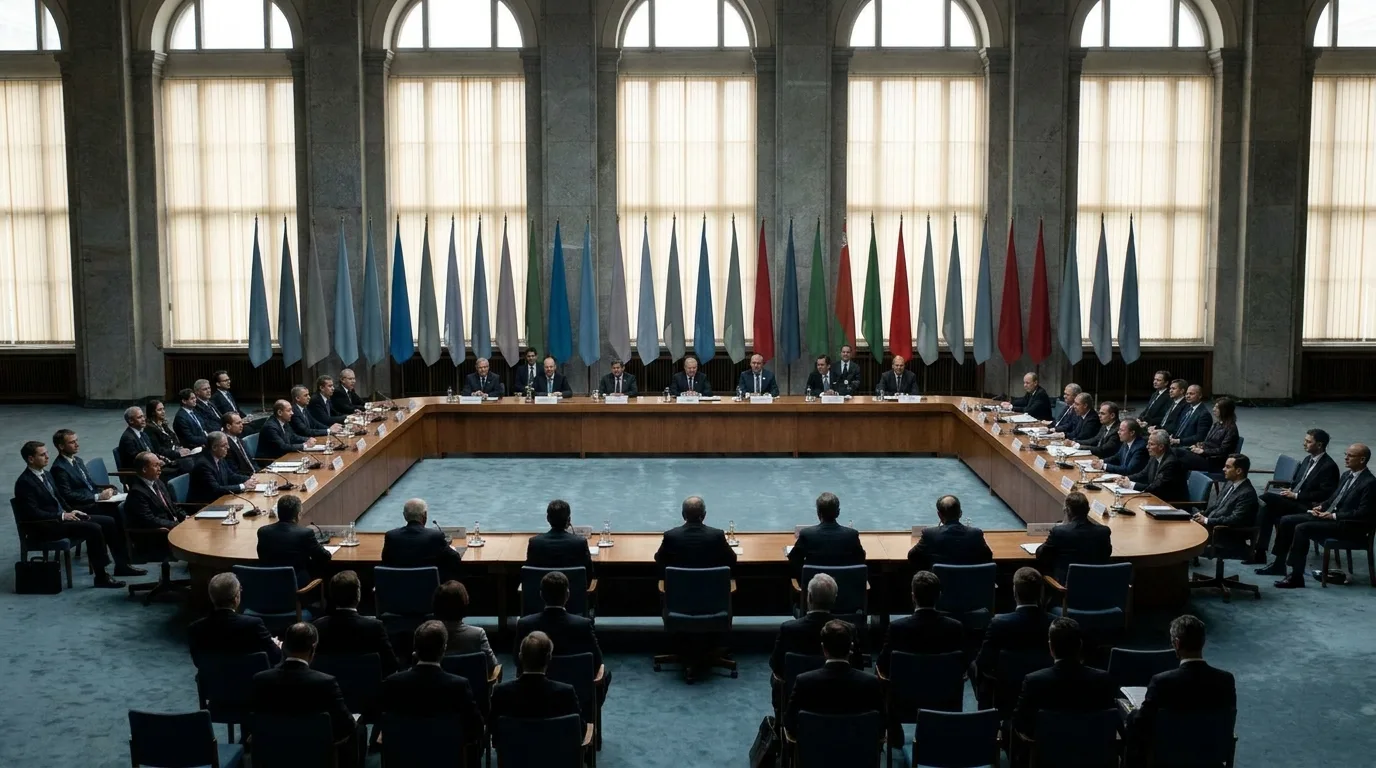
Foreign policy is the set of goals, strategies and actions a country uses to manage its relationships with other nations and with international bodies. It can include anything from an ambassador’s quiet phone call to trade agreements, foreign aid, military alliances and, at the far end, war.
In practice, a foreign policy answers two questions a country keeps asking itself: what it wants from the global arena, and what it is willing to pay to get it.
What is foreign policy in simple terms?
Every country has a foreign policy, including one that tries to stay out of international affairs, because staying out is also a choice. The objectives of foreign policy usually include:
- Security: protecting the territory and people of the country from attack.
- Prosperity: opening markets, securing energy and supplies, and protecting economic interests abroad.
- Influence: shaping the international system so that its rules favor the country’s interests.
- Values: promoting ideas such as human rights, democracy or national independence.
These goals often pull against each other. A government may want cheap imports and also want to punish the regime that sells them. Much of the work of foreign policy involves ranking goals when they collide.
Where the idea comes from
Relations between rulers are as old as written history, but the modern idea grew with the modern state. After the Peace of Westphalia in 1648, Europe moved toward a system of sovereign states that dealt with each other through permanent embassies and formal diplomatic contact.
The United States built foreign affairs into its political system from the start. Congress created a Department of Foreign Affairs in July 1789 and renamed it the Department of State that September. In his Farewell Address of 1796, George Washington warned against “permanent alliances,” and in 1823 the Monroe Doctrine told European powers to stay out of the Western Hemisphere. Both ideas shaped American debates for more than a century.
The academic study of foreign policy came later. Foreign policy analysis became its own field in the 1950s and 1960s, as scholars asked how decisions are actually made inside governments.
Foreign policy vs. domestic policy
The two are distinct, but they are linked: a tariff is a decision about other countries and also a price change at home.
| Foreign policy | Domestic policy | |
|---|---|---|
| Main question | How do we deal with other countries? | How do we govern at home? |
| Typical areas | Diplomacy, defense, trade deals, foreign aid | Taxes, schools, health care, policing |
| Who acts (US) | President, State Department, Pentagon, Senate | Congress, federal agencies, states and cities |
| Can it be enforced? | Only partly; other nations are sovereign | Yes, through law and courts |
| Example | Joining a military alliance | Raising the minimum wage |
Enforcement is the biggest difference. At home a government can pass a law and enforce it. Abroad it has to persuade, bargain or coerce, because no world government stands above the nations.
The tools of foreign policy
Foreign policies are built from a fairly stable set of instruments. Political scientists often sort them on a scale from soft to hard power, a distinction Joseph Nye popularized around 1990:
- Diplomatic tools: negotiation, summits, ambassadors and international organizations such as the United Nations.
- Information and culture: broadcasting, student exchanges and public diplomacy.
- Economic tools: trade agreements, tariffs, sanctions, loans and development aid.
- Military tools: alliances, arms sales, deterrence and, as a last resort, the use of force.
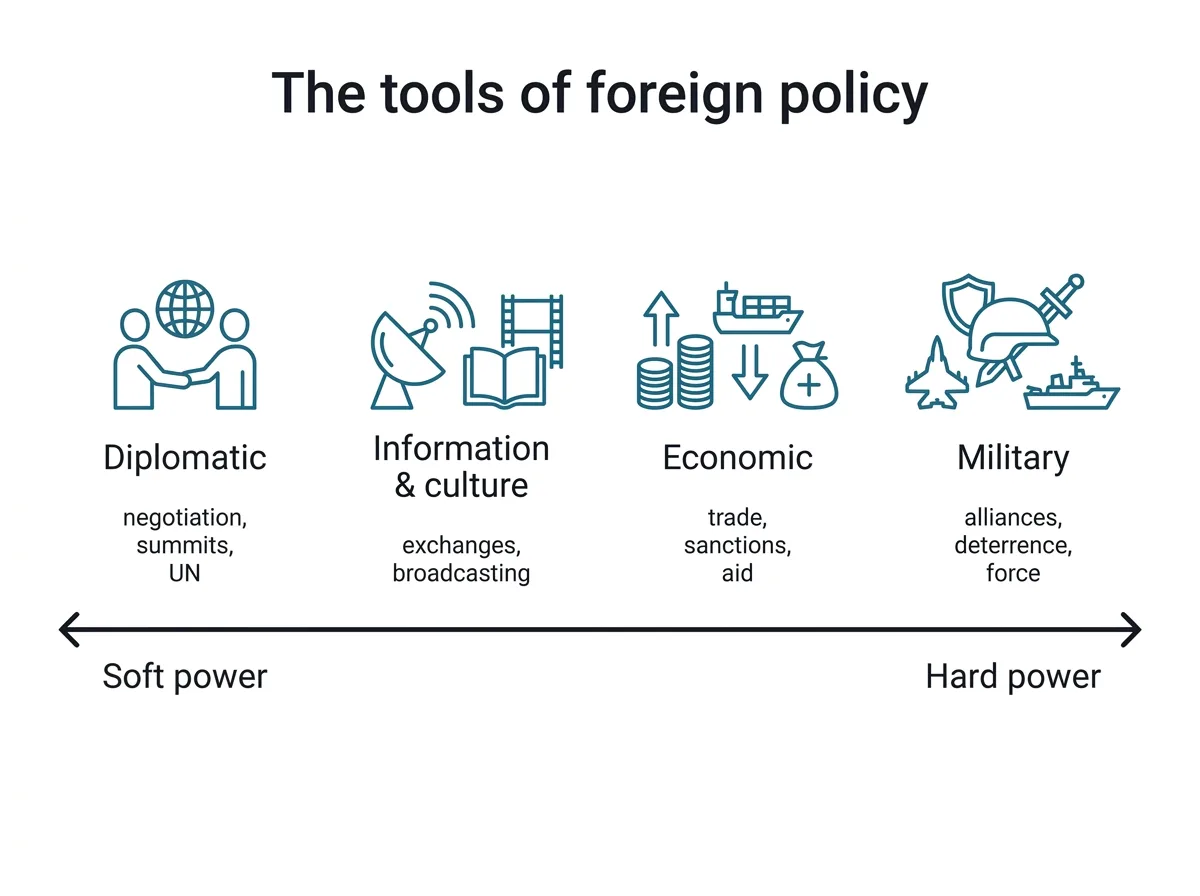
A single policy usually mixes several of these. The Marshall Plan is the classic case. After the Second World War, the United States committed over $12 billion to rebuild Western Europe under the Economic Cooperation Act of 1948. It was economic and humanitarian aid with a strategic purpose: to make Western European democracies stable and keep them out of the Soviet orbit.
Who makes foreign policy in the United States?

The Constitution splits the job, and the split invites rivalry. Article II makes the President commander in chief and gives the President power to make treaties “with the Advice and Consent of the Senate,” provided two thirds of the senators present agree. The President also appoints ambassadors, again with Senate approval.
Congress has powers of its own under Article I:
- the power to declare war,
- the power to regulate commerce with foreign nations,
- the power of the purse, which funds the military, the State Department and every aid program.
In daily practice the executive branch leads. The Secretary of State is the President’s chief adviser on foreign policy, and the National Security Council coordinates the State Department, the Pentagon and the intelligence agencies. Public opinion, interest groups and the press still limit what any administration can do.
Four schools of thought compared
Americans have argued about the right approach since Washington’s time. Four traditions come up again and again, and each makes a serious case.
| School | Core belief | Preferred tools | Typical worry |
|---|---|---|---|
| Realism | Countries pursue security in an anarchic system | Balance of power, deterrence, hard bargaining | Crusades that exceed national interests |
| Liberal internationalism | Institutions, commerce and law can tame conflict | Alliances, treaties, international organizations | A system without rules or cooperation |
| Restraint | Most foreign wars are unnecessary and costly | Strong defense at home, few commitments | Overextension and endless wars |
| Neoconservatism | Spreading democracy makes a country safer | Military strength, democracy promotion | Appeasing hostile regimes |
Realists such as Hans Morgenthau, author of *Politics Among Nations* (1948), argue that a foreign policy has to be judged by results, not intentions. A country that ignores the balance of power, in their view, will pay for it whatever its ideals.
Liberal internationalists reply that interdependence changes the incentives. Commerce, democratic governments and institutions such as NATO give countries reasons to cooperate. Woodrow Wilson’s Fourteen Points of 1918 are the founding text of this tradition in America.
Advocates of restraint, heirs of Washington’s warning, hold that two oceans and a nuclear deterrent make America unusually safe. They argue that most interventions cost more than they gain and that a country’s first job is to keep its own house in order.
Neoconservatives see democracy and security as linked. Democracies rarely fight each other, so promoting democracy, backed by strength, serves both national interests and American values and ideals.
Real administrations borrow from all four. Containment, the Cold War strategy George Kennan set out in 1946 and 1947, had realist roots but was carried out largely through liberal institutions such as NATO and the Marshall Plan.
Common questions
What are examples of foreign policy? Joining NATO in 1949, the Marshall Plan, the USMCA trade agreement, sanctions on a hostile government and a decision to send or withhold aid are all examples.
What are the 4 types of foreign policy? There is no official list. Many introductory courses use the four schools above; others sort policies by orientation, such as isolationism, nonalignment and alliance.
Do only governments have foreign policies? No. The European Union has a common foreign and security policy, and non-state actors such as large companies, churches or armed groups also pursue strategies toward other actors.
Is the foreign policy of a country the same as international relations? No. International relations is the study of the whole system. Foreign policy is what one actor decides to do inside it.
Sources
- U.S. Constitution, Article I, Section 8 and Article II, Section 2
- George Washington, Farewell Address (1796)
- Hans J. Morgenthau, Politics Among Nations (1948)
- Joseph S. Nye Jr., Bound to Lead: The Changing Nature of American Power (1990)
- Office of the Historian, U.S. Department of State: Marshall Plan, 1948