The essay in brief
Dana Dillon and John J. Tkacik Jr. argued in 2005 that China had already become the dominant power in Southeast Asia, using trade deals, new regional forums and open pressure, while the United States lost ground through neglect. They urged Washington to re-engage with ASEAN, its allies and new trade frameworks.
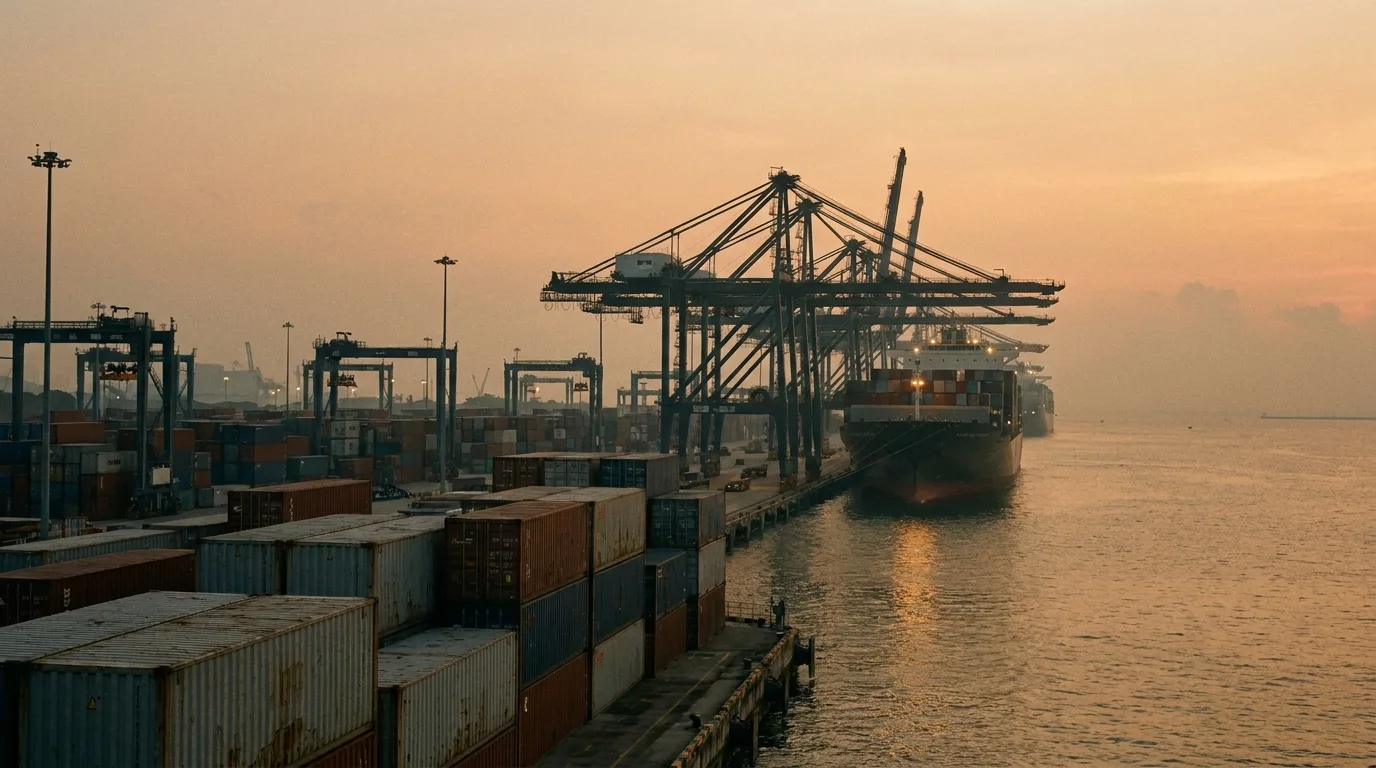
At the end of 2005, two Heritage Foundation analysts made a blunt case in *Policy Review*: China had already become the dominant power in Southeast Asia, and the United States had let it happen by not showing up. “China’s Quest for Asia,” by Dana Dillon and John J. Tkacik Jr., appeared in issue No. 134 (December 2005 and January 2006). It read the diplomacy of 2004 and 2005 as a warning and closed with advice for American foreign policy.
Most of its claims can be checked, so this guide sets out the argument and then compares five of them with what followed.
The argument in brief
Dillon and Tkacik opened with the 2004 Indian Ocean tsunami. China’s small aid pledge looked weak next to the American, Japanese and European effort, and some commentators concluded that Beijing was still a minor player. The authors disagreed. Great powers, they wrote, are measured by their ability to turn economic, political and military weight into deference from their neighbors, and on that measure China was winning.
Their core points:
- China is now the leading power in the region, and its neighbors already behave accordingly.
- Beijing uses trade deals and new forums to put itself at the center and push Washington to the edge.
- It openly mixes rewards and punishments, so neighbors side with Beijing when crossing it costs more than crossing the US.
- Even close American partners such as Australia, Singapore and the Philippines are bending to Chinese pressure.
- America is losing ground mostly through neglect, and can recover it by showing up at ASEAN meetings, restoring strategic dialogues with Japan and Australia, and opening new trade frameworks.
The tone was frankly realist. The authors borrowed Machiavelli’s line that it is safer to be feared than loved, and argued that America had lost influence in part because it was no longer feared.
The context: Washington’s priorities in 2005
American attention in 2005 was fixed on Iraq, terrorism and North Korea. Secretary of State Condoleezza Rice skipped the July 2005 ASEAN Regional Forum in Laos, which no secretary of state had missed since 1982, and no American attended that year’s meeting of ASEAN economic ministers.
China, meanwhile, was negotiating a free trade area with ASEAN, building new security dialogues and courting governments that Washington had sanctioned or ignored, above all Burma’s military junta. At a November 2004 summit in Vientiane, ASEAN, China, Japan and South Korea agreed to launch an East Asia Summit. The authors feared it would become a club with no seat for the US.
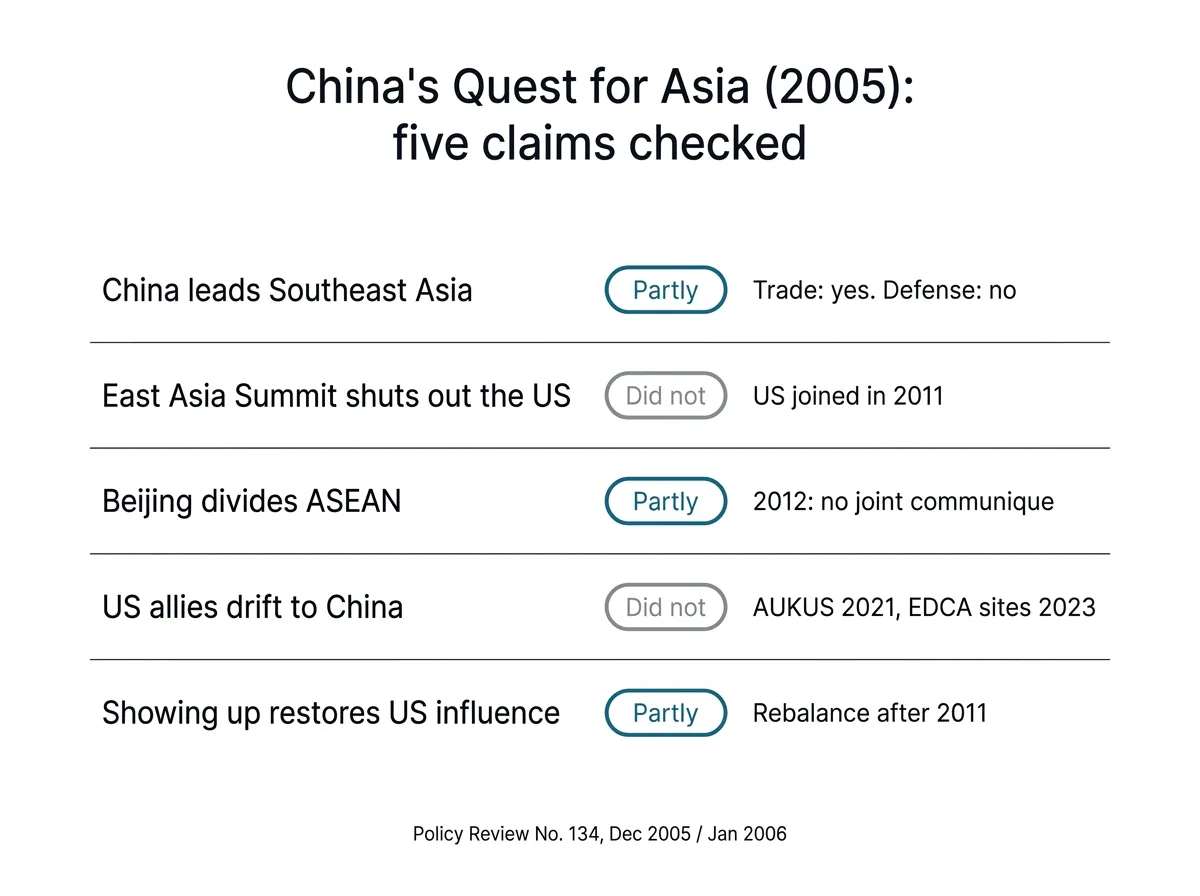
Claim 1: “China is the dominant power in Southeast Asia”
Verdict: partly true, and more so for trade than for security.
China has been ASEAN’s largest trading partner since 2009. A 2025 chapter by the US-China Economic and Security Review Commission states that China is the largest trading partner for almost every ASEAN country and that this economic role is the main source of its influence. The Lowy Institute’s influence index also ranks China first overall.
Security is another matter. The same Lowy work finds that Washington still has much stronger defense ties in the region. Chinese influence is concentrated in mainland countries such as Cambodia, Laos and Myanmar, while maritime states like the Philippines have moved closer to America.
Claim 2: “The East Asia Summit will shut America out”
This fear did not come true in the form the authors described.
The first East Asia Summit met in Kuala Lumpur in December 2005, with Australia, India and New Zealand at the table from the start. The US and Russia joined in 2011. It never grew into the European-style “Community” that worried Japanese diplomats and remains an annual leaders’ dialogue.
On trade, though, the essay was right: regional architecture did form without Washington. America signed the Trans-Pacific Partnership in 2016 and withdrew in January 2017. The Regional Comprehensive Economic Partnership, which joins China, Japan, South Korea, Australia, New Zealand and the ASEAN members, was signed in 2020 and took effect in 2022 without the US.
Claim 3: “Beijing will divide ASEAN and rule”
There is real evidence for this one, though ASEAN never split into blocs.
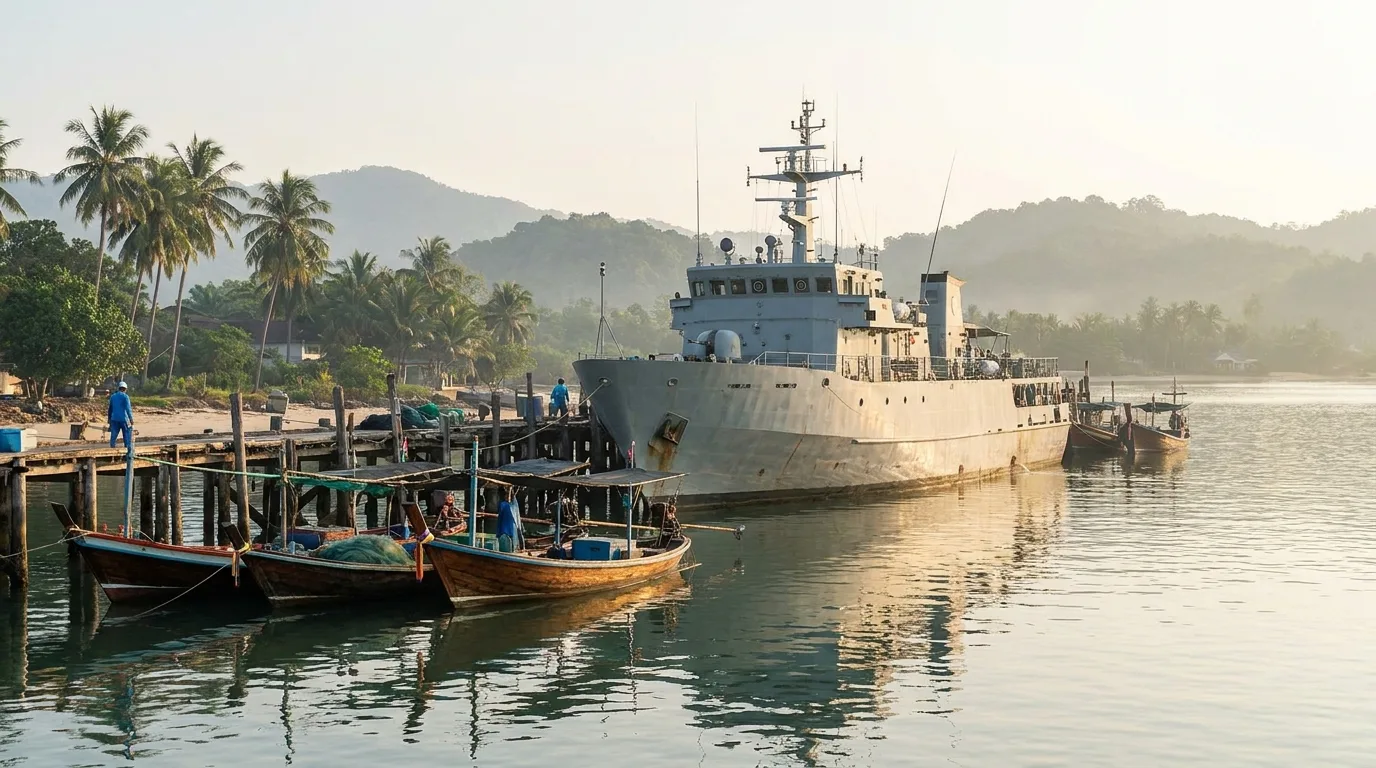
The clearest case came in July 2012, when ASEAN foreign ministers meeting in Phnom Penh failed to issue a joint communique for the first time in the group’s history, after Cambodia blocked language on the maritime disputes. Chinese-funded work at Cambodia’s Ream Naval Base has since added to that concern.
Yet ASEAN as a whole has not lined up behind Beijing. Vietnam and the Philippines have pushed back hard, while Indonesia and Thailand keep working relations with China and the United States alike.
Claim 4: “America’s allies are drifting toward China”
Largely not. There was a period of drift, but Chinese pressure pushed several of them back.
| Partner | What the essay saw in 2005 | What followed |
|---|---|---|
| Australia | Booming trade weakening support for the ANZUS alliance | A free trade agreement with China (2015), then Chinese restrictions on Australian goods (2020) and the AUKUS pact with the US and UK (2021) |
| Philippines | Manila tilting to Beijing after leaving the Iraq coalition | An arbitral tribunal ruled against China’s South China Sea claims (2016); after a turn toward Beijing under President Duterte, Manila and Washington added sites under their 2014 defense cooperation agreement (2023) |
| Singapore | Pressure over its military training ties with Taiwan | Close defense cooperation with America alongside heavy trade with China |
Trade did give China leverage, as the authors warned. But when Beijing used that leverage coercively, it often pushed partners toward Washington.
Claim 5: “Washington can recover by showing up”
Washington did engage more often after 2005.
After 2005 the US did much of what the essay asked. It signed ASEAN’s Treaty of Amity and Cooperation in 2009, named an ambassador to ASEAN, joined the East Asia Summit and announced a “rebalance” to Asia under President Obama. China’s defense minister, for his part, began attending the Shangri-La Dialogue in 2011.
China’s economic pull continued. The authors treated American neglect as the main problem; critics answer that geography and trade favored Beijing regardless of what Washington did.
Reception and criticism
The essay was written as policy advocacy by analysts at the Heritage Foundation, and some of its evidence came from unnamed diplomats.
Scholars who disagreed raised two main objections:
- David Kang’s *China Rising* (2007) argued that East Asian states were accommodating China’s rise rather than balancing against it, and that this could be a stable order, not simply a defeat for America.
- Later work, including Lowy Institute analysis, argues that treating the region only as a US-China contest says little about the varied interests of its eleven countries.
Supporters can reply that the essay saw the shift in economic gravity earlier than many others did.
How it has held up
On economics, later data match the essay: trade and investment became the main source of Chinese influence in Southeast Asia. On institutions and alliances events took a different course, because the East Asia Summit opened its doors and several partners moved closer to Washington. Their prescription, that America could win back ground by showing up, was largely tried; how much it achieved remains debated among analysts.
Readers’ questions
Who wrote China’s Quest for Asia?
Dana Dillon, then a senior policy analyst, and John J. Tkacik Jr., then a senior research fellow, both at the Heritage Foundation’s Asian Studies Center.
When was it published?
In *Policy Review* No. 134, the December 2005 and January 2006 issue.
Is China now the dominant power in Southeast Asia?
In trade and diplomacy it leads in most countries. In defense ties the United States has the stronger network.
Did the essay predict the South China Sea disputes?
It noted Chinese pressure on the Philippines, including the occupation of Mischief Reef, but the later island building and the 2016 ruling went beyond what it described.
Where to read the original
The full essay is in the Hoover Institution’s archive of *Policy Review*: China’s Quest for Asia, by Dana Dillon and John J. Tkacik Jr. Its country sections show how the region looked from Washington in 2005.
Sources
- Dana Dillon and John J. Tkacik Jr., "China's Quest for Asia", Policy Review 134 (2005)
- U.S.-China Economic and Security Review Commission, 2025 Annual Report, Chapter 4: Crossroads of Competition: China and Southeast Asia
- Lowy Institute, The Interpreter: Is the US really losing to China in Southeast Asia?
- David C. Kang, China Rising: Peace, Power, and Order in East Asia (Columbia University Press, 2007)