Definition
Terrorism is the use or threat of violence, usually aimed at civilians, to spread fear and push a government or a public toward a political goal. No single definition has ever won agreement among governments, courts and scholars.

Terrorism is the use or threat of violence, usually aimed at civilians, to spread fear and push a government or a public toward a political goal. That is the core of almost every terrorism definition in use today, yet no single wording has ever won agreement among governments, courts and scholars.
The first serious attempt to write the term into international law shows why.
Marseille, 1934: the case that started the search
On 9 October 1934, King Alexander I of Yugoslavia arrived in Marseille for an official visit. Minutes after he landed, a gunman working with Croatian and Macedonian separatist groups shot him in his car. The French foreign minister, Louis Barthou, also died from his wounds.
The killers had trained and sheltered abroad, so the crime crossed borders in a way national courts handled badly. The League of Nations responded with the 1937 Convention for the Prevention and Punishment of Terrorism. Its Article 1 described acts of terrorism as “criminal acts directed against a State and intended or calculated to create a state of terror in the minds of particular persons, or a group of persons or the general public.”
The convention never entered into force, because only one government ratified it. Some delegations found the text too vague. Others feared it could be turned against movements they supported. That pattern has been repeated for almost ninety years.
Three lessons from 1937
- The 1937 text protected governments and their officials. Ordinary civilians were not its focus.
- The killing of one king was aimed at a much larger audience.
- Delegations agreed the act was wrong but split over which other activities the label might cover.
Where the term terrorism came from
The word is older than the League. “Terror” comes from the Latin for great fear, and “terrorisme” entered French during the Revolution. In 1793 and 1794 the Jacobin government made terror an official instrument of rule, and thousands of people were executed during the Reign of Terror.
So the first terrorists held power. Soon afterward, critics such as Edmund Burke were using “terrorist” as an insult for the revolutionaries. In the nineteenth century, Russian revolutionaries and anarchists who killed officials adopted the language for themselves. Only in the twentieth century did the term terrorism settle on violent acts by non-state groups, and even that shift is contested, as the debate below shows.
How the United States defines terrorism
American federal law has no single wording. Different statutes serve different purposes, so the language changes with the job it has to do.
| Source | Key wording | Used for |
|---|---|---|
| 18 U.S.C. § 2331 | Acts dangerous to human life that violate criminal law and appear intended to intimidate civilians, influence a government by intimidation or coercion, or affect government conduct by mass destruction, assassination or kidnapping | Criminal and civil cases; separates international and domestic terrorism |
| 22 U.S.C. § 2656f | Premeditated, politically motivated violence perpetrated on noncombatant targets by subnational groups or clandestine agents | The State Department’s annual country reports |
| 18 U.S.C. § 2332b | A listed federal offense calculated to influence or retaliate for government conduct | The “federal crime of terrorism” category |
The criminal code splits the concept by geography. Under the federal definitions in 18 U.S.C. § 2331, international terrorism covers activities that occur primarily outside the United States or transcend national boundaries, while domestic terrorism covers activities that occur primarily within the territorial jurisdiction of the United States. The USA PATRIOT Act added the domestic category in 2001.
That domestic category is not a crime by itself. Prosecutors charge the underlying act, such as murder or a weapons offense, and the statute shapes how the FBI investigates it. Whether Congress should create a stand-alone domestic terrorism offense is an open policy argument, with civil liberties groups and some law enforcement voices on opposite sides.
How international law handles it
At the United Nations, the problem has a name: the draft Comprehensive Convention on International Terrorism. The General Assembly created an ad hoc committee on terrorism in 1996, which took up a comprehensive treaty in 2000. The talks are still stuck on two questions:
- Should the acts of national armed forces be excluded, since the law of war already governs them?
- Should fighters in national liberation movements or under foreign occupation be treated differently?
In the meantime, governments have worked around the gap. More than a dozen sectoral treaties ban specific acts, such as hijacking aircraft, taking hostages or bombing public places, without defining the whole concept. The 1999 International Convention for the Suppression of the Financing of Terrorism comes closest. Its Article 2 covers acts intended to kill or seriously injure a civilian when the purpose is to intimidate a population or to compel a government or an international organization to do or abstain from doing any act. UN Security Council Resolution 1566 from 2004 uses similar language.
Some countries write their own. The UK Terrorism Act 2000 covers the use or threat of serious violence, damage or disruption designed to influence the government or intimidate the public for a political, religious, racial or ideological cause.
The scholarly definition of terrorism
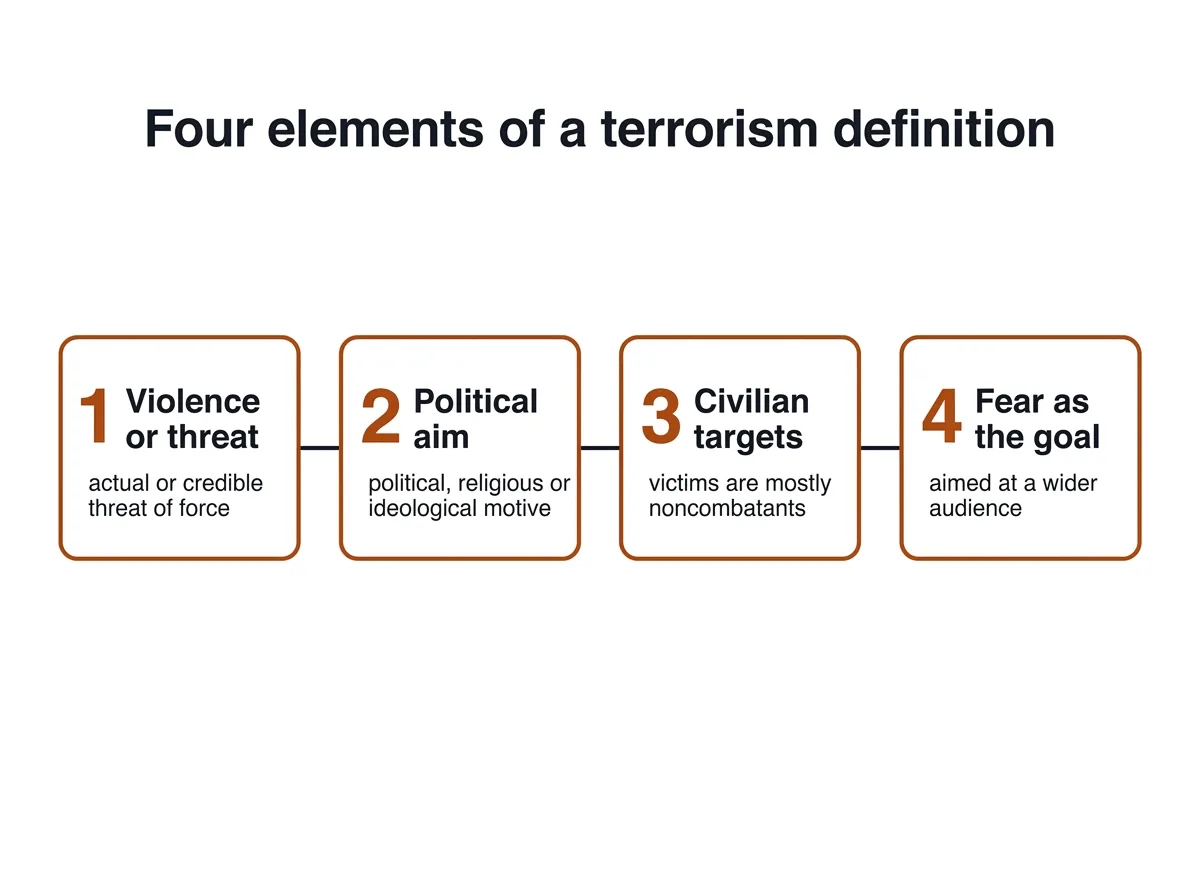
Researchers face the same problem with more freedom to argue. In their 1988 survey, Alex Schmid and Albert Jongman collected 109 academic and official definitions. The elements that appeared most often were violence or force, a political purpose, and fear or terror.
Most academic work now tests an act against four questions:
- Is there violence or a credible threat of it?
- Is the motive political, religious or ideological rather than private gain?
- Are the direct victims different from the real target audience?
- Is fear itself the intended effect?
Bruce Hoffman’s book Inside Terrorism (Columbia University Press, New York) gives a widely used version: the deliberate creation and exploitation of fear through violence or its threat in pursuit of political change. On this reading, the terrorist group cares less about the people it harms than about everyone who watches.

Competing views, in their own best terms
The narrow, actor-based view
Terrorism is political violence by non-state groups that targets noncombatants. Its defenders say criminal law needs bright lines. An offense with heavy penalties should be drawn tightly, and governments already answer for their conduct under the law of war and human rights treaties.
The act-based view
What makes terrorism wrong is the act, not the actor. Philosopher Michael Walzer argued that its defining feature is the deliberate killing of innocent people to spread fear. On this view, a government that bombs civilians to break morale commits terrorism too, and any wording that exempts governments is inconsistent.
The skeptical view
Historian Walter Laqueur doubted that a comprehensive formula was possible, given how many forms the violence takes. Critics in this camp warn that the label is often a political verdict on some group the speaker dislikes. Supporters of the other two views answer that “one man’s terrorist is another man’s freedom fighter” confuses the cause with the method, since a just cause does not license attacks on civilians.
Common questions
What is the simple definition of terrorism?
Violence or the threat of it, mostly aimed at civilians, meant to create fear and force political change.
What are the 4 types of terrorism?
There is no official list. A common scholarly scheme is David Rapoport’s four “waves” of modern terrorism: anarchist, anti-colonial, New Left and religious.
How is terrorism different from guerrilla warfare?
Guerrillas mainly attack military forces and try to hold territory. A terrorist campaign aims at civilians and at the psychological effect on a wider public. Many armed groups do both, which is one reason the categories blur.
Can a government commit terrorism?
Under the act-based view, yes. US statutes and most UN instruments focus on non-state actors and leave state conduct to the law of armed conflict.
Why does the wording matter?
It decides who may be prosecuted, which organization can be designated, what counts as material support, and which powers governments may use for security.
Sources
- League of Nations, Convention for the Prevention and Punishment of Terrorism (1937)
- International Convention for the Suppression of the Financing of Terrorism (1999)
- UN Security Council Resolution 1566 (2004)
- UK Terrorism Act 2000, section 1
- Alex P. Schmid and Albert J. Jongman, Political Terrorism (1988)
- Bruce Hoffman, Inside Terrorism (Columbia University Press)
- Michael Walzer, Just and Unjust Wars (1977)
- David C. Rapoport, "The Four Waves of Modern Terrorism" (2004)
- 18 U.S.C. § 2331, Definitions (Cornell Legal Information Institute)