The essay in brief
Lee Harris argued in 2002 that the 9/11 attacks were not Clausewitzian war aimed at a political concession but a symbolic drama staged for the attackers and their sympathizers. He called this a fantasy ideology: political symbols used to act out a group's picture of itself, with the enemy cast as a prop.

Most early readings of September 11 shared one premise: an attack of that size must have been meant to win something. Lee Harris rejected it. In “Al Qaeda’s Fantasy Ideology,” published in *Policy Review* No. 114 (August and September 2002), he argued that the attackers staged the event mainly for themselves and their sympathizers. The West, in his view, misread it by treating it as a move in a political war. The essay was among the most discussed pieces of the first year after 9/11, and its central term soon traveled far beyond it.
What did Harris argue about 9/11?
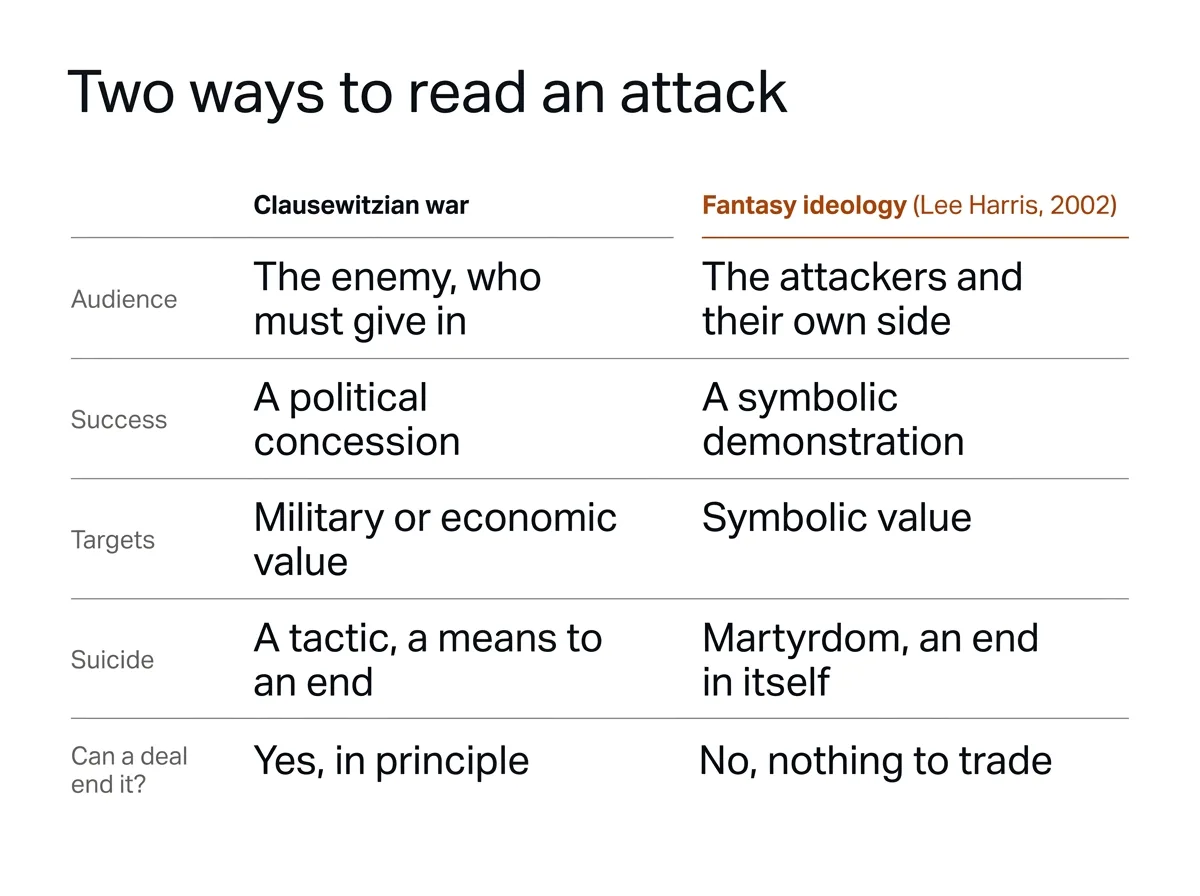
His central claim is that the attacks were no act of war in the sense Carl von Clausewitz gave the word. For Clausewitz, war is politics by other means: force used to make an enemy accept your aims. Violence on this model is instrumental, and its success is judged by one test. Does it work?
Harris thought 9/11 did not fit. In his reading the towers were chosen because they stood for American power, and the attack was “a spectacular piece of theater” whose real audience was the Muslim world. The buildings were props. The point was to show that a handful of men of pure faith could humble a superpower, and so to prove that God was on their side.
He builds the case in five steps:
- Faced with something strange, people explain it with the categories they already have. Harris opens with Montezuma reading Cortés through the myth of Quetzalcoatl and suggests that Americans read 9/11 through Clausewitz in a similar way.
- He recalls a college friend in the late 1960s who joined a disruptive anti-war protest even though it might hurt the cause, because it was, in the friend’s words, “good for his soul.” What mattered was what the protest did for him. The commuters he blocked were extras in his own drama.
- Groups can do this too. Harris names the Jacobins, the antebellum South and Mussolini’s fantasy that fascist Italy would revive the Roman Empire. He traces the method to Georges Sorel, for whom beliefs could be manufactured as myths and judged by their effect on those who held them. The Sorelian myth, Harris adds, worked best when it was staged as theater.
- His test case is fascist Italy’s 1935 invasion of Ethiopia, which in his view brought no strategic gain. Ethiopia was a prop in a pageant of the Roman Empire reborn.
- Al Qaeda, he concludes, gave the United States the role that Ethiopia had played for Mussolini.
How is a fantasy ideology different from normal politics?
The fantasist, in Harris’s account, treats other people as objects. They are not minds of their own but parts in a script. Fantasy ideologies do this at the scale of a movement: they cast the enemy, the setting and the props in advance, and the real world matters only as a stage. This does not mean that such movements are harmless dreamers. Harris insists that the fantasist often has more power over others, not less, because he never stops to ask what they want.
| Question | Clausewitzian reading | Fantasy ideology reading |
|---|---|---|
| Who is the audience? | The enemy, who must give in | The attackers and their own side |
| What counts as success? | A political concession | A symbolic demonstration |
| Why these targets? | Military or economic value | Symbolic value |
| What is suicide? | A tactic, a means to an end | Martyrdom, an end in itself |
| Can a deal end it? | Yes, in principle | No, because there is nothing to trade |
Harris also drew evidence from what did not happen. In the months after the attacks there was no campaign of smaller strikes, even though the anthrax letters had shown how much fear a minor incident could spread. A strategist would have pressed the advantage. But a group acting out a symbolic drama needed a Goliath, and a shopping mall in a small town would not have served the story. Harris read the Palestinian suicide bombings of the time in a similar way: the West saw a tactic, while for the bombers the act was martyrdom.
What policy conclusions did Harris draw?
If the enemy is acting out a fantasy, Harris wrote, then searching for the “root causes” of terrorism in poverty or a lack of democracy leads nowhere, since such movements are more often led by educated, middle-class people. Changing American policy toward the Arab world or Israel would not help either. There is no concession that has any place in the script.
He defended President Bush’s widely debated word “evildoers.” The villain of a fairy tale does not bargain, he argued, and so the word caught the problem better than the language of war. He then proposed replacing the war metaphor with that of fighting an epidemic, and he applied it to screening and monitoring at home.
Why did the essay land so strongly in 2002?
In mid-2002 the American debate was split between those who blamed U.S. policy for the attacks and those, like the classicist Victor Davis Hanson, who compared them to Pearl Harbor. Harris argued that both camps shared one hidden belief: that the attack served a political aim. By questioning it he stepped outside a debate many readers found stuck.
Four things helped it spread:
- “Fantasy ideology” was an easy phrase to quote and to apply to other movements.
- The essay moved from Aztec Mexico to fascist Italy to 1960s campus politics.
- It circulated on early political blogs and forums and drew long comment threads.
- Harris expanded the argument into *Civilization and Its Enemies* (Free Press, 2004) and returned to radical Islam in *The Suicide of Reason* (2007).

What did critics say about the essay?
*Policy Review* printed letters on it in its December 2002 and January 2003 issue. Their objections are still the main lines of criticism.
- One reader argued that Harris ignored retaliation and responses to perceived oppression, which would make the attacks a reaction to real conditions.
- David R. Henderson, a Hoover research fellow, said Harris wrongly grouped Noam Chomsky with those who blamed America outright, and that he asked readers to accept his account of radical Islam without much study of it.
- Another reader pointed out that Leninism and Stalinism were missing from the list and suspected that the essay was mainly a case against changing policy.
- A fourth letter said the contrast to a purely secular America overlooked the religious language of American politics itself.
Later, Robert Pape’s *Dying to Win* (2005) argued that suicide terrorism follows a strategic logic, with campaigns aimed at pushing democracies to withdraw forces from land the attackers regard as their homeland. That is close to the Clausewitzian reading Harris set aside.
How has Al Qaeda’s Fantasy Ideology held up?
Critics point to evidence since 2002 that counts against Harris. The group did state political demands: the 9/11 Commission Report records that bin Laden’s 1996 declaration called on Muslims to drive American soldiers out of Saudi Arabia, and that the 1998 “World Islamic Front” statement called for killing Americans anywhere. Follow-up attacks came too, from Bali in October 2002 to Madrid in 2004 and London in 2005, often by affiliated or inspired cells. After Madrid, Spain’s new government withdrew its troops from Iraq, which many analysts read as terror producing a political result. Bin Laden also later spoke openly about the attacks, which, critics say, undercuts the point that they had not been claimed.
Defenders of the essay point to other evidence. The weight jihadist groups give to martyrdom, spectacle and the effect on recruits fits his account, and the Islamic State later made staged propaganda central to its method. Many scholars now treat strategy and symbolism as two sides of one campaign. Other writers, such as [Norman Podhoretz],(https://policyreview.org/fall95/thgers.html) kept the language of war instead and called the conflict *World War IV*.
His policy conclusions remain disputed. Critics argue that the claim that grievances play no part at all is hard to square with the fact that recruiters use them; defenders reply that Harris was describing the movement’s aims, not its recruiting appeals. The epidemic metaphor, used as an argument for profiling, drew lasting objections on civil liberties grounds.
Was 9/11 an act of war according to Harris?
Only in a one-sided way. Harris wrote that the United States was at war with its attackers while they, in a strange sense, were not at war with it. A real war would have forced them to think about aims and about the power on the other side, and their fantasy left no room for this.
Where can I read the original essay?
The essay appeared in *Policy Review* No. 114, August and September 2002. The full text is available in the Hoover Institution’s Policy Review archive. This guide is new writing about it. It summarizes the argument in our own words and quotes only two short phrases.
Sources
- Lee Harris, "Al Qaeda's Fantasy Ideology", Policy Review 114 (2002)
- Policy Review letters: Fantasy ideology; the academy; religious excess (Dec 2002 & Jan 2003)
- The 9/11 Commission Report, chapter 2: The Foundation of the New Terrorism
- Lee Harris, Civilization and Its Enemies: The Next Stage of History (Free Press, 2004)
- Robert A. Pape, Dying to Win: The Strategic Logic of Suicide Terrorism (Random House, 2005)