The essay in brief
In 2004 Walter Laqueur argued that poverty does not explain terrorism, that settling local conflicts would not stop global jihadism, and that Europe was the most exposed front. The greatest danger ahead, he warned, was megaterrorism: very small groups with weapons of mass destruction. He expected no final victory, only a long struggle.
Three years after the attacks of September 11, most writing on political violence still looked backward at what had gone wrong. Walter Laqueur looked ahead. “The Terrorism to Come,” published in *Policy Review* No. 126 (August & September 2004), asked what kind of threat the West would face in the twenty-first century and which popular remedies he expected to fall short. He offered little comfort. His last line held that there could be no victory, “only an uphill struggle.”
This guide sets out what he argued, how his ideas were received, and how the essay reads two decades later.
Who was Walter Laqueur?
Laqueur (1921 to 2018) was a historian born in Breslau who fled Nazi Germany as a teenager. He wrote on the Holocaust, the Soviet Union, the Middle East and European decline, directed the Wiener Library in London for many years, and founded the *Journal of Contemporary History* with George Mosse. His *A History of Terrorism* (1977) and *The New Terrorism* (Oxford University Press, 1999) shaped the field, and the journalist Peter Bergen called him the “dean of terrorism studies.”
In 2004 he was co-chair of the International Research Council at the Center for Strategic and International Studies in Washington. The essay grew out of a larger book project and his earlier *No End to War* (2003).
What did Laqueur argue in The Terrorism to Come?
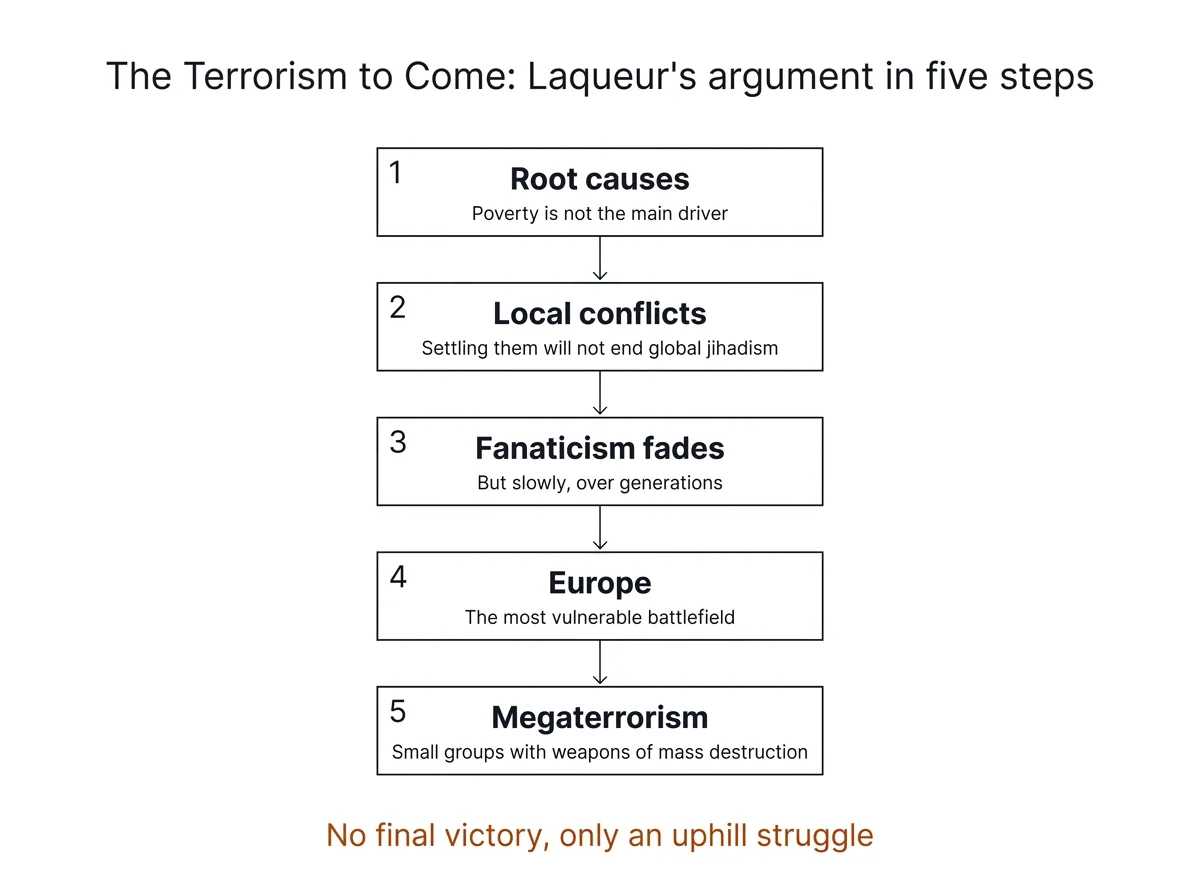
The argument moves in five steps:
- Poverty is not the root. The belief that economic misery breeds violence had survived every study that tested it.
- Local peace deals help only locally. Groups with global religious aims cannot be bought off with land.
- Fanaticism burns out, but slowly. Militant Islamism would weaken over generations; predictions of its quick collapse were premature.
- Europe is the weak point. Its diaspora networks, open societies and legal limits made it the most exposed front.
- Megaterrorism is the real danger. For the first time, very small groups could gain access to weapons of mass destruction.
From these he drew a hard policy conclusion. Governments should start a campaign against terrorist groups only if they are able and willing to use massive force when their core interests are at stake.
Does poverty cause terrorism?
This was his opening target. Laqueur noted that the world’s 50 poorest countries saw little or no terrorism, and that the people behind attacks in Europe and the United States tended to come from the middle class. He cited the economists Alan Krueger and Jitka Malečková, whose NBER study on education, poverty and political violence found that participants were not, on average, poorer or less educated than their peers.
He did not call poverty irrelevant. Youth unemployment in the Arab world, he wrote, created a climate in which radical sects could recruit. His point was narrower: fighting poverty is a moral duty, but expecting it to end international terrorism soon is unrealistic.
Why did he think Europe was the most vulnerable battlefield?
In the past decade, he argued, Western Europe had become the main base for support networks. Several things came together there:
- radical preachers could organize more freely than in Egypt, Jordan or Algeria;
- security services worked under tight legal limits;
- a second generation of immigrants, fluent in the local language but resentful of exclusion, was more open to radical messages than their parents;
- rising tension with the native population fed resentment on both sides.
He saw some hope as well. The pull of Western life on young Muslims would erode fervour over time. The question was whether that change would happen fast enough.
What is megaterrorism, and why did it worry him?
Laqueur treated September 11 as a stage between old-fashioned attacks and something worse. The idea of using poison or other mass-destruction weapons was more than a century old, but it had been fantasy. Now small groups with no state behind them, no wish to negotiate and perhaps no rational political goal could do enormous damage.
He doubted the comforting thought that such weapons would never be used. In his reading of history, weapons once invented had always found users. That is why he warned against focusing only on Islamist movements; the next danger could have other sources.
How should governments respond?
This part of the essay is the most contested. Laqueur gave the military a limited role and assigned the main work to intelligence and security services. He described the conflict as asymmetric: the terrorists ignore the laws of war, while democracies remain bound by them. If the survival of a society were ever at stake, he predicted, governments would not let rules written for an earlier age stop them.
On soft power he was sceptical. Great powers, he wrote, are feared and envied but never loved, so the realistic goal is respect. Public diplomacy could work in Europe, much less with audiences that reject democracy outright.
| Remedy | Laqueur’s verdict |
|---|---|
| Fighting poverty | Right in itself, little effect on attacks |
| Solving local conflicts | Useful, but no cure for global jihadism |
| Soft power and public diplomacy | Important, limited reach |
| Military force | A supporting role |
| Intelligence and security services | The central instrument |
| Stricter legal controls | Likely, once public opinion demands them |
How was the essay received, and what did critics say?
*Harper’s Magazine* reprinted it in its Readings section in November 2004, which brought it to a far wider audience than a policy journal usually reaches.
The broader ideas behind it have been contested. Scholars in the “new terrorism” debate, among them Isabelle Duyvesteyn, argued that the break between old and new forms was smaller than writers like Laqueur claimed, since religious motives and mass-casualty attacks both had long histories. On poverty, later research mostly supported the Krueger and Malečková finding, although the economist Alberto Abadie added that a lack of political freedom predicted violence better than income did. Some readers have also found his passages on Muslim immigrants too sweeping, arguing that conditions differ widely by country and community; others reply that he described networks, not communities as a whole.
How has the essay held up?
Readers who see the essay as prescient point to several later events:
- The 2005 London bombings were carried out mostly by young men raised in the United Kingdom, as his warning about the second generation suggested.
- Thousands of Europeans later travelled to join the Islamic State in Syria and Iraq.
- He expected Pakistan to remain a danger zone, a concern that stayed prominent in later security debates.
Other parts remain open. The megaterrorism he feared has not arrived; Aum Shinrikyo’s 1995 sarin attack in Tokyo is still the closest case. His idea of fanaticism slowly burning out fits the decline of al Qaeda’s central leadership, though new groups kept emerging. His last book, *The Future of Terrorism* (2018), widened the frame to the far right, much as this essay had urged.
Readers’ questions
Is this essay the same as Laqueur’s book *The New Terrorism*? No. The book appeared in 1999; the essay is a shorter, updated statement from 2004.
Did Laqueur think terrorism could be defeated? Not fully. He thought it could be contained and made much harder, never ended.
Where to read the original
“The Terrorism to Come” by Walter Laqueur appeared in *Policy Review* No. 126, August & September 2004. The full text is preserved in the Hoover Institution’s Policy Review archive. Policyreview.org is an independent reference and is not affiliated with the Hoover Institution.
Sources
- Walter Laqueur, "The Terrorism to Come", Policy Review 126 (2004)
- Alan B. Krueger and Jitka Maleckova, Education, Poverty, Political Violence and Terrorism: Is There a Causal Connection?, NBER Working Paper 9074
- Walter Laqueur, No End to War: Terrorism in the Twenty-First Century (Continuum, 2003)
- Walter Laqueur, The New Terrorism: Fanaticism and the Arms of Mass Destruction (Oxford University Press, 1999)