Definition
Isolationism is a foreign policy that keeps a country out of the political affairs, alliances and wars of other nations. In the United States it usually meant avoiding permanent alliances and foreign wars while still trading with the world.

Isolationism is a foreign policy that keeps a state out of the political affairs, alliances and wars of others. In its American form it rarely meant cutting off trade or diplomacy; it meant refusing binding commitments abroad and keeping the military at home unless the country itself was attacked.
The word worked as an insult long before anyone used it as a self-description. Few American politicians ever called themselves isolationists. Critics applied the label, mostly after 1941, to people who saw themselves as defenders of neutrality or of the war powers of Congress. In international relations debates the term still carries that charge.
Isolationism in one sentence, and what it is not
A working definition: isolationism is the view that a country’s core national interests are best served by staying free of foreign entanglements, above all permanent military pacts. Neighboring ideas often get mixed up with it.
- Non-interventionism rejects military intervention in other countries’ conflicts but accepts treaties, trade agreements and active diplomacy.
- Neutrality is a legal status in wartime. Switzerland is neutral, yet deeply tied into global trade and finance.
- Protectionism is about trade barriers such as tariffs. An isolationist can favor free trade.
- Restraint is a modern school of grand strategy that wants fewer bases and wars abroad without giving up every treaty.
- Seclusion, such as Japan’s closed-country policy from the 1630s to the 1850s, is the rare extreme case.
A timeline of American isolationism
The story moves in steps, each driven by a different fear: European monarchies in the 1790s, bankers and arms makers during the 1930s, costly wars in the 2010s.
Step 1: Washington’s Farewell Address (1796)
President George Washington used his Farewell Address to warn against long-term ties to Europe. “It is our true policy to steer clear of permanent alliances with any portion of the foreign world,” he wrote. He did not ask the American people to stop trading: commerce should grow while political connections stayed few.
Thomas Jefferson gave the idea its famous phrase in his first inaugural address in 1801: “peace, commerce, and honest friendship with all nations, entangling alliances with none.” The Monroe Doctrine of 1823 added the other half of the bargain: Europe should stay out of the Western Hemisphere, and the young republic would keep out of its quarrels.
Step 2: Rejecting the League of Nations (1919 to 1920)
President Woodrow Wilson took the United States into the First World War in 1917 and then championed the League of Nations. The Senate refused to ratify the Treaty of Versailles, which contained the League’s charter. Opponents objected above all to Article 10, which they read as a promise to defend other members by force without a vote of Congress. The United States never joined.
Step 3: The Neutrality Acts of the 1930s
By the mid-1930s much of the American public had concluded that entering the First World War was a mistake. A Senate committee led by Gerald Nye investigated the munitions industry and fed the suspicion that bankers and arms makers had pulled the United States into the war. According to the State Department’s Office of the Historian, the Great Depression and the memory of losses in World War I were the forces that pushed public opinion and policy toward isolationism.
Congress answered with a series of laws:
- 1935: an embargo on arms sales to all belligerents, regardless of who started the war.
- 1936: extended the embargo and banned loans to belligerents.
- 1937: kept the arms embargo and put trade in other goods on a “cash-and-carry” basis, so buyers paid up front and shipped the goods themselves.
- 1939: after war broke out, Congress lifted the arms embargo and let Britain and France buy weapons on cash-and-carry terms.
President Franklin Roosevelt disliked the restrictions but signed them, partly because he needed votes in Congress for the New Deal. Critics said that treating aggressor and victim alike helped the aggressor.
Step 4: America First and Pearl Harbor (1940 to 1941)
The America First Committee formed in September 1940 and quickly grew into one of the largest antiwar organizations in American history. Its supporters ranged from progressives and pacifists to business conservatives. Charles Lindbergh was its best-known speaker, and a 1941 speech in which he blamed Jewish Americans, among others, for pushing toward war badly damaged the movement. Roosevelt had meanwhile won Lend-Lease in March 1941, and Britain was receiving supplies on a large scale. The Japanese attack on Pearl Harbor in December 1941 ended the debate, and the committee dissolved within days.

Step 5: Internationalism and the Cold War (1945 to 1991)
After the Second World War the president and Congress did what Washington had warned against. It helped found the United Nations, joined NATO in 1949 and kept troops overseas for decades. Senator Arthur Vandenberg of Michigan, a leading isolationist before the war, became one of the chief Republican architects of this bipartisan internationalism. Isolationism survived as a minority view and as a term of political derision.
Step 6: The return of “America First” (2016 to today)
Donald Trump revived the America First slogan during his 2016 campaign, and his critics called the program isolationist. Many supporters and some scholars rejected the label, pointing out that the same administrations raised defense spending and used force abroad. They prefer words such as nationalism, sovereigntism or unilateralism. Advocates of restraint on the left and right argue that the United States should take on fewer overseas commitments.
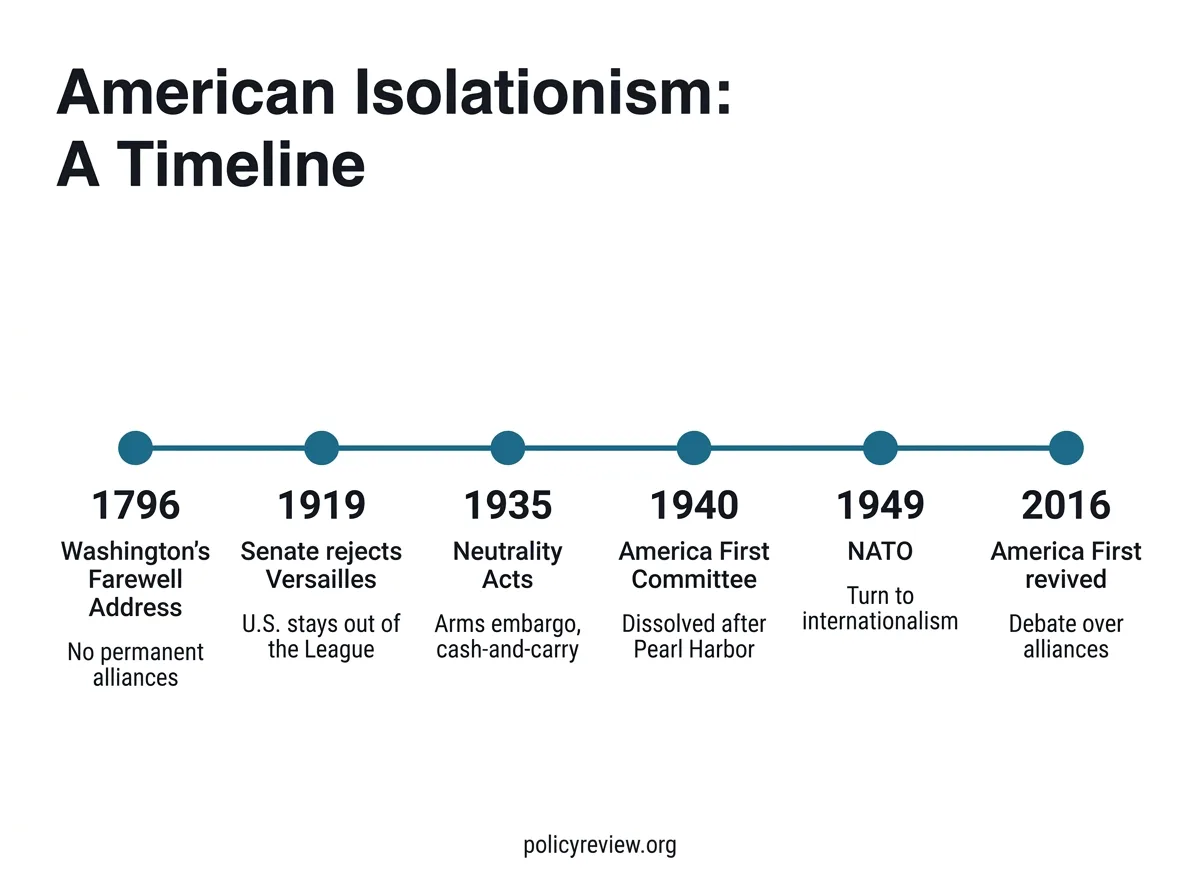
The timeline at a glance
| Period | Key event | What the isolationist side asked for |
|---|---|---|
| 1796 | Farewell Address | Trade with all, permanent pacts with none |
| 1823 | Monroe Doctrine | Separate spheres for the Old World and the New |
| 1919 to 1920 | Senate rejects the Treaty of Versailles | No duty to defend League members by force |
| 1935 to 1939 | Neutrality Acts | Arms embargoes and cash-and-carry rules for all belligerents |
| 1940 to 1941 | America First Committee | Aid short of war at most, no troops abroad |
| 1945 to 1991 | UN, NATO, Cold War | Isolationism becomes a minority view and a slur |
| 2016 onward | America First revived | Debate over alliances, trade deals and overseas wars |
Arguments for and against, in each side’s best terms
Supporters of a restrained policy make several points. Two oceans and friendly neighbors give the United States rare geographic security. Wars abroad were costly in lives and money, and they tend to expand presidential power at the expense of Congress. Military pacts can drag a country into conflicts that are not its own.
Critics answer from the record of the 1930s. Staying out did not keep war away, it only delayed American involvement while aggressors grew stronger. They argue that alliances deter wars rather than cause them, that an open global economy depends on someone keeping sea lanes safe, and that rivals would fill any vacuum left behind.
A third group of scholars takes a different angle. Bear Braumoeller and Charles Kupchan (author of a 2020 history of the idea from Oxford University Press) note that the United States was never fully cut off. It expanded across the continent, fought Spain in 1898 and traded worldwide. In their reading, the doctrine was selective: a rule about Europe and military pacts rather than a withdrawal from the world.
Common questions about isolationism
What is an example of isolationism?
The Neutrality Acts of 1935 to 1939 are the textbook American case; Japan under the Tokugawa shogunate is the classic case elsewhere.
Why did the United States adopt isolationism?
Disillusion with the First World War, the Depression and a belief that American security did not depend on events overseas.
When did the United States stop being isolationist?
Most historians date the turn to December 1941; the United Nations and NATO made it permanent.
Is isolationism the same as non-interventionism?
No. Non-interventionism rejects military intervention abroad but still accepts treaties and trade agreements. Strict isolationism also rejects binding political commitments.
Sources
- George Washington, Farewell Address (1796)
- Thomas Jefferson, First Inaugural Address (1801)
- Charles A. Kupchan, Isolationism: A History of America's Efforts to Shield Itself from the World (Oxford University Press, 2020)
- Bear F. Braumoeller, "The Myth of American Isolationism", Foreign Policy Analysis 6:4 (2010)
- Wayne S. Cole, America First: The Battle Against Intervention, 1940-1941 (University of Wisconsin Press, 1953)
- Office of the Historian, U.S. Department of State: American Isolationism in the 1930s
- Office of the Historian, U.S. Department of State: The Neutrality Acts, 1930s