Economy & Society
Markets, welfare, trade and the populations they serve.
5 concepts explained · 3 essay guides
Left: closer to domestic politics. Up: closer to theory. Placement is orientation, not judgement.
Placement: Policy Review editors, reviewed October 2026.
Concepts in this field
- Free Trade: How It Works and How It Compares Free trade is a trade policy under which governments do not restrict imports or exports with tariffs, quotas, subsidies or other barriers. Its main…
- Globalization: Seven Dimensions of a Connected World Globalization is the process by which economies, societies and governments around the world become more connected through flows of trade, money, people and ideas.…
- Keynesian Economics: Demand, Stimulus and the State Keynesian economics is the theory, developed by John Maynard Keynes in his 1936 General Theory, that total spending (aggregate demand) drives output and employment…
- Supply Side Economics: Five Myths and the Facts Supply-side economics is the theory that an economy grows mainly by expanding its capacity to produce, so policy should raise the rewards for working,…
- The Welfare State: Seven Things Worth Knowing A welfare state is a form of government in which the state takes public responsibility for the basic economic and social security of its…
Essay guides in this field
- Eminem Is Right: Mary Eberstadt’s Essay on Music and Broken Homes Mary Eberstadt argued in 2004 that much of the most popular rock and rap around 2000 was about divorce, absent fathers and inattentive parents,…
- The Mismeasure of Poverty: How Nicholas Eberstadt Tested the Official Poverty Measure In a 2006 Policy Review essay, Nicholas Eberstadt argued that the official U.S. poverty rate no longer measures the fixed level of hardship it…
- Demographics and the Culture War: Stanley Kurtz on Fertility and Politics In 2005 Stanley Kurtz argued that falling birth rates would strain the welfare state and force cultural change. He saw two possible paths: a…
Economic policy is what a government does to influence how much an economy produces, how many people have work, what prices do and who ends up with the gains. It is also one of the most argued-over areas of public life, and plenty of what people believe about it does not survive a closer look. This field of the site covers those choices, the ideas behind them and the other direction of travel: how economic arrangements shape families, welfare, poverty and trust.
The explainers and essay guides listed above each take one piece of that picture. The seven myths below are a quick way to see how the pieces fit.
Myth 1: “The government runs the economy”
Fact: In a market economy most decisions about prices, wages, investment and what to produce are taken by millions of households and firms. Government policy influences the conditions around those decisions: taxes, borrowing costs, rules and public spending.
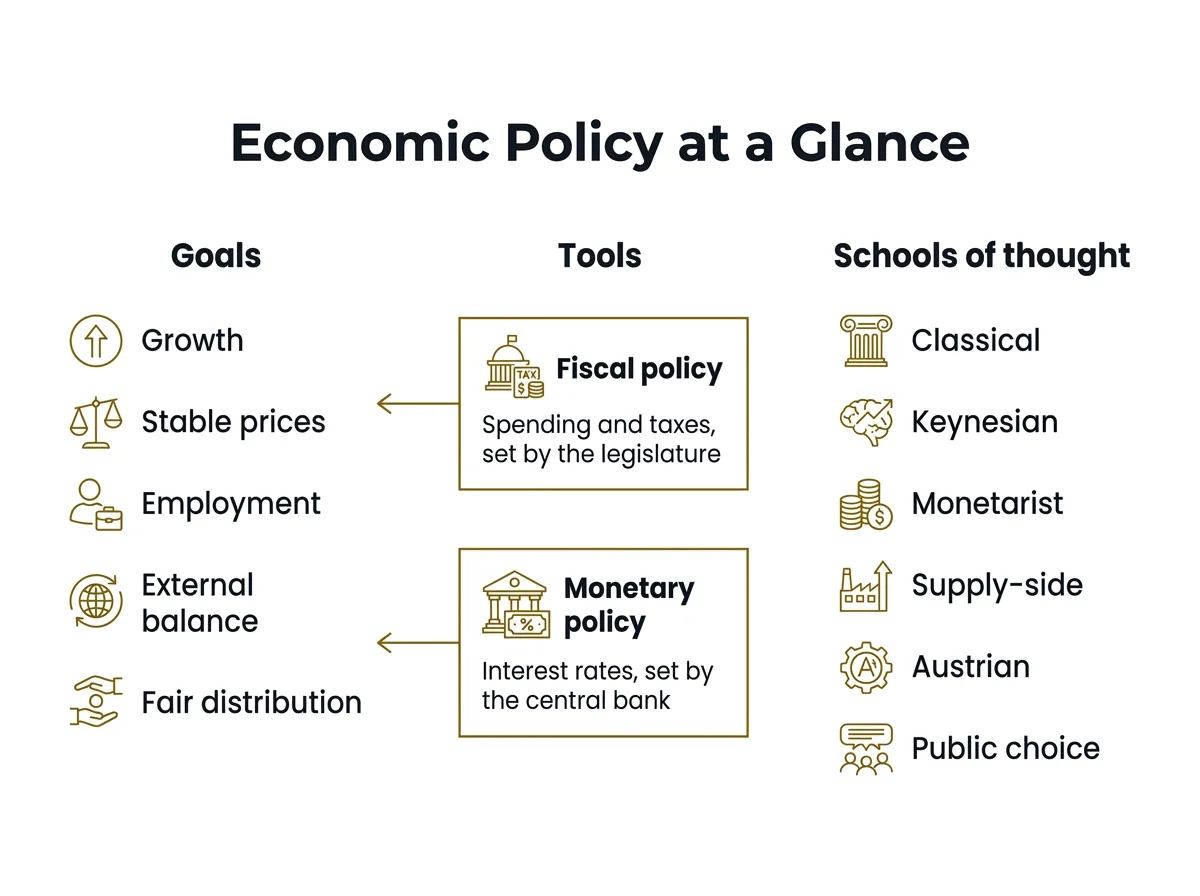
Economic policy usually aims at a short list of goals:
- Economic growth: a rising output of goods and services over time.
- Stable prices: low and predictable inflation.
- High employment: as many people working as the economy can sustain, with low unemployment.
- External balance: a manageable relationship between trade, the currency and foreign debt.
- Distribution: a share of income and wealth that the public accepts as fair.
The goals pull against each other. Pushing unemployment down quickly can raise inflation, and taxing high incomes to fund transfers may narrow inequality while, critics argue, slowing investment. Much of the real argument is about which goal comes first.
Myth 2: “Fiscal and monetary policy are the same thing”
Fact: They are the two main macroeconomic policy tools, and they work through different hands.
| Fiscal policy | Monetary policy | |
|---|---|---|
| Who decides | Legislature and government | Central bank |
| Main tools | Government spending and tax policy | The policy rate and open market operations |
| How quickly it can change | Slowly: budgets must pass as law | Quickly: a monetary policy committee can change course at any meeting |
| Expansionary version | More spending, lower taxes | Lower interest rates, easier credit |
| Contractionary version | Less spending, higher taxes | Tighter credit and less money |
In the United States, the Constitution gives Congress the power to tax, borrow and spend, so fiscal policy runs through the federal budget. The Congressional Budget Office, created in 1974, estimates what bills will cost. Expansionary fiscal policy is meant to lift aggregate demand in a downturn, while contractionary fiscal policy cools an overheating economy or reduces a deficit.
Myth 3: “The president sets interest rates”
Fact: In the United States, interest rates are set by the Federal Reserve, the central bank created in 1913. Its Federal Open Market Committee decides the policy rate and carries out open market operations, buying or selling government securities to change the money supply.
Congress has assigned the Federal Reserve two goals, maximum employment and stable prices, which the Fed itself calls its dual mandate. Presidents can nominate members of the Board, and they often comment on Fed decisions, but the decisions belong to the committee. Most rich democracies give their central bank a similar degree of independence, on the theory that monetary policy works better when it is shielded from the election calendar.

Since the financial crisis of 2008, central banks have also used large-scale asset purchases, often called quantitative easing. Whether it should follow a fixed rule or use its own judgment is one of the oldest debates in monetary economics.
Myth 4: “Economists all agree on what works”
Fact: They agree on a lot of the mechanics and disagree on a basic question: how well markets correct themselves, and how much policy can help. Each school below deserves to be heard in its own best terms.
| School | Core claim | Preferred policy |
|---|---|---|
| Classical and neoclassical | Markets tend to clear when prices are free to adjust | Sound money, light regulation, open borders for goods |
| Keynesian | Demand can fall short and leave workers idle for years | Fiscal stimulus and active monetary policy in a slump |
| Monetarist | Inflation is driven by growth in the money supply | A steady, rule-based growth path |
| Supply-side | The tax code shapes the incentive to work, save and invest | Lower marginal tax rates, fewer barriers to production |
| Austrian | Prices carry knowledge no planner can gather | Minimal intervention, caution about credit booms |
| Public choice | Officials and politicians pursue their own interests too | Constitutional limits on budgets and deficits |
These are not sealed camps, and many economists borrow from several. The classic starting points are Keynes’s *The General Theory* (1936), Friedrich Hayek’s *The Road to Serfdom* (1944) and Milton Friedman’s work on monetary history.
Myth 5: “Government spending either always works or never works”
Fact: The answer depends on conditions, which is why the argument never ends. Keynesian economics, which has its own explainer on this site, grew out of the Great Depression and holds that public spending can have a multiplier effect when private demand collapses. Its critics point to crowding out, where government borrowing pushes up borrowing costs and displaces private investment, and to the risk that temporary programs become permanent.
The 1970s added a further lesson. High inflation alongside high unemployment, often called stagflation, was hard to explain with the simple macroeconomic models of the time and gave monetarist and supply-side economists a hearing. The 2008 crash then revived interest in active fiscal policy. Each episode in the business cycle has strengthened one side for a while.
Myth 6: “Trade is a contest that one country wins”
Fact: The classic case for trade, going back to Adam Smith and David Ricardo, is that both sides can gain when each specializes in what it does comparatively well. That does not mean everyone gains equally. Workers in industries exposed to imports can lose jobs, and the case for protection stresses those workers, strategic industries and national security.
Trade policy covers tariffs, quotas, trade agreements, currency arrangements and rules on foreign investment. Some history helps here:
- The Bretton Woods conference of 1944 pegged currencies to the dollar and created the International Monetary Fund.
- That fixed exchange rate system broke down in the early 1970s.
- The World Trade Organization, which sets international trade rules, replaced the older GATT framework in 1995.
The site’s explainer on globalization looks at how trade, finance, migration and technology tie economies together, and why that has divided both left and right.
Myth 7: “Economic policy is only about numbers”
Fact: Behind every figure on growth or inflation sits a question about society. How a country measures poverty changes how large the problem looks and which programs seem to work. The Social Security Act of 1935 built much of the American welfare state, and arguments over its scope, cost and effect on work have run ever since. Family life, work and the institutions of civil society all respond to these decisions, and they shape it in turn.
That is why this field is called economy and society. The essay guides on this site return to some of those social questions, drawing on the original Policy Review archive.
How the field connects to the rest of the site
Economic questions run through every other field:
- Foreign policy uses sanctions, aid and commercial agreements as instruments.
- Security depends on a defense budget the economy has to carry.
- Law decides what a legislature may tax or regulate under the commerce power.
- Ideas trace how capitalism, socialism and communism answer who should own and decide.
- Policy analysis supplies methods such as cost-benefit analysis to test whether a program delivers.
Whenever someone asks what a policy costs, who pays and who gains, they are asking an economic policy question. The explainers above, from Keynesian economics to globalization, are a good place to start.