Definition
A democracy is a system in which political authority comes from the people, who rule directly or through elected representatives. A republic is a state with no hereditary monarch, where power belongs to the public and is exercised by officials under law. Most modern republics, including the United States, are also democracies.

A democracy is a system in which political authority comes from the people, who rule either directly or through representatives they elect. A republic is a state with no hereditary monarch, where power belongs to the public and is exercised by officials under law. So the republic vs democracy question compares two different things: one word describes who holds power, the other describes what kind of state holds it.
The two often overlap, but there are countries that are one without being the other, and much of the confusion between democracy and republic goes back to a single essay from 1787.
Two words with ancient roots
Democracy is Greek. *Demos* means the people and *kratos* means power or rule. In Athens after the reforms of Cleisthenes around 508 BCE, adult male citizens met in an assembly, voted on laws and on war, and filled many offices by lot. Women, enslaved people and foreigners were excluded, but those who did take part governed in person.
The word republic is Latin. *Res publica* means “the public thing” or “the public affair.” The Roman Republic, traditionally dated from 509 BCE to the rise of Augustus in 27 BCE, replaced its kings with elected magistrates: two consuls with one-year terms, a Senate of former officials and popular assemblies. Power was divided and checked, though wealthy families carried far more weight than ordinary voters.
What Madison meant in Federalist No. 10
In Federalist No. 10, published in New York newspapers in November 1787 to support ratification of the Constitution, James Madison set a “pure democracy” against a republic. By pure democracy he meant “a society consisting of a small number of citizens, who assemble and administer the government in person.”
His worry was faction: a group, the majority or a minority, united by a passion or interest hostile to the rights of others or to the public good. A pure democracy offers no cure for the causes of faction, he argued, because a passionate majority can outvote everyone else.
The Library of Congress text of Federalist No. 10 gives his two “great points of difference” between a democracy and a republic:
- Delegation: the people hand government to a small number of citizens elected by the rest, which he hoped would “refine and enlarge the public views.”
- Scale: a representative system can extend over far more people and a larger territory, so it takes in more parties and interests and makes it harder for one majority faction to form.
In Federalist No. 39 he widened the definition to any government that derives its powers from the great body of the people and is run by officials serving for a limited period or during good behavior. That is close to what political scientists now call representative democracy.
Republic vs democracy: the key differences side by side
The table compares democracy and republic in their classical meanings, as Madison used them; modern usage blurs most of these lines.
| Democracy (classical sense) | Republic (classical sense) | |
|---|---|---|
| Word origin | Greek *demos* + *kratos*, rule of the people | Latin *res publica*, the public affair |
| Model case | Athens, 5th century BCE | Rome, 509 to 27 BCE |
| Who decides | Citizens make laws themselves | Elected representatives decide |
| Head of state | Not defined by the term | Never a hereditary monarch |
| Main safeguard | Participation of all eligible citizens | The rule of law, divided power, a constitution |
| Main risk named by critics | The majority overriding individual rights | Elites drifting away from their voters |
| Typical size | Small city with one assembly | Large territory with many voters |
The columns are not opposites, since a state can combine elected representatives with broad voting rights, and most democracies and republics do. Only the “head of state” row is strict in the modern dictionary: the term republic always excludes a king or queen.

Democracies and republics in the real world
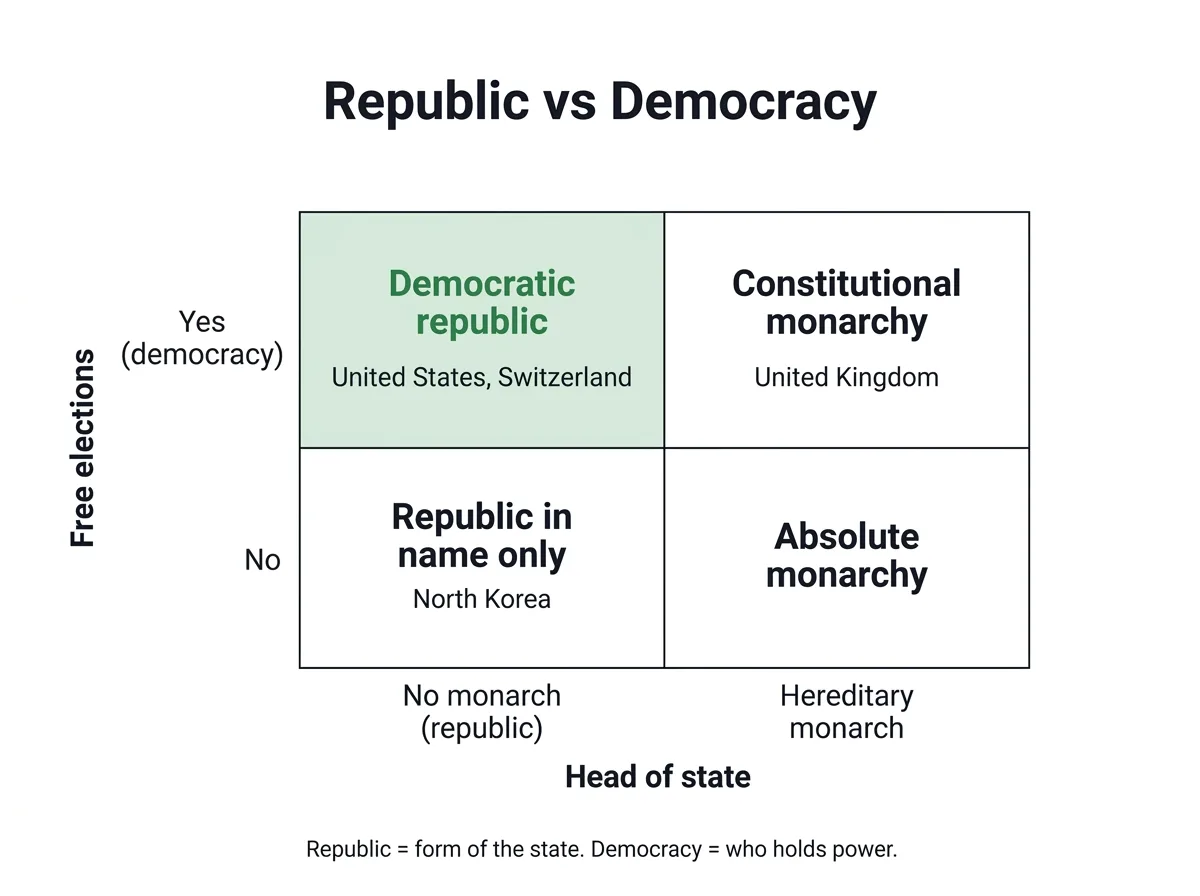
Neither word guarantees the other, as four cases show:
- United States: a federal constitutional republic whose officials are chosen in elections open to adult citizens, so it is both forms of government at once.
- United Kingdom: a democracy with a hereditary monarch as head of state, so not a republic, though its Parliament is elected.
- Switzerland: a federal republic whose government also uses direct democracy heavily. Voters can force national referendums on their laws.
- North Korea: officially the Democratic People’s Republic of Korea, but with no competitive elections it is not a democracy in any meaningful sense.
About half of the American states also let voters place measures on the ballot by petition. California’s Proposition 13 in 1978, which capped property taxes, is a well-known example of voters making policy directly.
Is the United States a republic or a democracy?
Both, and the Constitution itself uses the first word. Article IV, Section 4 commits the national government to “guarantee to every State in this Union a Republican Form of Government.” The story that Benjamin Franklin, asked what the Convention had produced, answered “A republic, if you can keep it” comes from the notes of a fellow delegate, James McHenry.
The democratic side grew over time. The original Constitution left voting rules largely to state governments, and the electorate was narrow. Later amendments widened it:
- the Fifteenth Amendment (1870) barred denying the vote on account of race;
- the Seventeenth (1913) had senators elected directly by voters instead of state legislatures;
- the Nineteenth (1920) barred denying the vote on account of sex;
- the Twenty-sixth (1971) set the voting age at 18.
The Voting Rights Act of 1965 enforced those guarantees in practice. The older features remain: the Electoral College, equal Senate representation for each state, a Bill of Rights that majorities cannot vote away and the Supreme Court, which can strike down laws. Most scholars call the result a constitutional or democratic republic, or simply a representative democracy.
Three ways to read the debate
People who say “we are a republic, not a democracy” usually mean the constitutionalist reading: the distinction protects freedom. The framers built filters between popular majorities and law: representation, the Senate, the courts and a demanding amendment process. The older word reminds citizens that some rights are not up for a vote, and that winning an election does not give a majority the power to override the Constitution.
A democratic reading treats the distinction as mostly historical. Madison’s term describes what we now call representative democracy, so setting the two words against each other misleads. Its advocates note that constitutional change since then has moved toward more equal participation, which they see as fulfilling the founding design.
A third, civic republican tradition, revived by the historian Gordon Wood in *The Creation of the American Republic, 1776 to 1787* (1969) and by the philosopher Philip Pettit in *Republicanism* (1997), holds that people are free when no one holds arbitrary power over them, which takes civic virtue and active participation. A good republic then needs democratic engagement, and a good democracy needs constitutional restraints.
Common questions
What is the difference between democracy and a republic?
In the classical sense, a democracy lets citizens make laws directly, while a republic delegates lawmaking to elected representatives under a constitution. In modern usage, a republic is any form of government without a monarch, and a democracy is any state whose leaders are chosen in free and fair elections.
Can a country be both a republic and a democracy?
Yes. The United States, France, Germany and India all have no monarch and hold democratic elections. These terms describe different features, and most modern republics have democratic elections, though not all of them do.
Is a republic better than a democracy?
That depends on what you value the most. Supporters of strong constitutional limits stress the protection of minority and individual rights. Supporters of broader participation stress political equality and accountability to voters. Most working democracies try to secure both.
Sources
- James Madison, The Federalist No. 10 (1787)
- James Madison, The Federalist No. 39 (1788)
- U.S. Constitution, Article IV, Section 4 (Guarantee Clause)
- Gordon S. Wood, The Creation of the American Republic, 1776-1787 (1969)
- Philip Pettit, Republicanism: A Theory of Freedom and Government (Oxford University Press, 1997)
- Library of Congress: Federalist Nos. 1-10