Definition
Neoconservatism is an American political current that combines skepticism about ambitious social programs with a confident, often interventionist foreign policy aimed at defending and spreading liberal democracy. It began in the 1960s and 1970s among left-leaning New York intellectuals who moved to the right, with Irving Kristol as its central figure.

Neoconservatism is an American political current that combines skepticism about ambitious social programs with a confident, often interventionist foreign policy aimed at defending and spreading liberal democracy. It began in the 1960s and 1970s among left-leaning intellectuals in New York who moved to the right, and it later became best known for its influence on the George W. Bush administration.
One essay from 1979 shows how that move played out in practice.
November 1979: an essay that found a president
In November 1979 *Commentary* magazine published “Dictatorships and Double Standards” by Jeane Kirkpatrick, a political scientist at Georgetown University and a member of the Democratic Party. Her target was the foreign policy of President Jimmy Carter, a Democrat like her.
Kirkpatrick argued that Washington had helped undermine friendly autocrats in Iran and Nicaragua, only to see them replaced by regimes more hostile to the United States and no freer at home. Traditional authoritarian governments, she wrote, could evolve toward democracy over time. Revolutionary communist states rarely did.
Ronald Reagan read the essay. After his election he named Kirkpatrick ambassador to the United Nations, where she served in the Reagan administration until 1985, the year she joined the Republican Party. A Democrat writing in a small New York journal of ideas ended up shaping how a Republican White House saw the world, which is roughly the arc of the whole movement.
Where the neocons came from
The roots lie in a circle known as the New York intellectuals, several of whom had been young socialists or Trotskyists at City College of New York in the late 1930s. Irving Kristol is the central figure. In 1965 he and the sociologist Daniel Bell founded *The Public Interest*, a quarterly that examined whether the programs of the Great Society were actually working.
Its contributors did not reject the welfare state outright. They warned about unintended consequences, and they trusted social science data more than good intentions. Daniel Patrick Moynihan, Nathan Glazer and James Q. Wilson wrote in this spirit. Norman Podhoretz, editor of *Commentary* from 1960 to 1995, brought a sharper cultural edge and a hostility to the New Left.
The term itself began as an insult. The socialist writer Michael Harrington used “neoconservative” in a 1973 *Dissent* article, “The Welfare State and Its Neoconservative Critics.” Kristol adopted it anyway and is often called the godfather of the movement. His famous definition: a neoconservative is “a liberal who has been mugged by reality.”
The second wave was political. After George McGovern won the Democratic nomination in 1972, anti-communist Democrats formed the Coalition for a Democratic Majority and rallied around Senator Henry “Scoop” Jackson of Washington. These neoconservatives were loyal to civil rights and the New Deal at home but wanted a firm line against the Soviet Union. Many of them moved to Reagan in 1980.
What neoconservatives believe
Neoconservatives have never agreed on a party platform, and Kristol himself called it a “persuasion” in a 2003 essay for *The Weekly Standard*. Still, a few commitments recur across the decades.
At home
- Respect for the market economy, captured in the title of Kristol’s 1978 book *Two Cheers for Capitalism*, with two cheers instead of three.
- Acceptance of a basic welfare state, combined with doubt about large new programs.
- Concern for law and order, family and the moral culture that a free society depends on.
- Less hostility to government as such than libertarians or traditional conservatives have.
Abroad
- The United States should be strong militarily and willing to use that strength.
- Democracy is worth defending, and its spread serves American security.
- The character of a regime matters: dictatorships tend to behave aggressively.
- International bodies such as the United Nations are useful but no substitute for American leadership.
The historian Justin Vaïsse, in *Neoconservatism: The Biography of a Movement* (Harvard University Press, 2010), describes three “ages” that put these ideas in sequence.
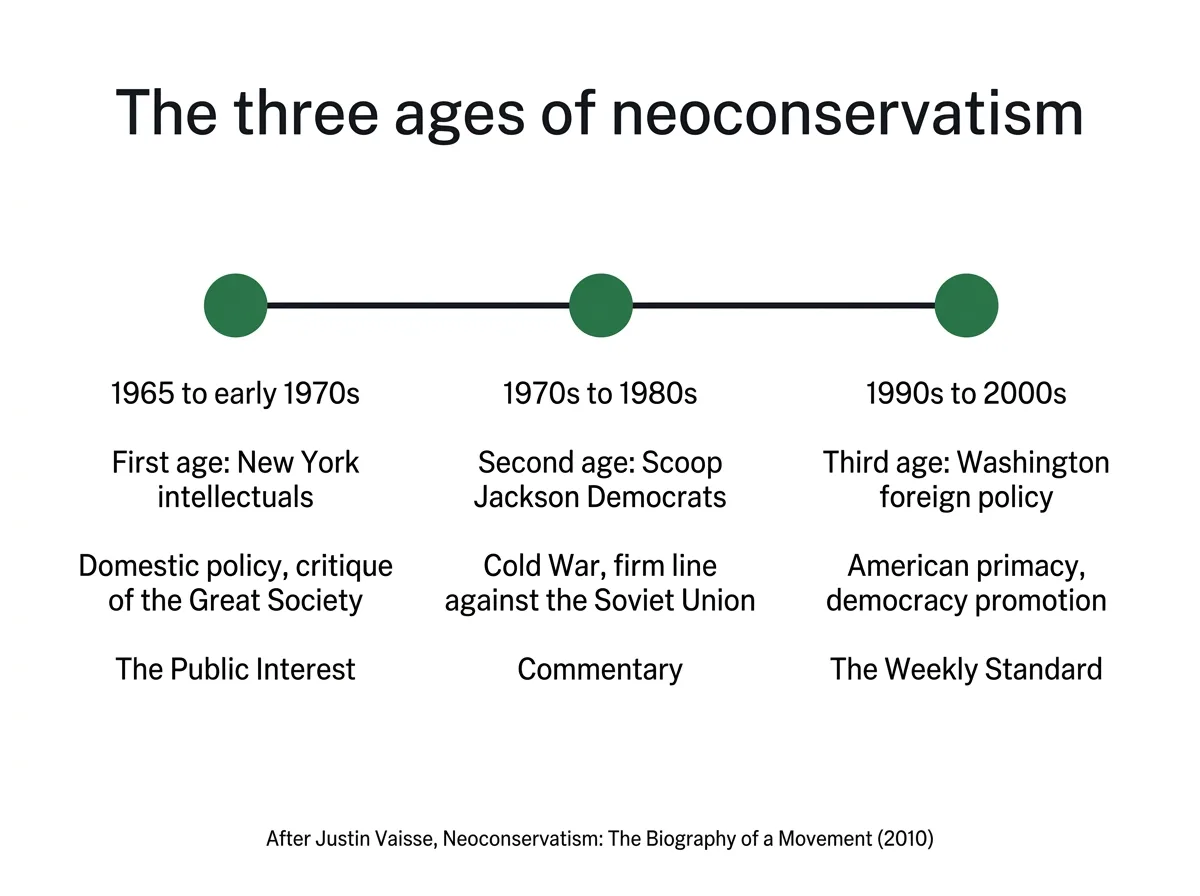
| Age | Period | Main focus | Typical figures |
|---|---|---|---|
| First | 1965 to early 1970s | Domestic policy, critique of the Great Society | Irving Kristol, Daniel Bell, Nathan Glazer |
| Second | 1970s to 1980s | Cold War, Scoop Jackson Democrats | Jeane Kirkpatrick, Norman Podhoretz, Richard Perle |
| Third | 1990s to 2000s | American primacy, democracy promotion | William Kristol, Robert Kagan, Paul Wolfowitz |
From Reagan to Baghdad: neoconservative foreign policy
After the Cold War ended, a younger generation argued that the United States should not retreat. In a 1996 *Foreign Affairs* essay, “Toward a Neo-Reaganite Foreign Policy,” William Kristol (Irving’s son) and Robert Kagan called for “benevolent global hegemony.” The younger Kristol had founded *The Weekly Standard* in 1995, and in 1997 the two launched the Project for the New American Century. A 1998 letter from that group urged President Bill Clinton to make the removal of Saddam Hussein the aim of American foreign policy toward Iraq. Think tanks such as the American Enterprise Institute gave many of these writers a home in Washington.
The September 11 attacks gave their ideas a wider audience. Paul Wolfowitz, deputy secretary of defense from 2001 to 2005, was among the leading advocates of confronting Saddam. The administration’s 2002 National Security Strategy stated that the United States would, “if necessary, act preemptively” against threats posed by terrorists and hostile states. This position, together with democracy promotion, is often called the Bush doctrine.

The neocons did not run the government. Bush, Dick Cheney and Donald Rumsfeld are usually described as assertive nationalists instead. Even so, the costs of the 2003 invasion damaged the ideas most closely tied to it.
How neoconservatism differs from other conservatives
| Position | Neoconservatives | Traditional conservatives | Libertarians | Realists |
|---|---|---|---|---|
| Role of government at home | Limited but accepted | Limited, rooted in tradition | Minimal | Not central |
| Foreign policy | Assertive, democracy promotion | Cautious | Non-interventionist | Interests and balance of power |
| View of other regimes | Character matters | Prudence first | Leave them alone | Behavior matters, not ideology |
| Political origin | Former liberals and leftists | Long-standing right | Classical liberal | Cross-party |
Paleoconservatives such as Pat Buchanan reject the emphasis on global commitments. Realists in the tradition of Hans Morgenthau and Henry Kissinger see democracy promotion as a risky substitute for the national interest.
The case against, and the reply
Critics make several serious arguments:
- Realists say the neocons overestimate what military force can achieve and underestimate nationalism and local politics, as the occupation of Iraq showed.
- Libertarians and the left argue that permanent global commitments expand executive authority and cost lives and money at home.
- Some former allies changed their minds. Francis Fukuyama broke with the movement in *America at the Crossroads* (2006).
Defenders reply that American leadership kept the peace among great powers after 1945, that regime type really does shape behavior, and that retreat creates vacuums rivals will fill.
A further dispute concerns the philosopher Leo Strauss of the University of Chicago, whom some critics treat as the movement’s hidden teacher. That link is contested, and many of the original figures had no connection to him.
Common questions about neoconservatism
What is neoconservatism in simple terms?
A form of conservatism that started with former liberals: wary of big social programs at home, confident about using American strength abroad to protect and spread democracy.
Is neoconservatism left or right?
It sits on the right today, but it began on the left, and its first members were Democrats.
Who is the father of neoconservatism?
Irving Kristol, who embraced the label and told its history in *Neoconservatism: The Autobiography of an Idea* (1995).
What does “mugged by reality” mean?
It is Kristol’s phrase for people on the left who changed their views after seeing policies fail in practice, especially on crime and welfare.
Do neoconservatives still have influence?
Fewer people use the label after Iraq, and prominent neocons such as William Kristol and Robert Kagan opposed Donald Trump. Many of its writers and some of its journals, such as *Commentary*, are still active, but they no longer form a clear camp inside the Republican Party.
Sources
- Jeane Kirkpatrick, "Dictatorships and Double Standards", Commentary (November 1979)
- Michael Harrington, "The Welfare State and Its Neoconservative Critics", Dissent (Fall 1973)
- Irving Kristol, Neoconservatism: The Autobiography of an Idea (Free Press, 1995)
- Irving Kristol, "The Neoconservative Persuasion", The Weekly Standard (August 2003)
- William Kristol and Robert Kagan, "Toward a Neo-Reaganite Foreign Policy", Foreign Affairs (July/August 1996)
- Justin Vaïsse, Neoconservatism: The Biography of a Movement (Harvard University Press, 2010)
- Francis Fukuyama, America at the Crossroads (Yale University Press, 2006)
- The National Security Strategy of the United States of America (2002), Section V