The essay in brief
Robert D. Kaplan argued in 2004 that the global news media had become an unelected, unaccountable power, comparable to the medieval church, that judges elected governments against impossible moral standards. His main example was the April 2004 cease-fire in Fallujah.

Who holds power in a modern democracy? Voters, presidents and parliaments are the textbook answer. In “The Media and Medievalism,” published in *Policy Review* No. 128 (December 2004 and January 2005), Robert D. Kaplan gave a darker one. Real influence, he claimed, had moved to the newsrooms, and journalists now played the part once played by the clergy of the Middle Ages.
Kaplan was then a correspondent for *The Atlantic Monthly* and had recently been embedded with U.S. Marines in Iraq. This guide sets out the problem he saw, the causes he named, the way out he imagined, the replies of critics and how the argument reads today.
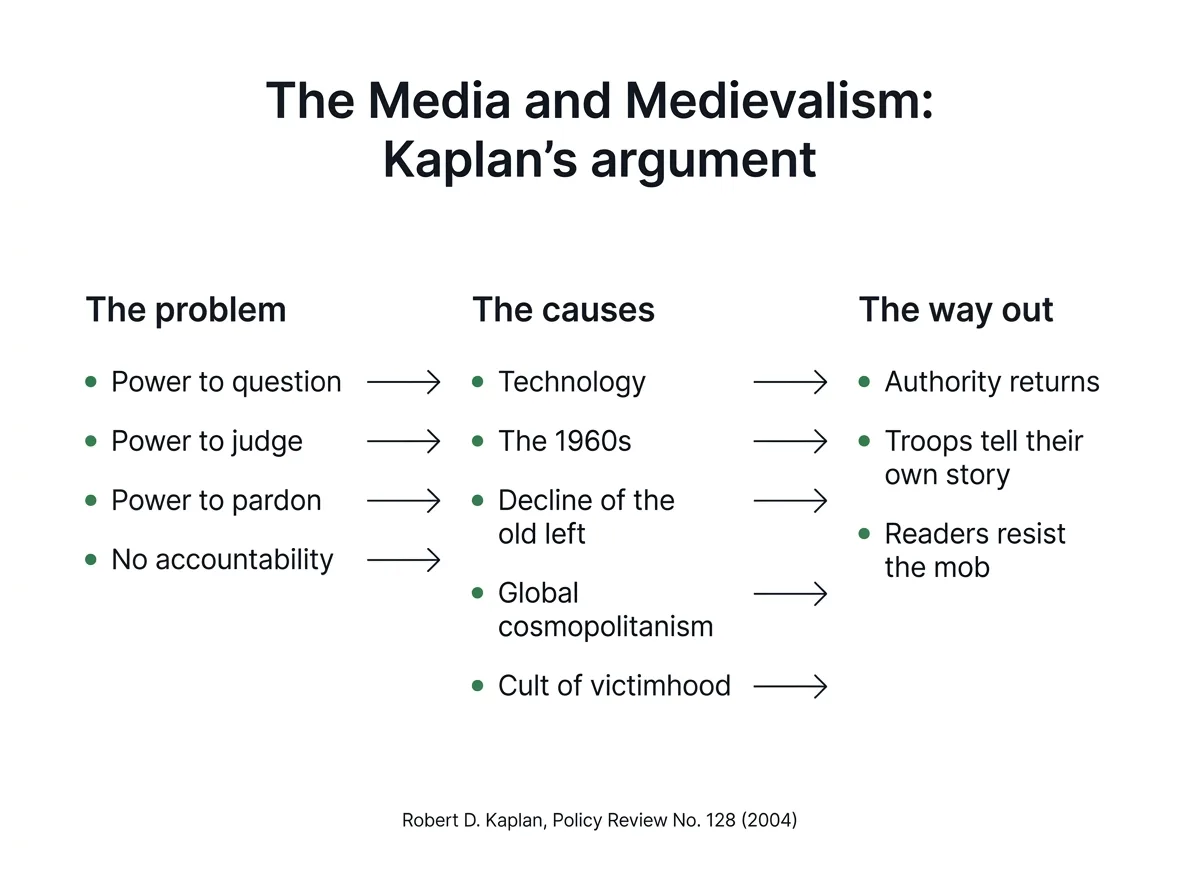
The problem Kaplan saw: power without accountability
The essay opens with Elias Canetti’s book *Crowds and Power* (1960), a study of mass psychology by the writer who went on to win the Nobel Prize in Literature in 1981. Canetti listed six ingredients of oppression: secrecy, physical brutality, swift reaction, the right to question and demand answers, the right to judge and condemn, and the right to pardon.
Kaplan’s twist: by 2004 the old tyrannies built on secrecy and brutality were in retreat, while some of the softer powers on Canetti’s list now belonged to journalists. The summary line is blunt: “Ours is not an age of democracy, or an age of terrorism, but an age of mass media.”
At the center sits a complaint about accountability. A president answers to voters and to history. A columnist, Kaplan wrote, can recommend a policy, watch it fail and move on as new events arrive. Investigative reporters, in this telling, have become inquisitors who can ruin a career with the exposure of a few sordid details.
Why a medieval comparison?
Kaplan put journalists in a line with the priests of ancient Egypt, the rhetoricians of Greece and Rome and the theologians of medieval Europe: an educated class with real influence over rulers but no duty to govern. He saw three medieval traits in modern newsrooms:
- Perfectionism. Medieval authorities demanded spiritual purity; reporters, he argued, demand moral purity from generals and officials, which makes practical decisions harder.
- Sanctity. Television anchors resemble the saints of medieval icons, remote figures watched by a crowd that cannot answer back.
- Universal claims. A global press works much like papal authority in the Middle Ages, a moral voice above any single kingdom that can still weaken the rulers who govern real territory.
This is where the word medievalism in the title comes from.
The causes Kaplan named
Why have journalists gained ground while politicians lost it? The essay gives several reasons.
| Cause | Kaplan’s claim |
|---|---|
| Technology | Satellite printing, cable news and big flat screens magnified a few large outlets. |
| The 1960s | Drawing on Samuel Huntington, Kaplan argued that in the late 1960s exposure turned from a technique into a principle. |
| The decline of the old left | Following Philip Bobbitt, he suggested news organizations took over the left’s role of questioning authority. |
| Global cosmopolitanism | Journalists belong to a mobile, prosperous class with little stake in any one country. |
| A cult of victimhood | Sympathy for the weaker side is treated as a moral verdict rather than a description of relative strength. |
Cosmopolitanism mattered most. CNN International, Kaplan wrote, served a global audience, while Fox News remained a nation-state network. A small editorial change at Fox or at *The New York Times*, he suggested, could even tip a close election in the United States. The demand for “peace and justice” running through much reporting struck him as moralistic rather than moral.
Fallujah as the test case
The main example comes from the author’s own reporting. In April 2004 Kaplan went in with the first U.S. Marines to enter Fallujah during the first battle for the city. After several days of fighting, with fresh forces arriving, a cease-fire was declared.
In Kaplan’s account, the Marines were stopped less by the insurgents than by coverage from the global press, including Al Jazeera, which presented the fighting in the city as indiscriminate. He admitted that American policy was incoherent, ordering an assault and then calling it off. Yet his larger claim remained that urban war in a satellite age carries political costs that no battlefield success can offset.
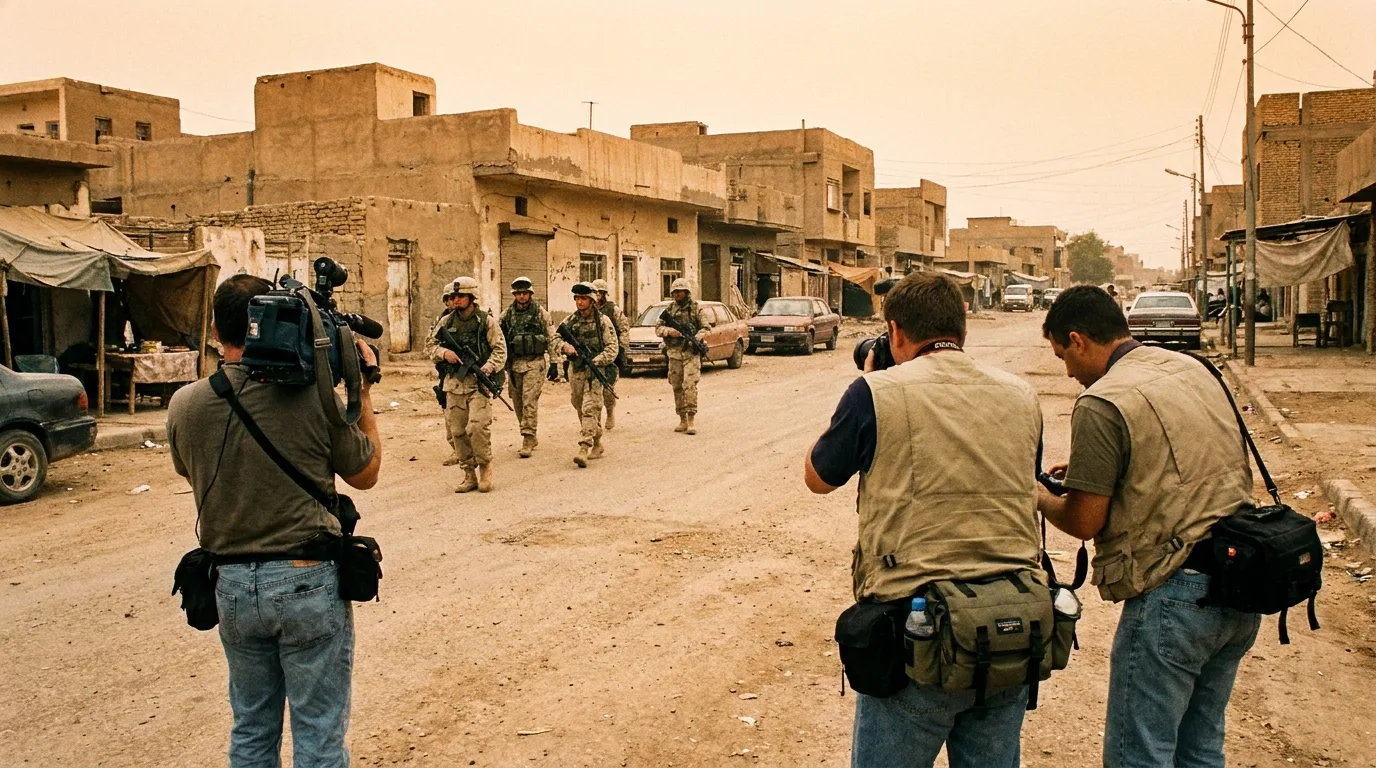
A cultural point follows. During the Second World War, soldiers and war correspondents belonged to the same society and the same crowd. By 2004, Kaplan wrote, reporters stood closer to a transnational professional class than to the working-class troops of the American military.
Kaplan’s way out
Kaplan did not call for censorship, and he said government would be worse off without pundits. The answers he offered drew on history and on practice.
- Authority returns. The Middle Ages came to an end, he recalled, when strong states such as Richelieu’s France replaced arbitrary feudal barons. Elected governments might reassert themselves in a similar way.
- Troops tell their own story. Soldiers and Marines, most with laptops at their bases, would publish accounts online and supply an American perspective that, in his view, reporters had dropped.
- Readers resist the mob. The closing image is an unelected crowd moving from one public shaming to the next. Seeing that crowd clearly, he suggested, is a first step against it.
How critics responded
A reply came fast. On December 8, 2004, Matt Welch of *Reason* called the essay overheated and listed specific objections:
- Kaplan described a centralizing press when audiences were splitting into niche and regional outlets.
- An airport full of television noise is not oppression.
- Washington kept up military action in Iraq despite hostile coverage, which weakens the claim that officials “had no choice” at Fallujah.
- Not every investigative reporter fits the profile of the old left.
Welch still called Kaplan worth reading. The journalist Nir Rosen also objected to Kaplan’s Fallujah reporting and to how closely he identified with the Marines. In 2007 a *Brooklyn Rail* review of the book *Hog Pilots, Blue Water Grunts* argued that Kaplan’s attacks on the press sit uneasily with his stated belief in an independent press.
How has the argument held up?
Readers disagree about which parts look prescient and which look dated.
- Fragmentation. Cable, online publishing and social platforms have since spread attention across many more sources, which critics cite in support of Welch’s objection to the picture of a few giant outlets.
- Soldiers did write. Military blogs became a recognized genre during the Iraq war, roughly as Kaplan expected, though they never replaced professional reporting.
- Accountability is still argued over. Who answers for a bad recommendation, the official or the commentator, has been a live question about press power ever since.
- Ford’s pardon. Kaplan wrote that it took a generation for Gerald Ford’s pardon of Richard Nixon to win respect. In 2001 Ford received the John F. Kennedy Profile in Courage Award for that decision.
Readers on the left and the right draw different lessons. Defenders of a watchdog press see exposure as the way citizens learn what governments do. Admirers of the essay read it as an early warning about moral performance replacing judgment.
Readers’ questions
What is The Media and Medievalism about?
It argues that journalists have become a powerful, unaccountable class, comparable to medieval churchmen, who weaken elected governments by judging them against impossible moral standards.
Did Kaplan want to limit press freedom?
No. He defended punditry in principle and proposed no legal limits. The target is a professional culture.
Why does Fallujah matter in the essay?
It is the firsthand case of coverage shaping a military outcome. Whether coverage or policy drove the April 2004 cease-fire is still debated.
Is the medieval analogy fair?
Kaplan himself admitted that likening the global press to papal universality is an exaggeration, yet insisted that comparison with the past was the best tool available.
Where to read the original
The full text of “The Media and Medievalism” by Robert D. Kaplan, *Policy Review* No. 128, is available from the Hoover Institution’s Policy Review archive. It runs to about 5,000 words, and the opening pages on Canetti are a good place to start.