Definition
Political socialization is the process by which people acquire their political values, attitudes, beliefs and habits of participation. It begins in childhood, continues throughout life, and works through agents such as the family, school, peers, religion and the media.
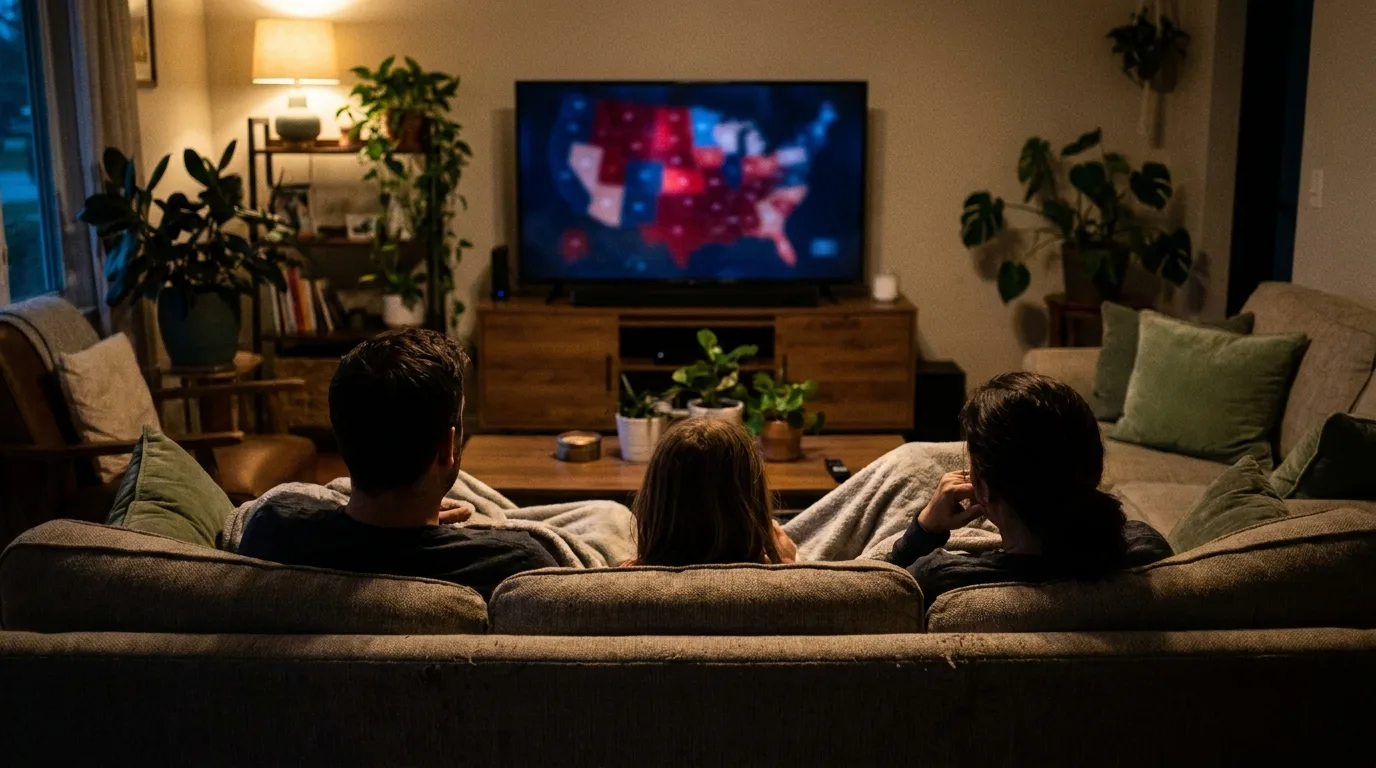
Political socialization is the process by which people acquire their political values and attitudes, beliefs and habits of participation. It begins in childhood, runs through the whole of life, and works through agents such as the family, school, peers, religion and the mass media.
Most Americans can name a party before they can explain what a party does. How a child of seven comes to think of herself as a Democrat or a Republican was the puzzle that started this field of political research in the United States.
The problem: where do political views come from?
Nobody is born with an opinion about tariffs or the Supreme Court. Yet by the time citizens vote for the first time, many already hold a stable party identification, a basic level of trust or distrust in the government, and a sense of whether politics is something people like them take part in.
Political scientists care about this for two reasons:
- Stability: a democracy needs citizens who accept its rules even when their side loses. Gabriel Almond and Sidney Verba, in *The Civic Culture* (1963), argued that the political culture of a democracy is learned, and that it has to be passed from one generation to the next.
- Change: if each generation learns its political lessons under different conditions, public opinion can shift over time even when no individual changes their mind.
The concept links the individual to the political system, which is why it sits between psychology and political science.
Origins of the concept
Interest in civic learning is old. In the early twentieth century, American educators surveyed pupils about the national figures they admired most, and Charles Merriam’s *The Making of Citizens* (1931) compared civic training in several countries. The sociologist Karl Mannheim had argued in 1928 that people who come of age at the same historical moment form a “generation” with shared outlooks.
The term itself entered political science with Herbert Hyman’s book *Political Socialization* (1959). A wave of studies followed in the 1960s:
- Fred Greenstein, *Children and Politics* (1965): questionnaires given to pupils in New Haven found that young children saw the president as a benevolent, protective figure.
- Robert Hess and Judith Torney, *The Development of Political Attitudes in Children* (1967): a large survey of elementary pupils that stressed the role of the classroom.
- David Easton and Jack Dennis, *Children in the Political System* (1969): a study of how support for the political system itself forms early.
- M. Kent Jennings and Richard Niemi, *The Political Character of Adolescence* (Princeton University Press, 1974): the first analysis of a national panel of high school seniors and their parents.
The main agents and what they teach
Researchers call the sources of political learning “agents.” The family is usually treated as the primary agent. The others are secondary: they reinforce, challenge or replace the attitudes and beliefs children bring from home.
| Agent | What it passes on | Typical example |
|---|---|---|
| Family | Party identification, trust in government, political interest | Children who hear their parents discuss the news at dinner |
| School | National symbols, knowledge of institutions, norms of participation | Reciting the Pledge of Allegiance; a civics class |
| Peers | Social pressure, new issues, the sense that politics matters | Friends who volunteer for a campaign or join a protest |
| Religion | Moral frameworks, community ties, views on social issues | A congregation that organizes voter registration |
| Media | Agenda, information, images of leaders and parties | Television news, podcasts, social media feeds |
| Events | Shared formative experiences | A war, a recession, a pandemic, a disputed election |
Family
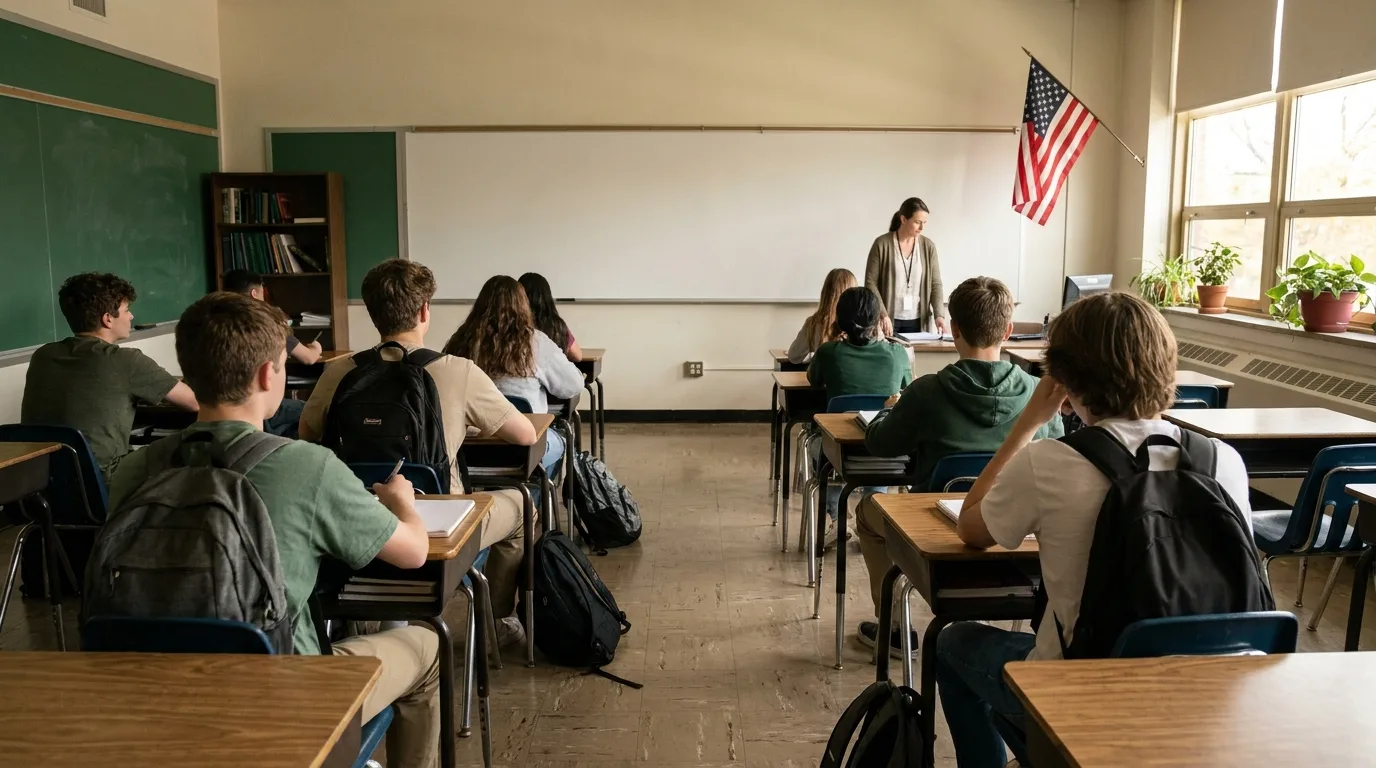
The Jennings and Niemi panel interviewed a national sample of 1965 seniors and their parents, then the same people again in 1973, 1982 and 1997. Party identification passed from parent to child fairly well. Opinions on specific political issues passed far less reliably. Transmission was strongest when both parents agreed and when politics came up often at home.
Classroom and peers
Teachers pass on the symbols of the nation and the basics of government. Their effect on political attitudes is harder to show. In a 1968 article in the *American Political Science Review*, Kenneth Langton and Jennings found that civics courses had little measurable effect on most students, with larger effects among Black students. Peers matter more as children grow older, and online networks now let peer influence reach far beyond the local community.
Media and events
The mass media shape which issues seem important and how leaders appear. Major events can socialize a whole cohort at once: Americans who came of age during the Great Depression, the Vietnam War or the attacks of September 11, 2001 often carry those experiences into their later political attitudes and voting behavior.
How it works over a lifetime
Political learning does not stop at eighteen, but it is not equally strong at every age, and participation builds with experience. According to the U.S. Census Bureau’s analysis of the 2020 Current Population Survey on voting, 57 percent of citizens aged 18 to 34 reported voting in the 2020 presidential election, compared with 74 percent of those aged 65 and older.
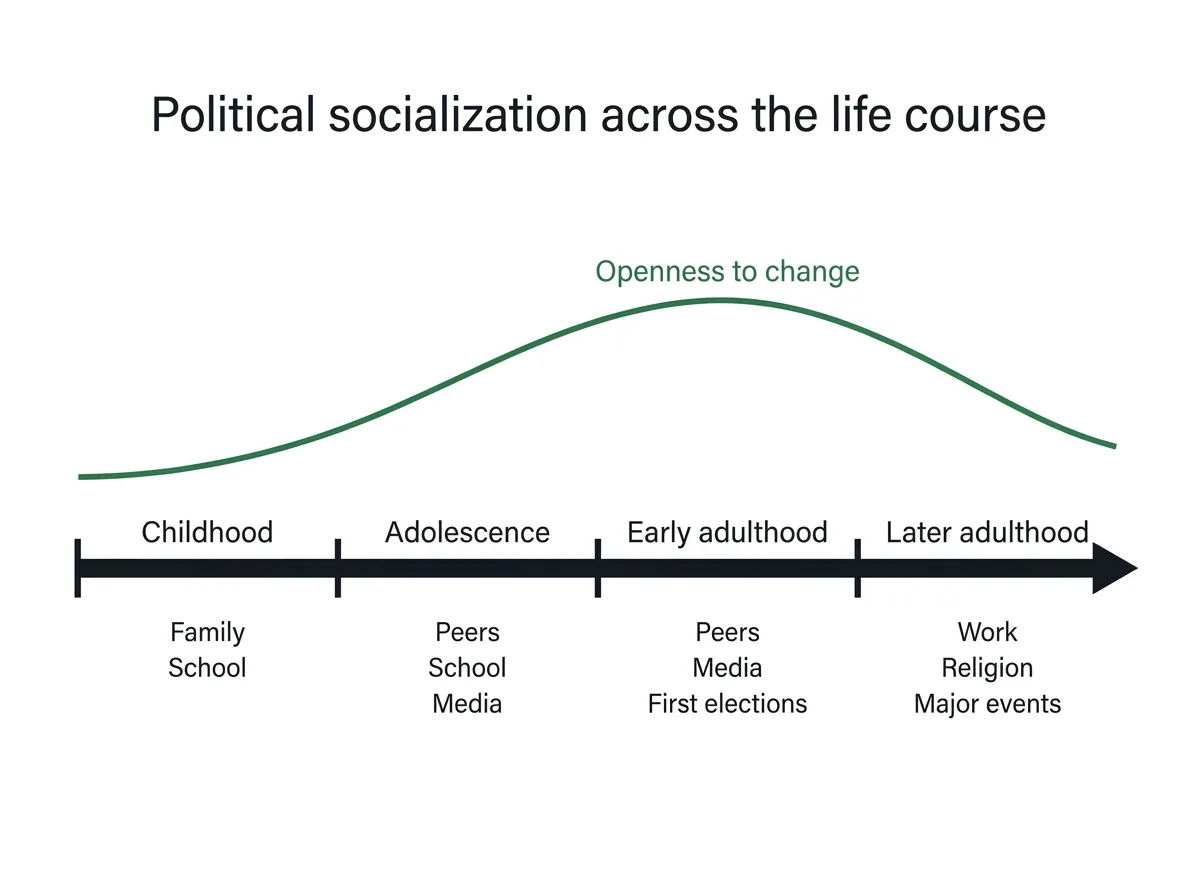
Researchers usually separate three kinds of change:
- Life cycle effects: people change as they age, settle down, pay taxes and vote more often.
- Generational effects: a cohort keeps the imprint of the political conditions in which it grew up.
- Period effects: one event shifts the views of all age groups at once.
Competing views
Few scholars doubt that politics is learned. The arguments are about timing, sources and results.
The primacy view. Early learning lasts. Supporters point to the persistence of party identification and to the “impressionable years” studied by Jon Krosnick and Duane Alwin (1989): attitudes are most open to change in late adolescence and early adulthood and settle afterward. On this view, the family and a citizen’s first elections matter most.
The lifelong openness view. Adults keep learning. A move, a marriage, a new job, a union, a church or a military career can all change political attitudes, and the panel studies also show real change in adulthood, especially on issues.
The biological view. In 2005 John Alford, Carolyn Funk and John Hibbing asked in the *American Political Science Review* whether political orientations are genetically transmitted. Their twin data suggested that part of the similarity between parents and children reflects inherited dispositions. Critics question how twin studies separate genes from environment; supporters reply that similar patterns have appeared in other twin samples.
The critical view. Some scholars see the political socialization of the young as a way of reproducing existing hierarchies, teaching citizens to accept authority rather than question it. Others answer that every stable democracy has to teach shared rules, and that respect for institutions is the precondition of peaceful disagreement.
Two-way influence. Michael McDevitt and Steven Chaffee (2002) described “trickle-up” influence: children who discuss politics in class bring new interest home and draw their parents into the conversation.
Common questions
What is political socialization in simple terms?
It is how a person learns what to think and feel about government, parties and public life, mostly from the people and institutions around them.
What is the most important agent?
Most studies name the family, especially for party identification. For specific issues, peers, the media and events often matter as much or more.
Does it continue in adulthood?
Yes. The strongest learning happens before the mid twenties, but work, marriage, moving and major events keep shaping political views and participation.
How does social media change it?
It widens the range of peers and sources a young person meets, and political content arrives without a parent or teacher filtering it. Researchers still debate whether this mainly deepens partisanship or broadens exposure.
Key points
- Family and political socialization: parents pass on party loyalty better than opinions on issues.
- Schools, peers, religion, media and events act as secondary agents.
- Childhood and early adulthood carry the most weight, but learning is lifelong.
- Scholars disagree on how fixed early learning is and how much biology contributes.
Sources
- Herbert H. Hyman, Political Socialization (Free Press, 1959)
- Gabriel A. Almond and Sidney Verba, The Civic Culture (Princeton University Press, 1963)
- Fred I. Greenstein, Children and Politics (Yale University Press, 1965)
- David Easton and Jack Dennis, Children in the Political System (McGraw-Hill, 1969)
- M. Kent Jennings and Richard G. Niemi, The Political Character of Adolescence (Princeton University Press, 1974)
- Jon A. Krosnick and Duane F. Alwin, "Aging and Susceptibility to Attitude Change", Journal of Personality and Social Psychology 57 (1989)
- John R. Alford, Carolyn L. Funk and John R. Hibbing, "Are Political Orientations Genetically Transmitted?", American Political Science Review 99 (2005)
- U.S. Census Bureau: Record High Turnout in 2020 General Election