Definition
A think tank is an organization that researches public policy and works to get its findings in front of decision makers. Most US think tanks are private nonprofits that operate independently of government, universities and parties, funded by foundations, donors, corporations and contracts.

A think tank is an organization that does research on public policy and tries to get its findings in front of the people who make decisions. Most in the United States are private nonprofits that sit outside the state, universities and political parties, although some are tied to one of these. Around the world the model varies: in many countries the leading institutes are attached to a ministry, a national legislature or a party.
In plain terms, a think tank is a research institute with an audience in mind. A university department writes for other scholars. A think tank writes with a senator’s staff, a cabinet department, a city council or a reporter on deadline in mind, and through them for voters like you.
Where the name “think tank” comes from
In early twentieth century American slang, “think tank” meant the brain. During and after World War II the phrase picked up a new sense: a secure place where military planners and scientists worked through strategy. By the 1950s and 1960s it was the standard label for organizations like the RAND Corporation, which began in 1946 as Project RAND, a research contract for the US Army Air Forces, and became an independent nonprofit in 1948.
The institutions themselves are older than the label. A few early landmarks:
- 1910: The Carnegie Endowment for International Peace is founded.
- 1916: The Institute for Government Research opens in Washington; in 1927 it merges into the Brookings Institution.
- 1920 and 1921: Chatham House in London and the Council on Foreign Relations in New York take up foreign affairs.
- 1938: The American Enterprise Association, later the American Enterprise Institute (AEI), is founded.
- 1960s to 2000s: A wave of new policy institutes spreads over the country and the world, among them the Urban Institute (1968), the Cato Institute (1977) and the Center for American Progress (2003).
What is a think tank in practice? The main types
There is no single definition, and the boundaries between think tanks and other groups such as universities, advocacy networks and interest groups are blurry. The political scientist R. Kent Weaver offered a typology in 1989 that is still widely used, and later researchers added a fourth category.
| Type | What it looks like | Typical output |
|---|---|---|
| University without students | Senior scholars, long projects, academic style | Books, edited volumes, working papers |
| Contract research organization | Work commissioned by public agencies | Technical studies and evaluations for a client |
| Advocacy tank | A clear point of view, fast turnaround | Short briefs, op-eds, testimony, media appearances |
| Party or government affiliated | Linked to a party, a ministry or a legislature | Programs, platform ideas, training for officials |
Many institutions mix these roles. A single public policy research institute can publish a long book on health care while its communications team turns a chapter into a two-page memo that lands on desks in Congress. Pew Research Center goes a different way and calls itself a “fact tank”: it publishes data and surveys but takes no policy positions.
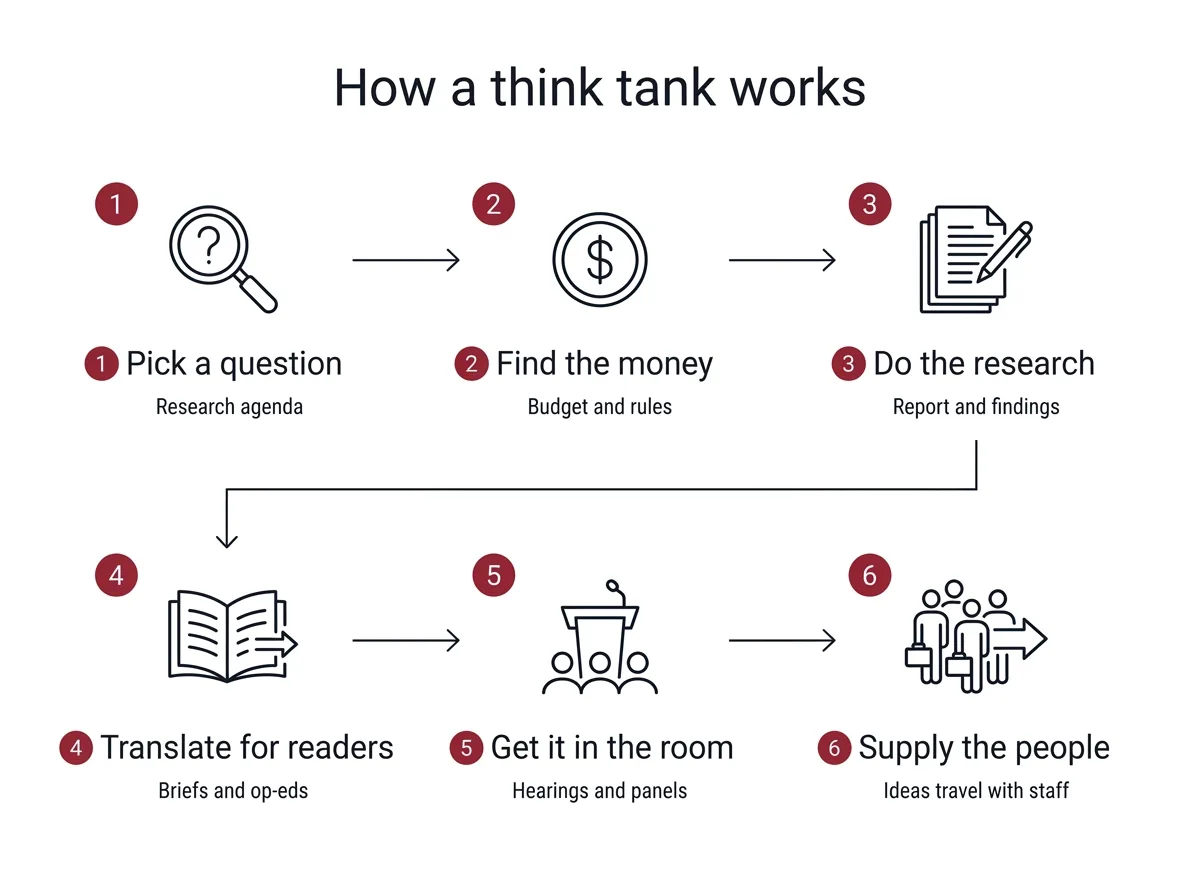
How a think tank works, step by step
The details differ from one institute to the next. Still, most of the work follows the same arc, from a question to a change in what lawmakers and agencies actually do.
Step 1: Pick a question
Leadership and senior fellows choose topics where they expect a policy window, such as an expiring law, a new administration or a crisis. Result: a research agenda for the year.
Step 2: Find the money
Projects need money, usually from foundations, individual donors or corporations, and in some cases from public contracts. Result: a budget and, at a careful institution, written rules that keep funders out of the conclusions.
Step 3: Do the research
Fellows gather data, build models, interview officials and compare countries or states. Better shops send reports out for peer review before release. Result: a report with findings and, at most institutes, recommendations.
Step 4: Translate it for busy readers
The long report becomes a policy brief, a chart pack, an op-ed and a podcast episode. Result: versions of the same idea for staffers, journalists and the public.
Step 5: Get it in the room
Staff host panels, brief congressional offices and agency officials, and send experts to testify at hearings. Over time an institute builds a network of contacts on Capitol Hill and in the press. Result: the idea now has a name attached and a place in the debate.
Step 6: Supply the people
When a new administration arrives, scholars often move into appointed posts, and departing officials move back out to research jobs. Critics call it a revolving door; defenders call it a bench of trained talent. Result: ideas travel with the people who wrote them.
How are think tanks funded?
Most American think tanks are tax-exempt charities under section 501(c)(3) of the tax code. Their typical revenue sources are these:
- grants from private foundations
- gifts from individual donors, large and small
- corporate support, either general or tied to a project
- public contracts, which matter most to contract research shops such as RAND
- endowment income, event fees and other earned revenue
That tax status comes with limits. The IRS bars 501(c)(3) organizations from campaigning for or against any candidate for public office, and lobbying cannot be a substantial part of their activity. Some institutes set up separate 501(c)(4) affiliates to do more direct advocacy.
Funding is also where the hardest questions sit. In 2014 The New York Times reported that foreign governments had given money to several prominent Washington institutions, which led to calls for fuller disclosure. Groups such as Transparify now rate institutes by how openly they list their funders.

Are think tanks good for democracy? Three views
Scholars who study the sector disagree about what it adds to public life. Each of the three main positions rests on real arguments.
The expertise view
Legislators and agency staff are stretched thin. Independent research institutes give them evidence, cost estimates and tested proposals they could not produce alone. On this view a crowded market of ideas, with institutes on the left, right and center, improves public debate because weak arguments get answered.
The pluralist view
Think tanks are one more channel through which organized interests compete, alongside parties, unions, trade associations and other interest groups. Andrew Rich, in *Think Tanks, Public Policy, and the Politics of Expertise* (2004), found that ideological institutes gained visibility by marketing their work aggressively. Pluralists see this as normal democratic competition: every side gets to make its case.
The critical view
Some scholars, including the sociologist Thomas Medvetz in *Think Tanks in America* (2012), argue that think tanks have blurred the line between policy research and advocacy. Because they borrow academic prestige while answering to donors and political allies, readers can mistake a position paper for neutral science. Critics want stronger disclosure and clearer labels.
Common questions about think tanks
Are think tanks nonpartisan?
Legally, a 501(c)(3) think tank must be nonpartisan in the sense that it cannot back candidates. In ideas, many are openly left, right or libertarian. What readers can check is whether an institution is open about its views and its funding.
Is a think tank the same as a lobbying group?
No. Lobbyists push for specific bills on behalf of clients. Think tanks produce research and argue about policy ideas, and charitable ones face strict caps on lobbying. In practice the line can be thin, which is why disclosure matters.
How many think tanks are there?
The University of Pennsylvania’s Think Tanks and Civil Societies Program counted 11,175 think tanks worldwide in its 2020 Global Go To Think Tank Index, with 2,203 in the United States, the most of all countries in the world. The index has not been updated since, so the figures are a snapshot.
Why do think tanks matter to ordinary readers?
Their numbers end up in news stories, speeches and bills. If you know who wrote a study, who paid for it and what the author’s record is, you can read policy debates and think tanks themselves with a sharper eye.
Sources
- R. Kent Weaver, "The Changing World of Think Tanks", PS: Political Science & Politics 22 (1989)
- Andrew Rich, Think Tanks, Public Policy, and the Politics of Expertise (Cambridge University Press, 2004)
- Thomas Medvetz, Think Tanks in America (University of Chicago Press, 2012)
- James G. McGann, 2020 Global Go To Think Tank Index Report, University of Pennsylvania
- IRS: The restriction of political campaign intervention by section 501(c)(3) tax-exempt organizations