Definition
Public policy is what a government decides to do, or decides not to do, about a public problem. It takes the form of laws, regulations, budgets, programs and court rulings.
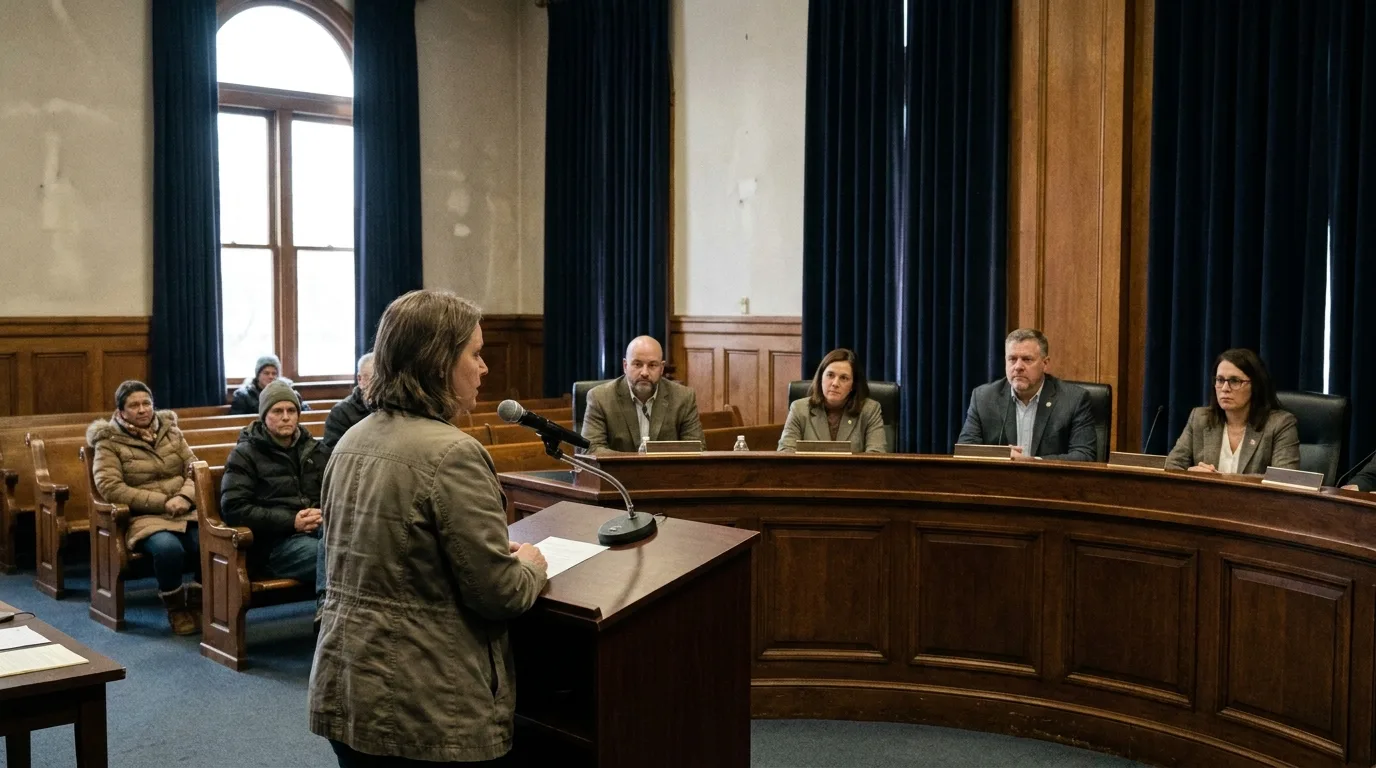
Public policy is what a government decides to do, or decides not to do, about a public problem. It takes the form of laws, regulations, budgets, programs and court rulings, and it reaches into almost every part of daily life, from the air you breathe to the price of a school lunch.
The political scientist Thomas Dye put it in one line in 1972: public policy is “whatever governments choose to do or not to do.” Inaction counts. When a legislature lets a tax break expire or a city decides against a new bridge, that decision shapes people’s lives as much as a new law would.
What is public policy in simple terms?
Think of it as a government’s plan of action for a problem that affects many people at once. Four features set public policy apart from private decisions such as a company’s hiring rules:
- It is made by public authorities: Congress, a state agency, a county board or a court.
- It is binding, or it runs on public money. People have to comply, or taxes pay for the program.
- It aims at a public problem, such as pollution, unemployment, unsafe roads or rising rents.
- It is a pattern of action. One speech is not policy; a law together with the rules, funding and enforcement behind it is.
The study of public policy grew out of political science. Harold Lasswell called it the “policy sciences” in 1951. Today universities teach public policy analysis as its own subject, usually next to economics, statistics and public administration, and schools of public policy train people for work in government, nonprofits and the private sector.
What are the 4 types of public policy?
The typology most textbooks still use comes from Theodore Lowi. He sorted policies by what they do to people rather than by subject area, and he argued that each type produces its own kind of politics.
| Type | What it does | Example |
|---|---|---|
| Distributive | Gives benefits to a specific group, paid for by everyone | Farm subsidies, a new highway |
| Regulatory | Sets rules that limit what people or firms may do | Emission limits, food safety standards |
| Redistributive | Moves resources from one group to another | Progressive income tax, Medicaid |
| Constitutive | Creates or changes the rules and agencies of government itself | Redrawing districts, founding a new agency |
Real policies are often mixtures. A health law can regulate insurers and redistribute income in the same section. The categories still help, because distributive policy tends to pass quietly while redistributive policy rarely does.
What are the stages of the public policy process?
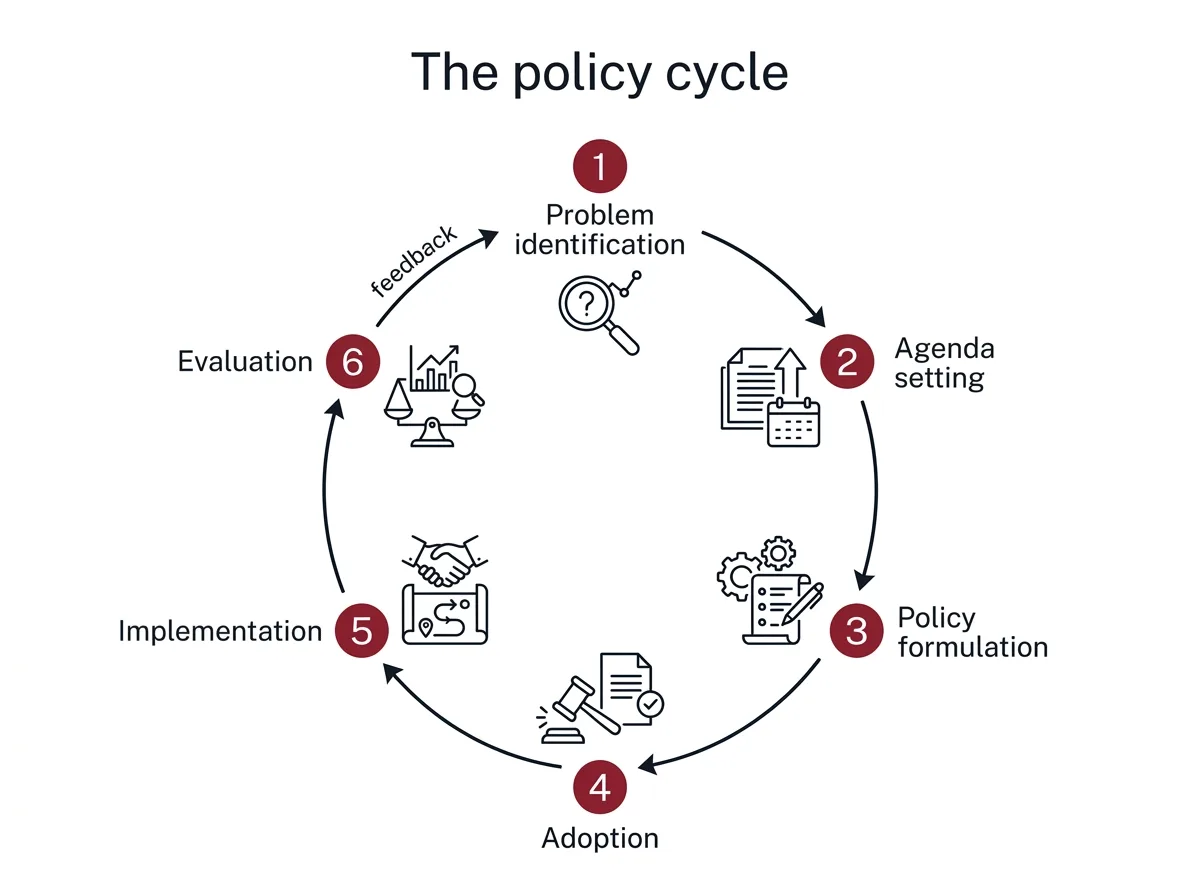
Political scientists describe the policy process as a cycle. Actual decisions rarely move in a straight line, but the stages show where an idea stands and who has influence at each point.
- Problem identification: data, a crisis or media coverage turns a condition into a public problem.
- Agenda setting: the problem gets the attention of decision-makers. Most issues never reach this stage, and public opinion often decides which ones do.
- Policy formulation: officials, experts and interest groups draft options. Research methods such as cost-benefit analysis and data modeling do most of their work here.
- Adoption: a legislature votes, an agency issues a rule or a court decides.
- Implementation: agencies turn the decision into programs, budgets and enforcement.
- Evaluation: analysts measure whether the policy worked, and the results feed into the next round of the cycle.
To follow one example through the adoption stage, the official USAGov guide to how a bill becomes a federal law walks through each step, from introduction to the president’s signature.
Who makes public policy?
Formally, public policy is made by those who hold public authority. Legislatures pass laws and approve budgets. Executives and agencies write regulations, run programs and decide how strictly to enforce them. Courts interpret laws and the constitution, and because courts follow precedent, a single ruling can create or end a policy. State and local governments make most of the policy that touches daily life, from zoning to schools.
Many more actors shape the result. Interest groups lobby, think tanks publish research, journalists set the agenda, and citizens vote (in some places directly on laws through referendums and initiatives), testify at hearings and file comments on proposed rules. Political science calls this wider circle of public and private actors a policy network. International organizations belong to it too: climate change, trade and public health are problems no single country solves alone, so many national policies are negotiated with the rest of the world first.
What are examples of public policy?
Public policy covers every field in which government acts. Some well-known examples from the United States:
- Social policy: the Social Security Act of 1935, which created old-age pensions.
- Environmental policy: the Clean Air Act of 1970 and the emission standards the EPA sets under it.
- Health policy: the Affordable Care Act of 2010 and its insurance marketplaces.
- Economic policy: tax law, trade agreements and the monetary policy of the Federal Reserve.
- Education policy: school funding formulas, testing rules and student-loan programs.
- Foreign policy: treaties, sanctions and alliances with other countries.

What is the difference between public policy and law?
Law is one tool of public policy. A policy can work without any new law, for example through spending, tax incentives, public information campaigns or a change in how an agency enforces rules it already has. The political scientist Christopher Hood grouped these tools into four families: information, authority (laws and rules), money, and organization, meaning the agencies that deliver services.
A simple test helps. A law says what is allowed or required. A policy is the whole strategy for a problem, and the law may be only one part of it.
Why does public policy matter?
Public policy decides who pays, who benefits and which problems get solved first. Knowing how it works makes the news easier to read and campaign promises easier to judge. It also shows you where you can take part: policies are open for public comment before they are adopted, and city councils, school boards and state agencies hold hearings that anyone can attend.
For students, public policy is also a career field. Policy analysts work for legislatures, agencies, think tanks and international organizations, and many companies employ them to follow regulation that affects their business.
Sources
- Thomas R. Dye, Understanding Public Policy (Prentice Hall, 1972)
- Theodore J. Lowi, "Four Systems of Policy, Politics, and Choice", Public Administration Review 32 (1972)
- Harold D. Lasswell, "The Policy Orientation", in The Policy Sciences (1951)
- Christopher Hood, The Tools of Government (1983)
- USAGov: How laws are made