Definition
Representative democracy is a system of government in which citizens elect representatives to make laws and policy on their behalf, instead of voting on each question themselves. The people hold ultimate authority but exercise it mainly by choosing, and removing, those who govern.
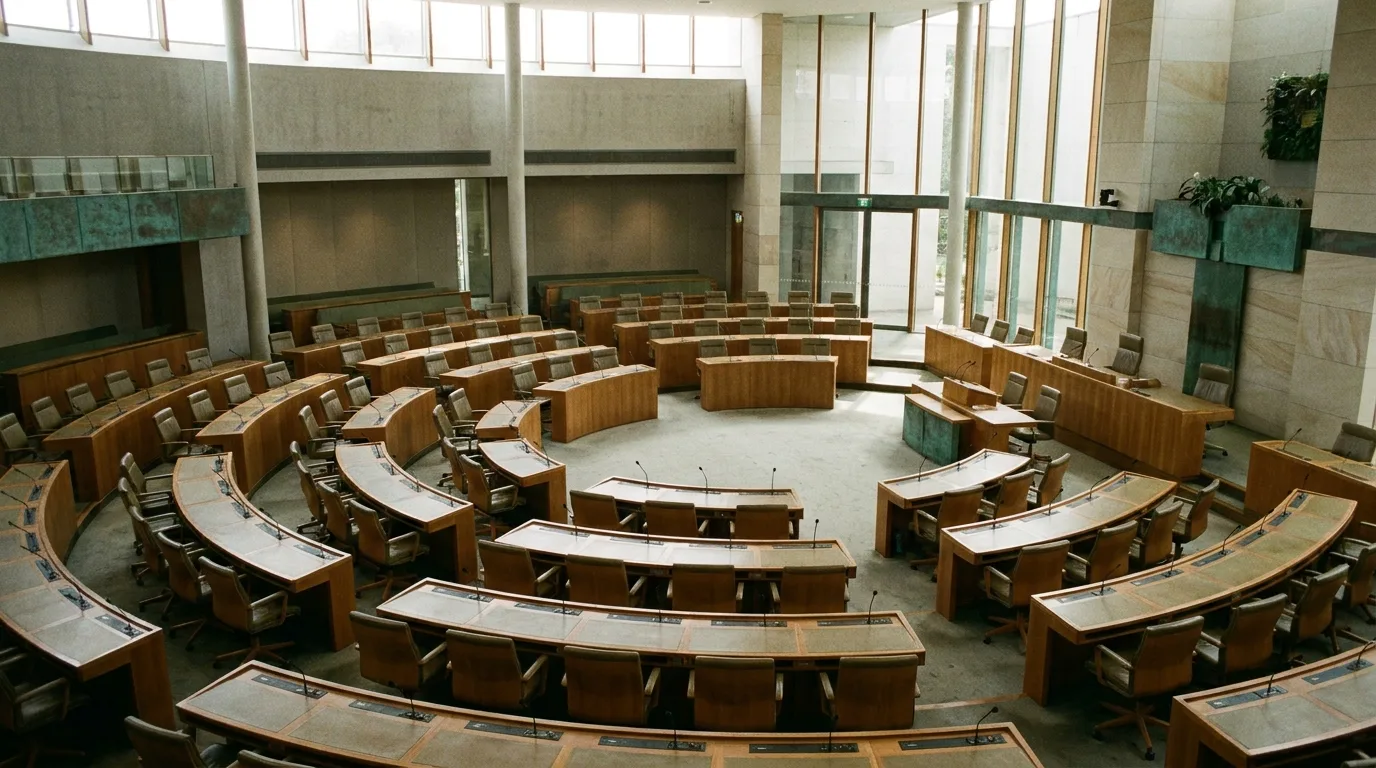
Representative democracy is a system of government in which citizens elect representatives to make laws and policy on their behalf, instead of voting on each question themselves. The people hold ultimate authority, but they exercise it mainly at the ballot box, by choosing who governs and by removing them at the next election.
As of 2026, almost every democracy in the world works this way, including the United States, the United Kingdom, India and Germany. Many add some direct democracy, such as state ballot initiatives or national referendums, but the daily work of passing laws and setting budgets falls to an elected body. That makes the representative model the default form of modern democratic government, and the one most often argued over.
Where the idea came from
Ancient Athens did not work this way. Its citizens met in the Assembly and voted on laws directly, and many officials were chosen by lot rather than by election. The representative principle has other roots:
- Rome. The Roman Republic elected magistrates such as consuls and tribunes, though power stayed concentrated in a narrow class.
- Medieval estates. English kings summoned knights and townsmen to Parliament to approve taxes. Simon de Montfort’s Parliament of 1265 and the Model Parliament of 1295 are the usual landmarks.
- The American Revolution. “No taxation without representation” turned a medieval practice into a political creed, and the Constitution of 1787 built a whole government on elected representatives.
James Madison gave the clearest defense of the design. In Federalist No. 10 he distinguished a “pure democracy” from a republic, which delegates government “to a small number of citizens elected by the rest.” Representation, he argued, would “refine and enlarge the public views, by passing them through the medium of a chosen body of citizens.” The full text is available from the Library of Congress guide to the Federalist Papers.
John Stuart Mill went further in *Considerations on Representative Government* (1861). He called it the ideally best form of government for a large modern state, since citizens cannot all take part in public business personally.
The framework: five parts of a working representative democracy
Political scientist Bernard Manin, in *The Principles of Representative Government* (1997), identified four features shared by every representative system since the eighteenth century. Adding accountability through courts and a constitution gives a practical five-part framework.
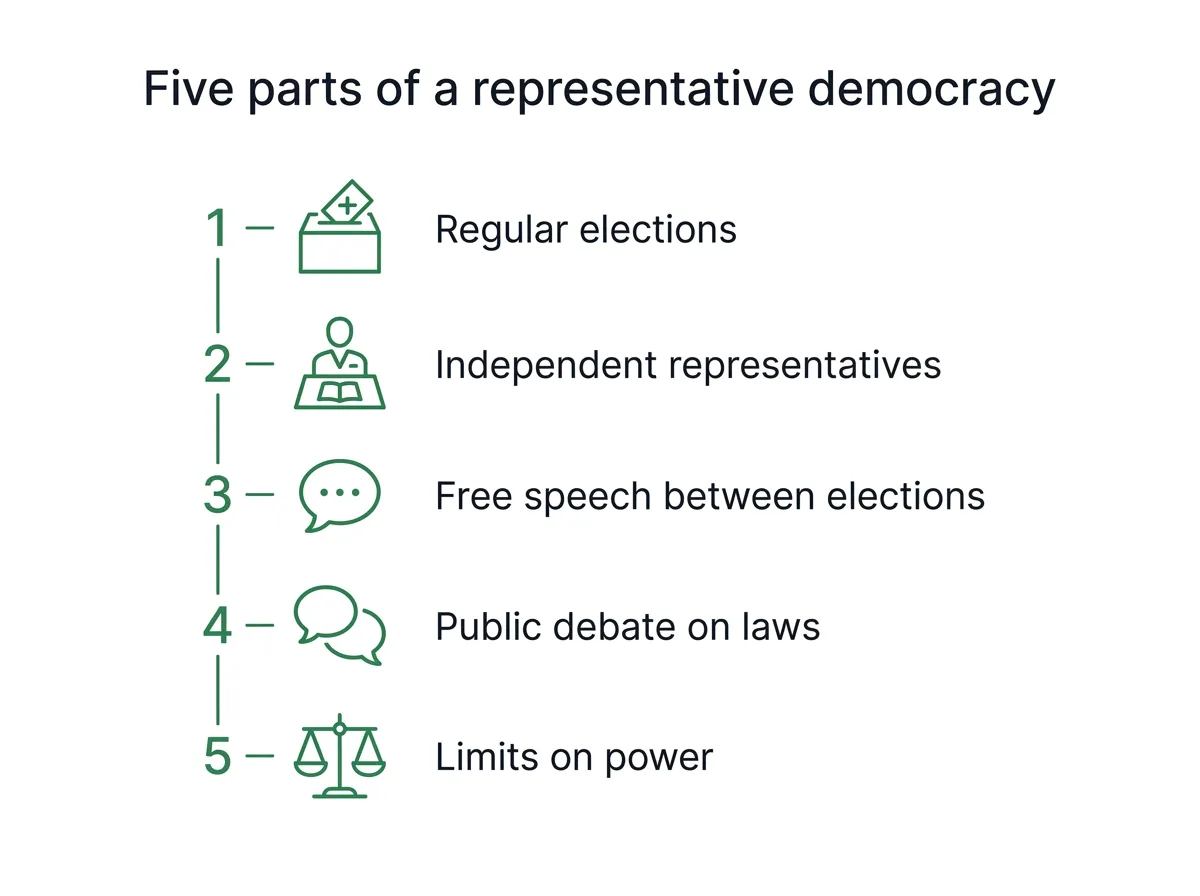
1. Rulers are chosen in regular elections
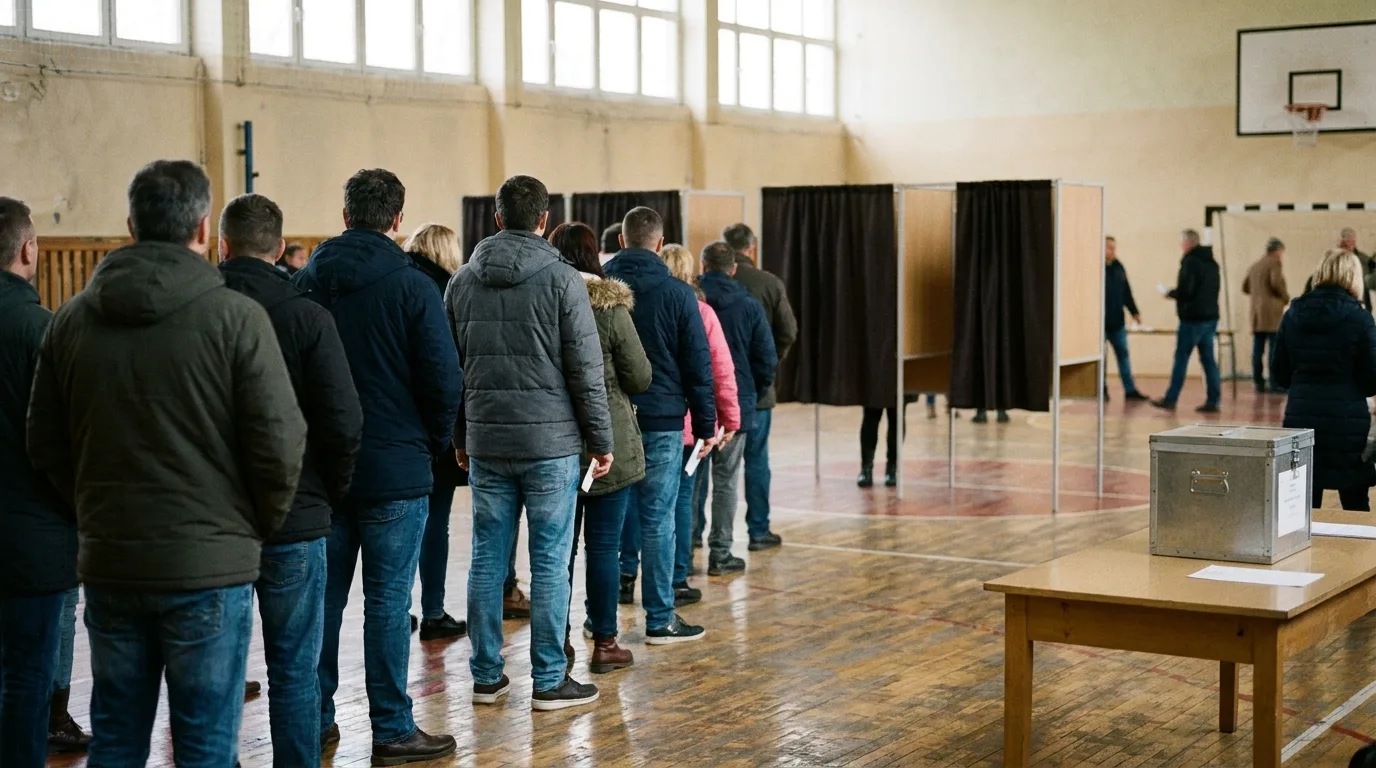
Citizens elect the people who make laws, at fixed intervals, and adults have the right to vote in those elections. There are differences in detail between democracies, but the process is always periodic. Members of the U.S. House of Representatives serve two-year terms and senators six-year terms. Since the Seventeenth Amendment (1913), voters elect senators directly rather than through state legislatures.
2. Representatives keep some independence
Elected representatives are not bound by instructions. Voters may punish them at the next election, but they cannot legally force a particular vote in between. The elected representative is free to weigh the evidence, and representatives make decisions with more information than most voters have the time to gather.
3. Citizens can speak freely between elections
Freedom of speech, press and assembly lets the electorate push representatives through protests, petitions, letters and the media. Without them, elections alone would offer little real control over government.
4. Decisions pass through debate
Laws are argued over in public before they are adopted. In the House of Commons, the United Kingdom’s 650 members debate bills in several readings, and the prime minister answers questions from members each week.
5. Power is limited and checked
A constitution, independent courts and checks and balances keep a majority from overriding basic rights. In the United States, the Supreme Court can strike down laws that violate the Constitution, which marks the difference between a liberal democracy and an illiberal one.
How the system looks in practice
Representative democracies share these five parts but differ in how votes become seats and how power is divided.
| Country | Type | How representatives are elected |
|---|---|---|
| United States | Presidential, federal | Single-member districts for the House; the president through the Electoral College |
| United Kingdom | Parliamentary | 650 single-member constituencies, first past the post; the prime minister leads the largest party |
| Germany | Parliamentary, federal | Mixed system: district seats plus party lists for proportional results |
| India | Parliamentary, federal | 543 Lok Sabha seats in single-member constituencies |
| Netherlands | Parliamentary | Nationwide party-list proportional representation |
The choice of electoral system matters for how well legislatures represent other views. Single-member districts tend to produce two large political parties and clear majorities. Proportional systems give smaller parties seats and usually lead to coalition governments.
Article IV of the U.S. Constitution guarantees every state “a Republican Form of Government.” So when people ask whether the United States is a republic or a democracy, the honest answer is both: the founders used “republic” for exactly the representative form that political scientists today call by the newer name.
Competing views of representation
What should a representative actually do? Thinkers have answered that question in different ways, and each answer has serious defenders.
The trustee view
Edmund Burke told the voters of Bristol in 1774 that a member owes them “his judgment,” and betrays them if he sacrifices it to their opinion. On this account, representatives are chosen for their judgment and should use it, even against the mood of the moment.
The delegate view
Many Anti-Federalists answered that representatives should resemble the people and follow their wishes closely. A legislature that mirrors the electorate, they argued, is less likely to drift into serving a narrow elite.
The competitive view
Joseph Schumpeter, in *Capitalism, Socialism and Democracy* (1942), described democracy as a competition between leaders for the people’s vote. On this realist account, voters do not set policy; they choose and remove those who do, and that is enough to keep government in check.
The participatory and deliberative view
Jean-Jacques Rousseau held that sovereignty cannot be represented, and mocked the English as free only during elections. Modern defenders of deliberative democracy want citizens more directly involved. Ireland’s Citizens’ Assembly, a randomly selected group of citizens, recommended in 2017 the change that voters approved in the 2018 abortion referendum.
What are the advantages and cons?
The case for the system:
- It works at scale, since millions of people cannot debate every bill.
- Representatives can build expertise and weigh competing interests.
- Constitutions and courts can protect minorities from a passing majority.
The case against it:
- Low turnout can leave representatives unrepresentative of their constituents.
- Voters choose a package of policies, not a position on each issue.
- Money, lobbying and safe seats can weaken accountability.
Common questions
What is representative democracy in simple terms?
Voters pick people to run the government for them, and can replace them at the next election.
What is the difference between direct and representative democracy?
In direct democracy, citizens vote on laws themselves, as Swiss voters do in their national referendums. In the representative model, elected representatives make laws and policies, and citizens judge them at the polls. Most democracies mix both.
Is the United States a representative democracy?
Yes. Congress, state legislatures and city councils are all elected, and there is no national referendum. Many states, though, let citizens put measures on the ballot themselves.
Who came up with representative democracy?
No single person. It grew from Roman magistracies and medieval parliaments, and Madison, Burke and Mill gave it its theory in the eighteenth and nineteenth centuries.
Checklist: is it a representative democracy?
Use these questions to test any political system:
- Are lawmakers chosen in free, regular and competitive elections?
- Can voters remove those who govern without violence?
- Can citizens criticize the government and organize openly?
- Are laws debated in public before they pass?
- Do courts and a constitution limit what an elected majority can do?
A system that passes the first two tests is representative. One that passes all five is what most people today mean by a working democracy of this kind.
Sources
- James Madison, The Federalist No. 10 (1787), Library of Congress
- John Stuart Mill, Considerations on Representative Government (1861)
- Edmund Burke, Speech to the Electors of Bristol (1774)
- Bernard Manin, The Principles of Representative Government (Cambridge University Press, 1997)
- Joseph A. Schumpeter, Capitalism, Socialism and Democracy (1942)
- Jean-Jacques Rousseau, The Social Contract (1762)