Definition
A welfare state is a form of government in which the state takes public responsibility for the basic economic and social security of its citizens. It works mainly through social insurance, public services such as health care and education, and income support for those in need.

A welfare state is a form of government in which the state takes public responsibility for the basic economic and social security of its citizens, mainly through social insurance, public services and income support. It protects people against the common risks of modern life: old age, sickness, disability, unemployment and poverty.
That short definition covers very different countries. Sweden, Germany, the United Kingdom and the United States all run a welfare system, yet they finance it, organize it and argue about it in different ways. The seven points below explain where the idea came from, how it works and why people still disagree about it.
1. It is a package of social programs
No country has one law that creates a welfare system. The term covers a package of public programs that provide for the basic needs of individuals and families. Most include some mix of the following:
- Social insurance: pensions, unemployment benefits, sick pay and disability benefits, usually funded by compulsory contributions from workers and employers.
- Social assistance: means-tested support for the poor, such as cash aid, food assistance or housing benefits.
- Universal services: public health care and public education, available to all citizens regardless of income.
- Family support: child benefits, parental leave and child care.
- Tax credits: support paid through the tax system, such as the Earned Income Tax Credit in the United States.
The balance among these tools is what separates one country from another. Some countries lean on universal services. Others rely more on targeted assistance for those in need.
2. Its origins lie in nineteenth-century Germany
The first modern welfare state took shape in imperial Germany. Chancellor Otto von Bismarck introduced compulsory health insurance in 1883, accident coverage in 1884 and old-age and disability pensions in 1889. His motives were political as much as social. He hoped to win the loyalty of the working class and weaken the appeal of the socialist movement.
The term itself came later. In Britain in the early 1940s, Archbishop William Temple contrasted the democratic “welfare state” with the Nazi “warfare state,” and the phrase spread during the Second World War. Earlier, German writers had used the word *Wohlfahrtsstaat* in a different and often critical sense.
3. The Great Depression and the Second World War built the modern version
Mass unemployment in the 1930s convinced many governments that private charity and local relief could not cope. In the United States, the New Deal produced the Social Security Act of 1935. According to the National Archives summary of the Social Security Act, the law set up old-age benefits for workers, unemployment insurance and aid for dependent mothers and children, blind persons and people with disabilities. Before the 1930s, support for the elderly had been mainly a local, state and family concern.
In Britain, the Beveridge Report of 1942, formally titled *Social Insurance and Allied Services*, named five “giant evils” that postwar policy should defeat:
- Want
- Disease
- Ignorance
- Squalor
- Idleness
The Labour government after 1945 turned much of the plan into law, including National Insurance and the National Health Service, which opened in 1948. The decades that followed are often called the “golden age” of the welfare state in western Europe.

4. There are three classic models
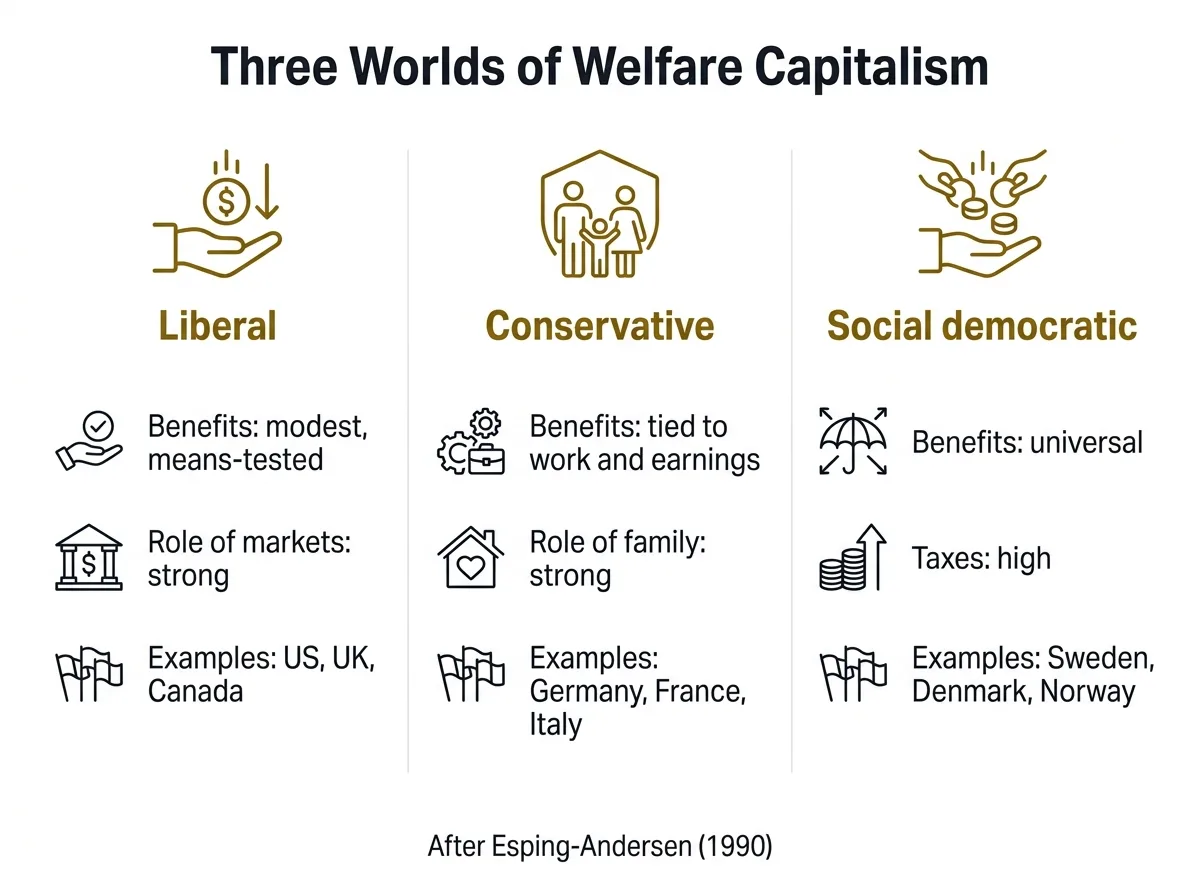
In *The Three Worlds of Welfare Capitalism* (Princeton University Press, 1990), the Danish sociologist Gøsta Esping-Andersen grouped rich democracies into three regimes. His key test was how far benefits allow people to maintain a decent life without depending on the labor market, a quality he called decommodification.
| Model | Typical countries | Main features |
|---|---|---|
| Liberal | United States, United Kingdom, Canada, Australia | Modest universal benefits, means-tested assistance, strong role for private providers and markets |
| Conservative (corporatist) | Germany, France, Austria, Italy | Social insurance tied to work and occupation, benefits linked to earnings, important role for the family and churches |
| Social democratic | Sweden, Denmark, Norway, Finland | Universal benefits and services for all citizens, high taxes, high employment and gender equality as goals |
Later scholars added more categories, such as a southern European model and East Asian systems built around family and employer provision. The three types remain the standard starting point.
5. The United States has one too, with its own design
People often ask whether the United States counts. Most scholars say yes. Social Security, Medicare and Medicaid (both created in 1965), unemployment compensation, SNAP food assistance and the Earned Income Tax Credit together form a large social welfare system.
What sets the American model apart is its structure. A large share of support runs through employers, such as job-based health coverage, or through the tax code. Many programs for the poor are means-tested and run jointly with the states. The 1996 welfare reform replaced Aid to Families with Dependent Children with Temporary Assistance for Needy Families (TANF), which added work requirements and time limits. Political scientists sometimes call this a “hidden” or “submerged” welfare state.
6. Supporters and critics both make serious arguments
Few questions in social policy divide people as clearly as the proper scope of social and economic support from government. Each side has a strong case in its own terms.
The case for
Supporters argue that markets reward people unequally and that illness, job loss and old age can strike anyone. Pooling these risks through public programs, they say, is efficient, since private insurers struggle with risks that are hard to price. The British sociologist T. H. Marshall described social rights as the third stage of citizenship, after civil and political rights. In this view, security is part of what makes people free and equal members of society. Supporters also point to reduced poverty among the elderly and to healthier, better-educated workforces.
The case against
Critics on the right argue that generous benefits weaken the incentive to work and save, and that high taxes slow economic growth. Charles Murray’s *Losing Ground* (1984) claimed that American antipoverty programs encouraged the very behaviors they aimed to cure. Milton Friedman preferred a simple negative income tax to a maze of programs run by bureaucracy. Public choice economists warn that welfare spending grows because it is politically easy to expand and hard to cut. Others stress fiscal pressure: aging populations mean more pensioners and fewer workers to pay for them.
Criticism from the left
Some critics on the left see the whole system as a compromise that stabilizes capitalism without changing it. Others argue that means-tested programs stigmatize the poor and that benefits often fail to reach those who need them most. Recent proposals for a universal basic income draw on both camps.
7. A welfare state is not the same as socialism
The two ideas are often confused. Socialism, in its classic sense, means social ownership of the means of production. A welfare state, by contrast, operates within a market economy with private property and private firms. It redistributes income and provides services, but it does not abolish capitalism.
That is why parties of the center right, from German Christian Democrats to British Conservatives, have built and defended welfare programs too. Outside the far ends of the spectrum, the political argument is mostly about the size, design and cost of the safety net.
Common questions about the welfare state
What is a welfare state in simple terms?
It is a country where the government provides a safety net, such as pensions, health care and unemployment support, so that people are protected against major economic risks.
Who created the first one?
Otto von Bismarck’s Germany, with social insurance laws passed between 1883 and 1889.
Which countries are welfare states?
Nearly all wealthy democracies have been welfare states since the mid-twentieth century. The Nordic countries are the best-known examples of a comprehensive model, while the United States runs a more limited and targeted system.
Is the welfare state growing or shrinking?
Since the 1980s many governments have trimmed benefits, tightened eligibility or added work requirements. Yet social spending has remained a large share of public budgets, partly because pensions and health care costs rise as populations age.
Sources
- Social Insurance and Allied Services (the Beveridge Report), HMSO, 1942
- T. H. Marshall, Citizenship and Social Class (Cambridge University Press, 1950)
- Milton Friedman, Capitalism and Freedom (University of Chicago Press, 1962)
- Charles Murray, Losing Ground: American Social Policy, 1950-1980 (Basic Books, 1984)
- Gøsta Esping-Andersen, The Three Worlds of Welfare Capitalism (Princeton University Press, 1990)
- National Archives: Social Security Act (1935)