The essay in brief
In a 1990 Policy Review interview, Senator Joseph Lieberman argued that Democrats should return to the tradition of Roosevelt, Truman and Kennedy: economic growth at home and military strength abroad. He named Henry "Scoop" Jackson, a liberal at home and a Cold War hawk abroad, as his model.

A Scoop Jackson Democrat is a liberal at home and a hawk abroad: pro-labor and in favor of an active federal government, but committed to a strong military and a hard line against dictatorships. In the summer of 1990, *Policy Review* put that label on a freshman senator from Connecticut, Joseph Lieberman, in the headline of a long interview by its editor, Adam Meyerson.
This guide explains who Senator Henry Jackson was, what the label meant, how it compares with other currents in American politics, and how Lieberman’s later career tested it.
The interview in brief
The conversation took place in May 1990 and ran in *Policy Review* No. 53. Lieberman had won his seat in 1988 by defeating the Republican incumbent Lowell Weicker, helped by many conservatives. Meyerson asked about the economy, defense, religion and the state of the Democratic Party.
Lieberman’s main points, in our summary:
- The national party had drifted from the tradition of Franklin Roosevelt, Harry Truman and John F. Kennedy, who all stood for growth and military strength.
- Growth needed targeted capital gains tax cuts and federal support for civilian research, on the model of the Pentagon agency DARPA.
- Market tools deserved a trial: school vouchers, tradeable emissions permits and private long-term care insurance.
- Force in Grenada, Libya and Panama had been justified.
- President George H. W. Bush was too quiet about liberty in Lithuania and China.
When asked for models, Lieberman named Jackson, who had backed both a strong American presence in the world and a positive role for government at home. He called it a vision of an America that is “strong, prosperous, and caring.”
Who was Henry M. “Scoop” Jackson?
Henry Martin Jackson was born in Everett, Washington, in 1912 and studied law at the University of Washington. He served in the House from 1941 to 1953 and as a senator from 1953 until his death in 1983. The University of Washington Libraries’ guide to Senator Henry M. Jackson documents that career year by year. Washington state voters kept sending him back; in 1970 he won about 82 percent of the vote. At home he and the state’s second senator, Warren Magnuson, were known simply as “Scoop and Maggie,” and Everett remained his base all his life.
For Jackson, the following positions belonged together:
- high defense budgets and opposition to détente with Moscow;
- the National Environmental Policy Act of 1969, which he sponsored in the Senate;
- civil rights and organized labor;
- the Jackson-Vanik amendment to the Trade Act of 1974, which tied trade benefits for the Soviet Union to the right of its citizens, many of them Jews, to emigrate.
He chaired the Democratic National Committee in 1960 and ran for president in 1972 and 1976. In 1976 he won the Massachusetts and New York primaries but never reached the White House. Several former aides, among them Richard Perle and Elliott Abrams, later served in Republican administrations, which is why histories of neoconservatism often mention the senator.
What the label means
The phrase works like “Taft Republican”: a wing named for one senator. It usually describes a politician who treats military strength, and the willingness to use it, as a first duty of government; who wants the United States to promote democracy; and who accepts an active federal role in jobs and research while staying close to unions. By 1990 the term was used mostly for liberals who looked out of step with their own side on foreign affairs.
Scoop Jackson Democrats compared with other currents
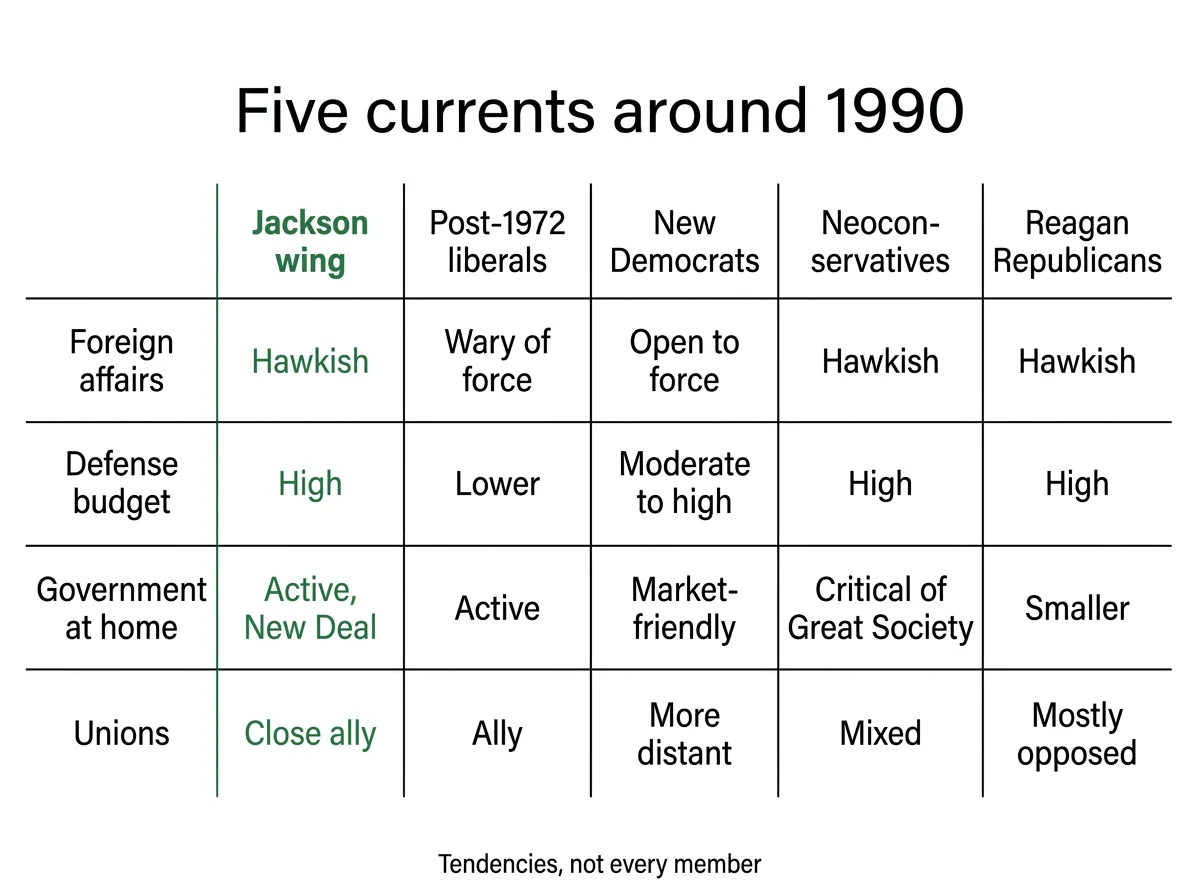
The table sets the Jackson wing beside four currents active around 1990. Each column describes a tendency, not all members.
| Jackson wing | Post-1972 liberals | New Democrats (DLC) | Neoconservatives | Reagan Republicans | |
|---|---|---|---|---|---|
| Foreign affairs | Hawkish, anti-Soviet | Wary of force after Vietnam | Internationalist, open to force | Hawkish, democracy promotion | Hawkish, anti-communist |
| Defense budget | High | Lower | Moderate to high | High | High |
| Government at home | Active, New Deal style | Active, more social programs | Market-friendly | Critical of Great Society programs | Smaller, lower taxes |
| Unions | Close ally | Ally | More distant | Mixed | Mostly opposed |
| Party home | Democratic | Democratic | Democratic | Many moved to the GOP | Republican |
Lieberman’s 1990 answers do not fit one column. On defense and Lithuania he spoke like Jackson. On vouchers, emissions trading and capital gains he sounded closer to the Democratic Leadership Council, founded in 1985, which he would later chair.

The context in 1990
The interview appeared between the fall of the Berlin Wall and the end of the Soviet Union. Lithuania had declared independence on March 11, 1990, and Moscow was pressing it hard. Lieberman expected fresh dangers: unstable states, terrorism, drugs and the spread of chemical, biological and nuclear weapons, with the Middle East as the likely tinderbox.
At home, Democrats had lost five of the last six presidential elections. Lieberman wanted to win voters back on growth, crime, faith and national security. *Policy Review* was then published by the Heritage Foundation; the Hoover Institution took it over in 2001.
Reception and criticism
*National Review* had endorsed Lieberman in 1988, so conservatives were paying attention before the interview. Yet *Policy Review* added a caveat in its own introduction: his Senate votes had not differed much from those of his colleagues. A few positions they liked did not make him a conservative.
On the left, the same record read as too close to Republicans on the use of force and too friendly to markets. That criticism grew over the next fifteen years and peaked during the Iraq war.
How has the label held up?
Lieberman kept the label alive for two decades:
- In 2000 he was Al Gore’s running mate, the first Jewish candidate on a major party’s national ticket.
- He backed the Iraq war, lost the 2006 Connecticut primary to Ned Lamont, then won the general election as an independent.
- In 2008 he endorsed the Republican John McCain for president.
- He retired from the Senate in 2013 and died in 2024.
Commentators who see the interview as forward-looking point to two parts of his 1990 argument: the warning about post-Cold War threats, and his support for emissions trading, which the 1990 Clean Air Act amendments used against acid rain. His broader hope for the party had mixed results. Under Bill Clinton the party moved toward the center on economics, while on the Iraq war most Democratic voters came to hold a different view from Lieberman’s.
Readers’ questions
Was Jackson a neoconservative? No. He stayed a Democrat and a New Deal liberal on domestic issues. Some of his staff and allies became leading neoconservatives, so the two are often linked. What Jackson would have thought of the Iraq war is unknown; he died twenty years before it.
Why was Lieberman called a Scoop Jackson Democrat? He paired a hawkish foreign line with mainstream liberal positions at home, and he named Jackson as a model in this interview.
Are there any such Democrats today? The term has faded. It still turns up for politicians who favor high defense spending and a firm line against authoritarian states.
Where to read the original
“Scoop Jackson Democrat: Senator Joseph Lieberman’s Case for Economic and Military Strength,” an interview by Adam Meyerson, appeared in *Policy Review* No. 53, Summer 1990. The text is in the Hoover Institution’s Policy Review archive. This guide is new writing, reviewed in October 2026; it summarizes the interview in our own words and quotes only one short phrase.
Sources
- Adam Meyerson, "Scoop Jackson Democrat: Senator Joseph Lieberman's Case for Economic and Military Strength", Policy Review 53 (1990)
- University of Washington Libraries: Senator Henry M. Jackson, 1912-1983
- Robert G. Kaufman, Henry M. Jackson: A Life in Politics (University of Washington Press, 2000)
- Justin Vaïsse, Neoconservatism: The Biography of a Movement (Harvard University Press, 2010)