The essay in brief
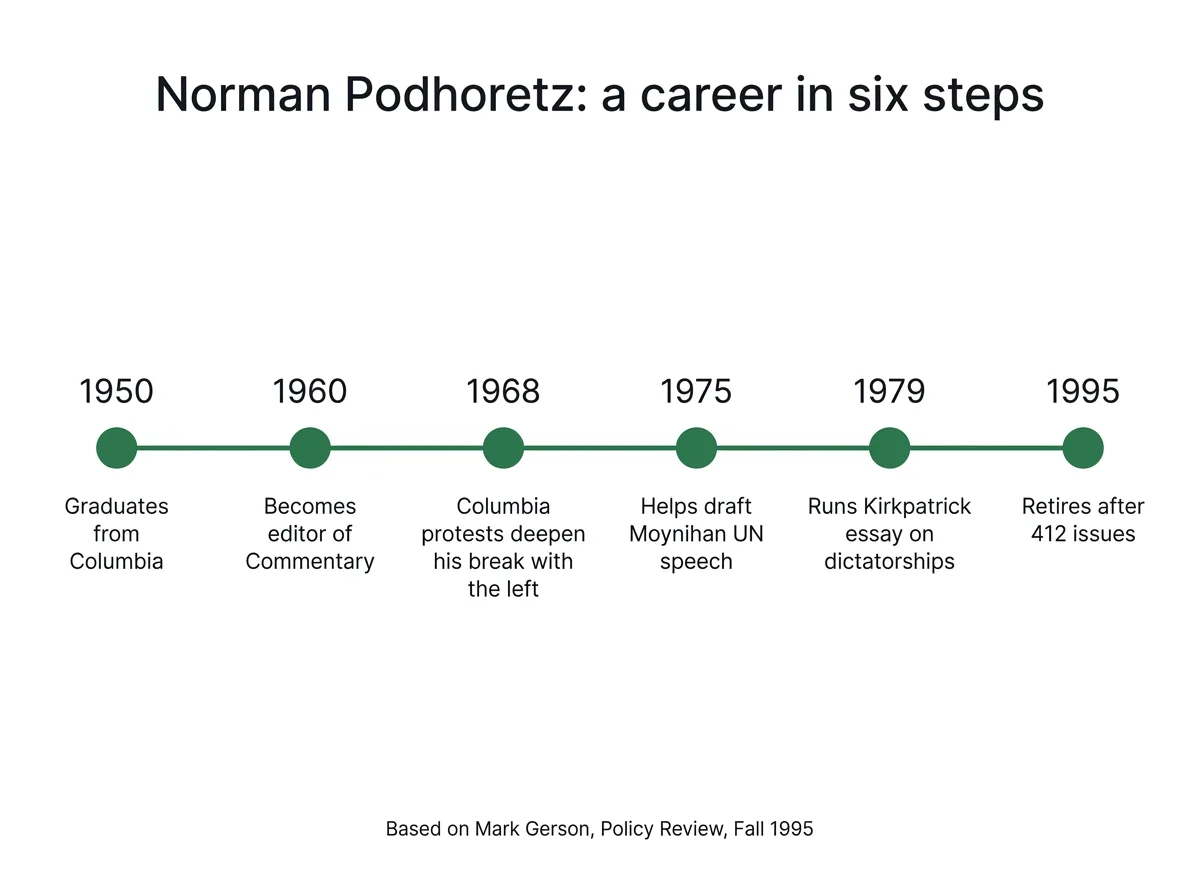
Writing in Policy Review in fall 1995, Mark Gerson argued that Norman Podhoretz, editor of Commentary from 1960 to 1995, won the battle of ideas of his generation: his magazine shaped Reagan's Cold War policy, the case against racial quotas and the defense of middle-class culture.

In November 1975 the United Nations General Assembly voted that Zionism was a form of racism. Daniel Patrick Moynihan, then the American ambassador, answered from the floor with a speech that caused an uproar in the hall and made headlines across the United States. According to the essay discussed here, much of that speech was drafted by his former editor at *Commentary* magazine, Norman Podhoretz.
Twenty years later, when Podhoretz stepped down as editor, a young writer named Mark Gerson used that episode and many others to take stock of the Norman Podhoretz legacy. His essay, “Norman’s Conquest: A Commentary on the Podhoretz Legacy,” appeared in *Policy Review* in fall 1995 (No. 74). This guide summarizes what Gerson argued, the moment in which he wrote, what critics said about Podhoretz and his movement, and how the case looks now.
The essay in brief
Gerson opens with a joke credited to Lionel Trilling, who taught Podhoretz at Columbia University. (The young student took classes at the Jewish Theological Seminary at the same time.) In the early 1960s Trilling warned of a “Norman Invasion” by three young literary stars: Norman O. Brown, Norman Mailer and Norman Podhoretz. Of the three, Gerson writes, only one conquered. His monument was 412 issues of *Commentary*, edited from 1960 until 1995, the magazine in which neoconservatism took shape and from which it spread into the world of Washington policy.
Gerson names three contributions:
- The Cold War: Podhoretz and his writers supplied much of the intellectual case behind Ronald Reagan’s confrontation with the Soviet Union.
- Civil rights and affirmative action: *Commentary* backed the civil rights movement in the 1960s and then opposed racial quotas and preferences, arguing that they broke the movement’s promise of judging people as individuals.
- The “adversary culture”: The magazine defended ordinary middle-class American life against intellectuals who scorned it, a phrase Gerson again borrows from Trilling.
The rest of the essay follows his political journey, starting with a boy raised in a lapsed Orthodox Jewish home in Brooklyn. Gerson argues that the editor did not so much move to the right as stay put while liberalism changed around him. As evidence he cites essays from the 1950s, including the 1958 attack on the Beat writers, “The Know-Nothing Bohemians,” which already showed impatience with utopian and romantic politics.
Where the essay came from
The piece appeared at a turning point for both its subject and its author. *Commentary*, founded in 1945 by the American Jewish Committee, had been one of the main outlets of the New York intellectuals for decades, and its editor had retired in spring 1995. Gerson was a first-year student at Yale Law School and the author of a forthcoming book, *The Neoconservative Vision: From the Cold War to the Culture Wars* (Madison Books). *Policy Review* was then published by The Heritage Foundation; the Hoover Institution took over the journal in 2001.
The political setting mattered too. The Soviet Union had collapsed four years earlier. Republicans had just won control of Congress in the 1994 midterm elections. A fight over affirmative action was building in California and in national politics. To a conservative reader in 1995, much of what *Commentary* had argued for two decades seemed to be winning.
How Podhoretz broke with the left
Gerson’s middle sections tell a story that most accounts of Podhoretz’s life repeat in some form. In the early 1960s the new editor opened *Commentary* to radical writers such as Paul Goodman, which upset Trilling and Irving Kristol. Vietnam changed that. Podhoretz opposed the war, but on the practical ground that it could not be won. He opposed the antiwar movement more strongly, because he believed it used the war to attack American institutions as a whole.
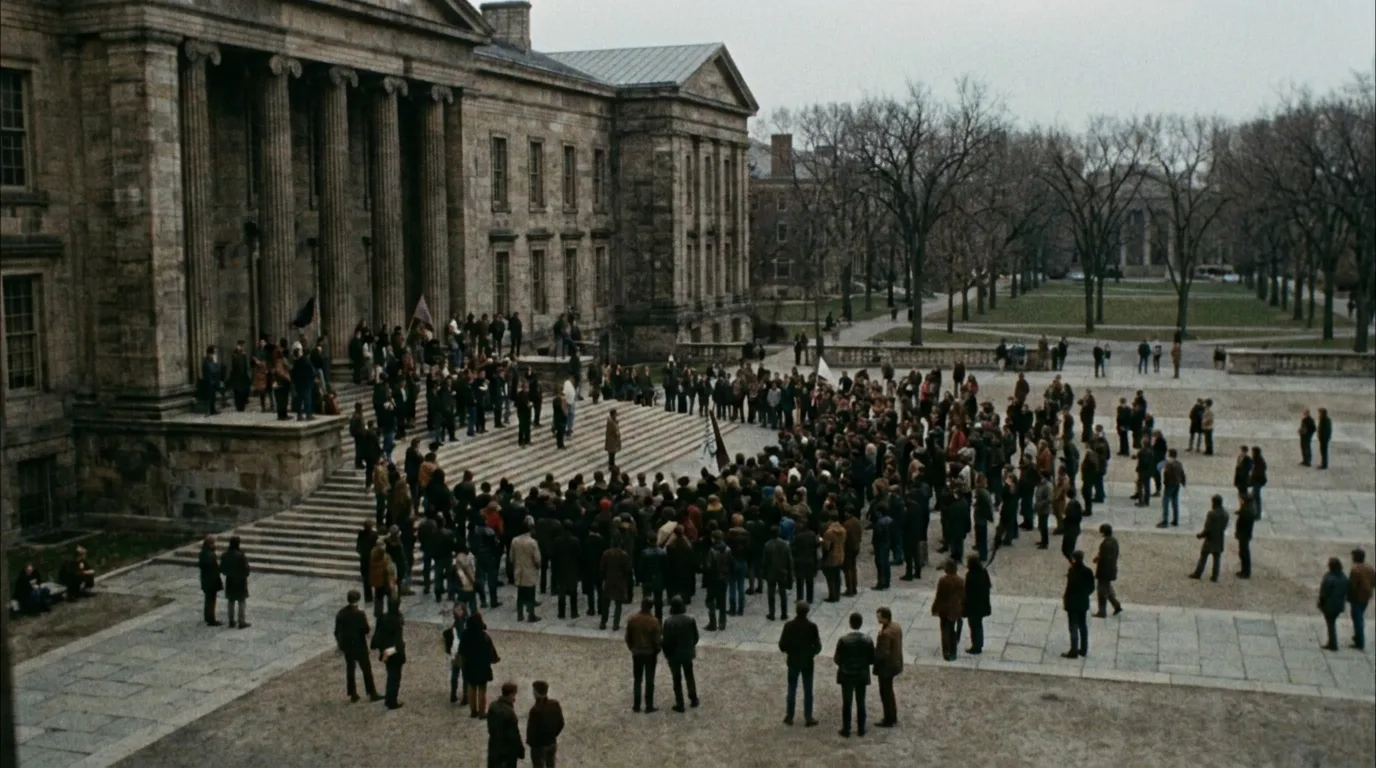
The student takeover at Columbia in 1968 sharpened the break. Gerson recounts how liberal professors excused radical tactics as youthful idealism, and he retells a story from Midge Decter, the writer who was married to Podhoretz, about a party where she objected to students wrecking a professor’s files and the critic Dwight Macdonald replied that she cared more about material values than human ones. He treats this as the moment liberalism lost the will to defend its own principles. The term neoconservatism, he notes, was coined in the early 1970s by the socialist Michael Harrington, at first as a label for these defectors.
From there the essay tracks the magazine’s main fights:
| Period | Fight in *Commentary* | Examples Gerson cites |
|---|---|---|
| 1970s | Against quotas and racial preferences | Michael Novak (1976), Thomas Sowell (1989) |
| 1970s | Against post-Vietnam retreat abroad | Podhoretz’s warnings of a “failure of nerve”; *The Present Danger* |
| 1975 | At the United Nations | Moynihan’s “The United States in Opposition” |
| 1979 | Foreign policy doctrine | Jeane Kirkpatrick’s “Dictatorships and Double Standards” |
| 1980s | For capitalism and critiques of the welfare state | George Gilder, Michael Novak, Charles Murray |
Gerson draws a direct line from those articles to appointments. Moynihan’s essay was followed by his posting to the UN under President Ford. Kirkpatrick’s caught Reagan’s eye, and as president he named her ambassador to the United Nations. Gerson also stresses that the editor criticized Reagan when he thought the administration too soft on Moscow, most sharply in a 1982 article for The New York Times Magazine. In his view the free world had to resist communism, and Western governments failed at it whenever they put trade first.
Reception and criticism
“Norman’s Conquest” is openly admiring. It ends by praising Podhoretz for a long career of “fighting for the right,” a phrase from Theodore Roosevelt that Podhoretz had quoted in his farewell issue. It was written by a supporter of the movement it describes and does not set out to give a balanced assessment.
His critics made several points the essay passes over:
- Tone: Opponents on the left saw his polemics as harsh, and his 1967 memoir *Making It* drew a famously hostile response from the New York literary world.
- Foreign policy: Critics argued that the neoconservative stress on American power and moral clarity led to overreach, a charge that grew louder after Podhoretz supported the Iraq War and argued in *World War IV* (2007) that the struggle against Islamist terrorism was a new world war.
- Fights on the right: Paleoconservatives clashed with the neoconservatives over foreign policy and Israel, and argued that the newcomers had reshaped conservatism in their own image.
- Race: Defenders of affirmative action rejected the claim that preferences harmed their beneficiaries and saw the color-blind argument as a way to stop needed remedies.
Each camp reads the record through its own priorities, and the essay does not set out to weigh them against each other.
How the essay has held up
Thirty years on, parts of Gerson’s account are still debated.
His account of *Commentary*’s influence on Cold War policy is still widely repeated in histories of neoconservatism, though historians differ over how much any magazine shaped Reagan’s choices. On affirmative action, the long legal and political debate reached the Supreme Court, which in *Students for Fair Admissions v. Harvard* (2023) ruled race-conscious college admissions unconstitutional.
Other parts describe a moment that has since changed. Gerson wrote as if the neoconservative synthesis had become conservatism’s settled center. After the Iraq War, the American right debated interventionism more openly, and parts of it moved away from the foreign policy he described. Podhoretz kept writing well after 1995, and in 2004 he received the Presidential Medal of Freedom. Opinion on his legacy remains divided.
Readers’ questions
Who wrote “Norman’s Conquest”?
Mark Gerson, then a Yale law student and author of *The Neoconservative Vision*. He went on to co-found the expert network firm Gerson Lehrman Group.
What is Norman Podhoretz known for?
For his 35 years as editor of *Commentary* magazine, from 1960 to 1995, for his memoirs *Making It*, *Breaking Ranks* and *Ex-Friends*, and for helping found neoconservatism.
Was he always a conservative?
No. He was a liberal Democrat in the 1950s and 1960s. He voted Republican for president for the first time in 1980, for Reagan.
Where to read the original
The full text of Mark Gerson’s essay is available in the Hoover Institution’s archive of *Policy Review*: Norman’s Conquest, Policy Review, Fall 1995. Policyreview.org is an independent reference site and is not affiliated with the Hoover Institution or The Heritage Foundation.
Sources
- Mark Gerson, "Norman's Conquest: A Commentary on the Podhoretz Legacy", Policy Review 74 (1995)
- Mark Gerson, The Neoconservative Vision: From the Cold War to the Culture Wars (Madison Books, 1996)
- Norman Podhoretz, Making It (Random House, 1967)
- Norman Podhoretz, Breaking Ranks: A Political Memoir (Harper & Row, 1979)
- Norman Podhoretz, World War IV: The Long Struggle Against Islamofascism (Doubleday, 2007)