Definition
Soft power is the ability of a country or another actor to get what it wants by attracting others rather than by coercing or paying them. Joseph Nye, who popularized the term, traced it to a country's culture, political values and foreign policies.

Soft power is the ability of a country or another actor to get the outcomes it wants by attracting others rather than by threatening or paying them. The Harvard political scientist Joseph Nye, usually credited with having coined the term, described it as getting others to want what you want.
The concept of soft power has become a fixture of international relations. It is easiest to grasp next to hard power and smart power, so this guide compares all three.
Three ways to get what you want
Power, in this view, is the ability to affect others so as to obtain preferred outcomes. The means fall into three groups.
- Coercion: threats of military force, blockades and sanctions.
- Payment: aid, trade deals, bribes and economic inducements.
- Attraction: values, ideas and a way of life people admire.
Sticks and carrots make up hard power. Attraction is a form of power that also covers persuasion and agenda setting, so some options never come up at all.
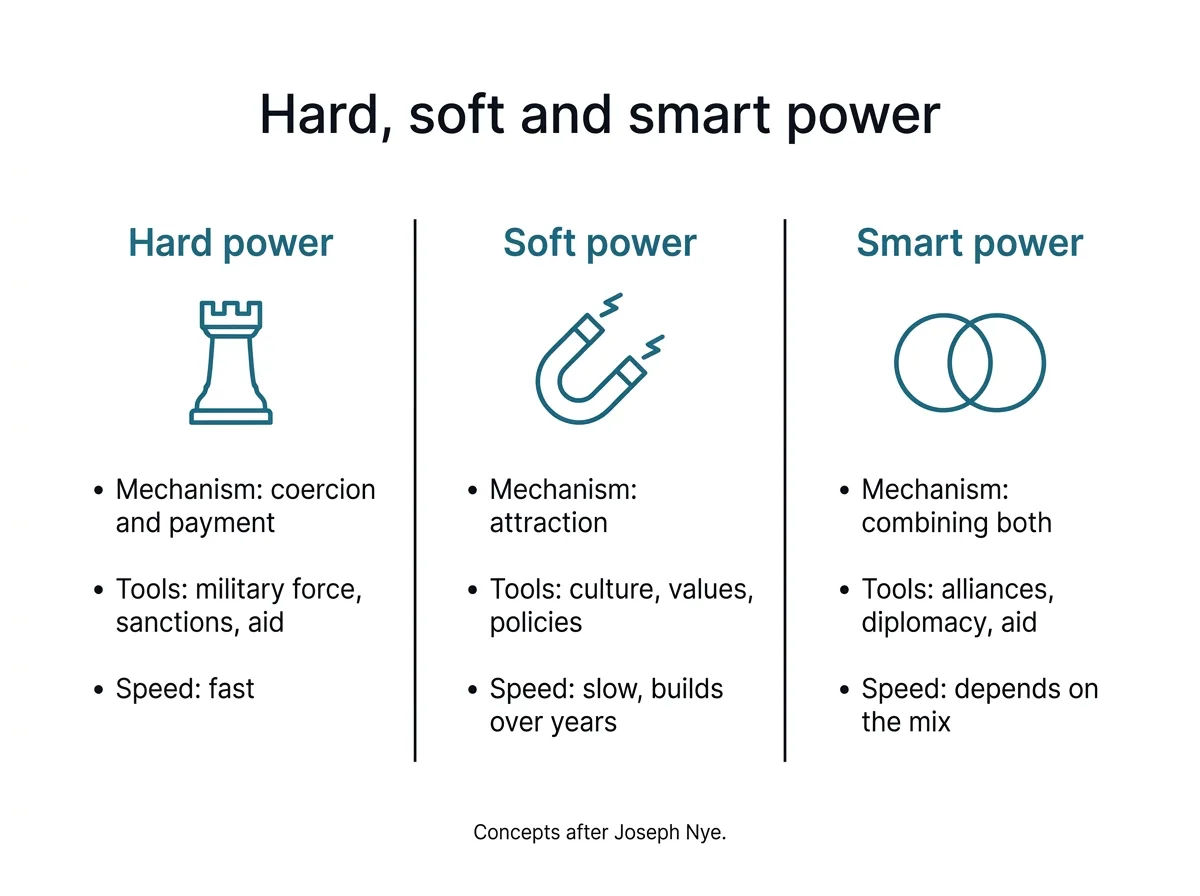
Hard and soft power, plus smart power, side by side
| Hard power | Soft power | Smart power | |
|---|---|---|---|
| Core mechanism | Coercion and inducement | Attraction and persuasion | Combining both in one strategy |
| Typical tools | Military force, sanctions, conditional aid | Culture, political ideals and policies seen as legitimate, public diplomacy | Alliances, development aid, diplomacy backed by credible force |
| Who controls the resources | Mostly governments | Largely civil society, firms, universities, media | Governments, coordinating the rest |
| Speed | Fast, often visible within days | Slow, builds over years | Depends on the mix |
| Associated with | Classic realist thinking | Joseph Nye, liberal internationalism | Nye, Suzanne Nossel, CSIS Commission on Smart Power (2007) |
Most governments use all three at once, choosing the tool by the job.
Where the idea came from
Nye set out the argument in 1990, in *Bound to Lead* and in *Foreign Policy*. As the Cold War ended, many writers predicted American decline. He replied that the United States held a source of influence the USSR could not match: the appeal of its universities, films and open society.
He expanded the case in *Soft Power: The Means to Success in World Politics*, published by PublicAffairs in 2004 and listed by Harvard’s Belfer Center. It arises, he wrote, from the attractiveness of a country’s culture, political ideals and policies, the three soft power resources:
- culture, where it appeals to people,
- political values, when a government lives up to them at home and abroad,
- foreign policies, when they are seen as legitimate and as having moral authority.
The book appeared after the 2003 Iraq war, when polls showed a sharp fall in America’s standing around the world. He read the drop as evidence that unpopular policies drain attraction while military strength stays the same.
Smart power came next. Suzanne Nossel used the phrase in a 2004 *Foreign Affairs* essay, and Nye adopted it to stress that attraction should complement coercion. A 2007 CSIS commission he co-chaired with Richard Armitage pushed it in Washington, and Hillary Clinton made it a theme of her 2009 confirmation hearing as Secretary of State.
How nations use it: five examples

- Exchange programs: the US Fulbright Program, founded in 1946, has brought generations of students and scholars to American campuses.
- Cultural institutes: the British Council (1934), Germany’s Goethe-Institut (1951) and China’s Confucius Institutes (from 2004) teach language abroad.
- Popular culture: South Korea’s Korean wave of dramas, films and K-pop grew mostly from private industry and made the country one of the most visible new exporters.
- Mediation: Norway hosted the secret talks behind the 1993 Oslo Accords, and that diplomatic reputation gives a small state a voice in distant conflicts.
- Official strategy: in 2007 Hu Jintao told China’s 17th Party Congress to strengthen culture as part of national soft power, making the idea a formal goal of a diplomacy already courting Southeast Asia.
Much of this lies outside government control: studios and universities pursue their own aims.
Does soft power work? The debate
The case for
Supporters argue that attraction is cheap compared with force and lasts longer. Coalitions form more easily when partners trust the leader, and alliances such as NATO rest on shared values as much as on military strength.
The realist objection
Realists answer that soft power, though real, stays secondary. States follow their interests, and admiration for American films did not stop governments opposing American wars. Attraction may also be a by-product: rich, strong nations draw admirers because they are rich and strong.
The conceptual objection
Scholars such as Janice Bially Mattern argue that attraction is less gentle than it sounds, since narratives can pressure people into agreement. Critics also find the label so broad that sports events and cuisine can be counted.
Sharp power
In 2017 Christopher Walker and Jessica Ludwig of the National Endowment for Democracy proposed the label sharp power for efforts by authoritarian states to manipulate opinion abroad through censorship, disinformation and covert influence. Nye later drew the same distinction: one is voluntary attraction, the other deception.
How is soft power measured?
There is no single measure. Researchers use proxies:
- surveys of how foreign publics view a country, such as those by the Pew Research Center,
- composite rankings like the Soft Power 30 index (2015 to 2019) and the Brand Finance Global Soft Power Index (since 2020),
- flows of students, tourists and migrants, and the international reach of a nation’s films, music and media.
Popularity differs from influence, and an admired government can still fail to persuade on a specific issue.
Common questions
What is soft power in simple terms?
Influence through attraction. Others go along because they like a country’s culture, share its values or see its policies as fair. Nobody forces or pays them.
Who came up with the term?
Joseph Nye of Harvard University, who published it in 1990.
Is it better than hard power?
Neither is better in general. Nye argued for combining hard and soft power, the idea behind smart power.
Can non-state actors have soft power?
Yes. NGOs, churches, universities, companies and international institutions attract support around the world, sometimes more than governments do.
Sources
- Joseph S. Nye Jr., Bound to Lead: The Changing Nature of American Power (Basic Books, 1990)
- Joseph S. Nye Jr., "Soft Power", Foreign Policy 80 (1990)
- Joseph S. Nye Jr., Soft Power: The Means to Success in World Politics (PublicAffairs, 2004)
- Suzanne Nossel, "Smart Power", Foreign Affairs (2004)
- CSIS Commission on Smart Power, A Smarter, More Secure America (2007)
- Christopher Walker and Jessica Ludwig, Sharp Power: Rising Authoritarian Influence (National Endowment for Democracy, 2017)