Definition
Stare decisis is the legal principle that courts follow their previous decisions when the same legal question comes up again. Lower courts are bound by higher courts, while a top court such as the US Supreme Court can overrule its own precedents for special reasons.
Stare decisis is the legal principle that courts follow their previous decisions when the same legal question comes up again. The Latin phrase means “to stand by things decided,” and it is the reason one ruling can control the outcome of many later cases.
The doctrine of stare decisis is a working part of every common law system, England and the United States included. Courts can and do overrule precedent, though, and when they should is one of the oldest debates in American law.
Where the principle of stare decisis comes from
The full maxim is *stare decisis et non quieta movere*: stand by what has been decided and do not disturb what is settled. It grew out of English common law, where judges built the law case by case.
In England the principle became strict. In *London Street Tramways v London County Council* (1898), the House of Lords held that it was bound by its own prior decisions. It relaxed that position only in 1966, when a Practice Statement said the Lords would depart from a previous decision “when it appears right to do so.”
American lawyers inherited the same tradition. In Federalist No. 78, Alexander Hamilton wrote that to avoid “an arbitrary discretion in the courts,” judges should be “bound down by strict rules and precedents.” The Constitution never mentions stare decisis. It is a judicial doctrine, so the judges who apply it also decide how strong it is.
The vocabulary of precedent
A handful of terms come up in almost every discussion of the doctrine:
| Term | Meaning |
|---|---|
| Binding precedent | A prior decision a judge must follow, because a higher court in the same system (or the same court) made it |
| Persuasive precedent | A decision a judge may consider but need not follow, such as a ruling of another state or federal circuit |
| Vertical stare decisis | Lower courts follow the decisions of the courts above them |
| Horizontal stare decisis | A court follows its own prior decisions |
| Holding | The legal point necessary to decide the case; this is the part that binds |
| Dicta | Remarks that were not necessary to the result; they can persuade but do not bind |
Vertical stare decisis is close to absolute. A federal district judge in Texas must follow the Fifth Circuit and the Supreme Court, whatever the judge thinks of those rulings. Horizontal stare decisis is softer. The justices have repeatedly called it “not an inexorable command.”
How stare decisis works in a court case, step by step
In a single case, a trial or appellate court typically moves through these stages:
- Frame the legal question. The judge identifies the question of law, for example whether a search without a warrant violated the Fourth Amendment.
- Find the prior decisions. The lawyers for each side brief the judges on earlier cases with similar facts and the same legal issue.
- Sort binding from persuasive authority. Each earlier decision is placed in the court hierarchy. A ruling of the Supreme Court or of the court’s own circuit binds; one of a neighboring circuit only informs.
- Extract the holding. Judges read the earlier case to separate what decided it from passing remarks. Only the holding carries the force of precedent.
- Compare the facts. If the new case is materially the same, the earlier answer applies. If an important fact differs, the judge may “distinguish” the precedent and set it aside for this dispute.
- Decide and explain. The judge applies the precedent and writes out the reasoning. That written decision becomes a precedent for future cases.
- Appeal and review. A higher court can affirm, reverse, or, if it set the original rule, reconsider the precedent itself.
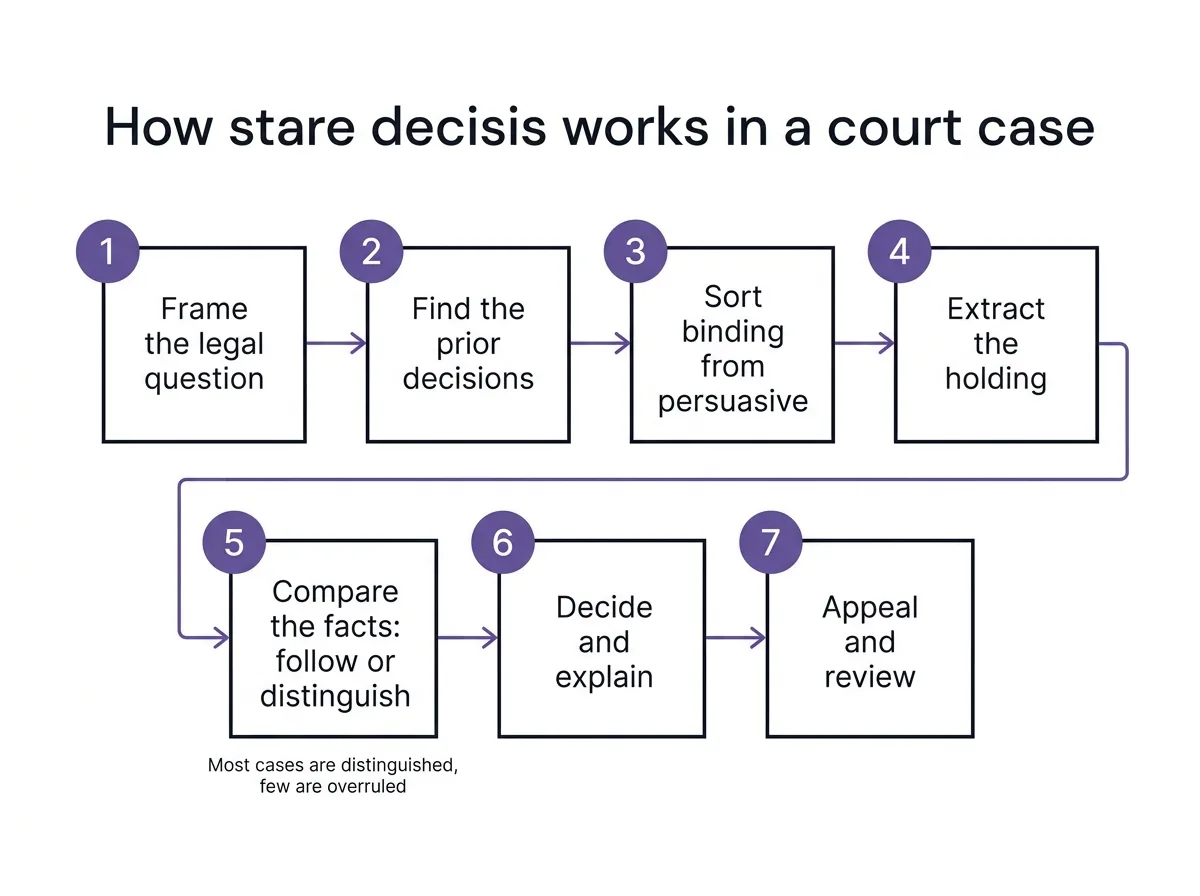
Most of the work happens at stages 4 and 5. Distinguishing a case is far more common than overruling one, and it lets the law adjust at the edges while the core holding stays in place.
When the Supreme Court overrules precedent
The Supreme Court sits at the top of the federal system, so it is the one court that can overrule its own constitutional precedents outright. Lower courts cannot. The justices usually say that more is needed than a belief that the earlier case was wrong.
In *Dobbs v. Jackson Women’s Health Organization* (2022), the majority named five factors that weighed in favor of overruling *Roe v. Wade* and *Planned Parenthood v. Casey*: “the nature of their error, the quality of their reasoning, the ‘workability’ of the rules they imposed on the country, their disruptive effect on other areas of the law, and the absence of concrete reliance.” The Supreme Court’s opinion in Dobbs also reviews earlier overrulings that the justices treated as models.
Statutory precedents get stronger protection than constitutional ones. If the justices misread a statute, Congress can amend it. If they misread the Constitution, only an amendment or a later decision can correct the error.
Famous overrulings
Several of the best known decisions in American law exist because the Supreme Court set an earlier precedent aside:
| Earlier decision | Overruled by | What changed |
|---|---|---|
| *Plessy v. Ferguson* (1896) | *Brown v. Board of Education* (1954) | “Separate but equal” segregation in public schools was struck down |
| *Adkins v. Children’s Hospital* (1923) | *West Coast Hotel Co. v. Parrish* (1937) | States regained room to set minimum wages |
| *Minersville School District v. Gobitis* (1940) | *West Virginia State Board of Education v. Barnette* (1943) | Public schools could no longer compel students to salute the flag |
| *Bowers v. Hardwick* (1986) | *Lawrence v. Texas* (2003) | State laws criminalizing private same-sex intimacy were held unconstitutional |
| *Roe v. Wade* (1973) and *Casey* (1992) | *Dobbs* (2022) | The Court held that the Constitution confers no right to abortion, leaving regulation to elected legislatures |
| *Chevron v. NRDC* (1984) | *Loper Bright Enterprises v. Raimondo* (2024) | Judges stopped deferring to agencies’ reasonable readings of ambiguous statutes |
*Barnette* is often cited because it came only three years after *Gobitis*, with no change in the underlying facts. *Dobbs* had a quick sequel: several states put abortion rules to voters in ballot measures.

Competing views on how strong precedent should be
Judges and scholars disagree about how much weight precedent should carry against a judge’s own reading of the law.
The case for strong stare decisis
Supporters stress stability and predictability. Justice Louis Brandeis wrote in 1932 that “in most matters it is more important that the applicable rule of law be settled than that it be settled right.” People, businesses and governments plan around settled law, and a court that often reverses itself can look political. In *Payne v. Tennessee* (1991) the justices said the doctrine promotes “the evenhanded, predictable, and consistent development of legal principles.”
The case for a weaker doctrine
Critics, many of them originalists, argue that a judge owes loyalty first to the Constitution and the statute, and only then to what earlier judges have said. Justice Clarence Thomas, concurring in *Gamble v. United States* (2019), argued that courts should not follow precedents that are “demonstrably erroneous.” On this view, keeping a wrong decision because it is old lets judges, rather than the people, amend the Constitution.
A pragmatic middle
Many judges treat stare decisis as a strong presumption with exceptions, weighing reliance, workability and changed facts case by case. Critics on both sides say the factors are loose enough to justify almost any result.
Common questions
Is stare decisis in the Constitution?
No. The text does not mention it. Courts treat it as part of the judicial power described in Article III, and its strength comes from judicial practice.
Does stare decisis apply in civil law countries?
Not in the same form. In civil law systems such as France and Germany, judges decide cases mainly from written codes, and earlier decisions are not formally binding in the common law sense. A consistent line of rulings (in French law, *jurisprudence constante*) still carries real weight.
Why is stare decisis important?
It makes the law predictable. When courts follow prior decisions, similar cases tend to get similar outcomes, and people can learn what the law requires before they act.
Sources
- Dobbs v. Jackson Women's Health Organization, 597 U.S. 215 (2022)
- Alexander Hamilton, The Federalist No. 78 (1788)
- Burnet v. Coronado Oil & Gas Co., 285 U.S. 393 (1932) (Brandeis, J., dissenting)
- Payne v. Tennessee, 501 U.S. 808 (1991)
- Gamble v. United States, 587 U.S. 678 (2019) (Thomas, J., concurring)
- LII Wex: Stare decisis