The essay in brief
In a 2003 Policy Review essay, John Rosenthal argued that anti-Semitism in Europe was underreported, homegrown rather than simply imported, and echoed by parts of the political elite. His central claim was that European minority-rights and regionalist politics, built on the idea of native ethnic groups, risked marking Jews and immigrants as outsiders.
Most writing on anti-Semitism and ethnicity in Europe in 2003 asked who was attacking Jews. John Rosenthal asked what political order Europe was building, and where Jews would fit in it. His essay “Anti-Semitism and Ethnicity in Europe,” published in *Policy Review* No. 121 (October and November 2003), opens with the 2002 murder of a teenager in the German village of Potzlow, whose killers called him a Jew although he was not one, and ends with a warning about minority-rights law.
The context: a hard year for Jews in Europe
The Second Intifada began in late 2000, and Israel and support for the Palestinians were fixtures of street protest. In spring 2002 arson attacks hit French synagogues, including one in Lyon that was rammed with burning cars. The Iraq war debate then brought claims in some newspapers about who steered American policy.
Many writers began to speak of a “new anti-Semitism” tied to the Middle East conflict. The OSCE held its first conference devoted only to anti-Semitism in Vienna in June 2003, and the EU’s monitoring centre on racism (EUMC) was preparing a report on anti-Semitic incidents in 2002 and 2003.
According to his author note in *Policy Review*, Rosenthal had taught European and political philosophy in the United States and France and was working on a book on ethnic-national politics. That interest shapes the essay.
The argument in brief
Rosenthal built his case in four steps, each aimed at a view that was common at the time.
- The problem was underreported. English-language media covered the French arson wave, then lost interest even as attacks on people continued. Germany, with more recorded incidents than France, was barely mentioned.
- It did not simply arrive with immigration. He rejected the view that hostility to the Jews was imported by North African and Muslim migrants as a reaction to the Middle East. In his reading, French television and parts of the left made Jews seem acceptable targets, and young men in poor suburbs acted on a climate that others created. Plain delinquency, he added, played a large part.
- Elites used the same motifs. He collected remarks by senior politicians and public figures on a powerful “Jewish lobby” behind American policy in the world, and argued that such talk ran across all of the spectrum, from Christian Democrats to Social Democrats to the anti-globalization left.
- Ethnic politics posed a larger danger than any of these. This is the claim behind the title.
The thesis on ethnicity
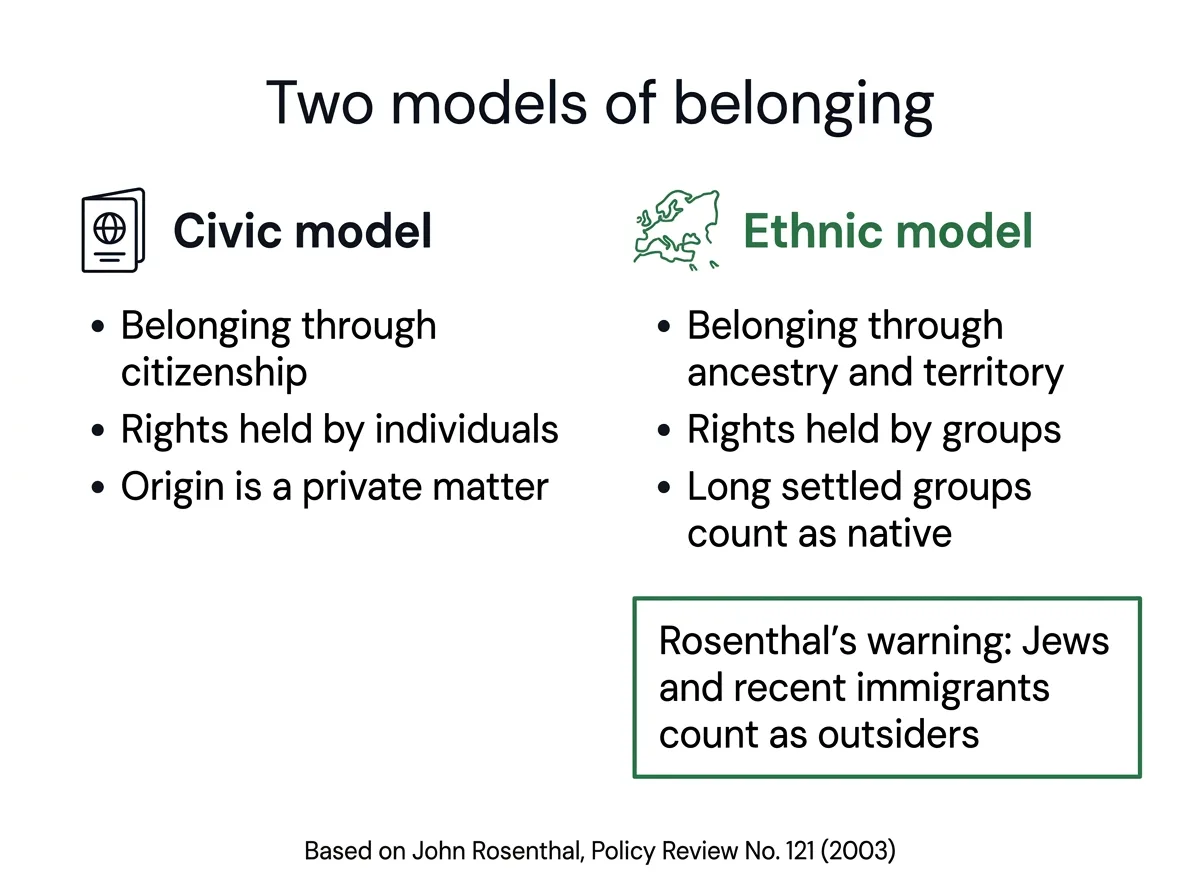
Rosenthal argued that integration was gradually turning ethnic groups into political actors. He pointed to regionalism, minority-rights treaties and a “law of ethnic groups” (in German, *Volksgruppenrecht*) promoted by the Federal Union of European Nationalities (FUEN).
Such frameworks, he wrote, rest on autochthony: a protected nationality is one that has been settled in a defined region for a very long time. Jews are, as usually viewed, neither long settled in one region nor concentrated there. Turks and Algerians are not either. This, in his account, sorts people into those who belong to the soil and those who do not, which he compared to the blood-and-soil ideology that ended in the Holocaust.
Corsica was his example: French data for 2002 showed that 45 of 74 reported anti-Muslim attacks took place on that island, where some nationalist groups claimed responsibility. He traced links between legal theorists of the Third Reich and postwar ethnic-group organizations, relying mainly on one German book. He closed by recalling August Bebel’s description of anti-Semitism as “the socialism of fools.”

The evidence then: France and Germany compared
Rosenthal used official 2002 figures to argue that Germany had a larger, if less reported, problem than France.
| Indicator (2002) | France | Germany |
|---|---|---|
| Source cited | National Consultative Commission on Human Rights (CNCDH) | Federal Ministry of the Interior |
| Anti-Jewish incidents reported | 924 | about 1,594 |
| Violent acts | 193 | not given separately |
| Trend | sharp rise, roughly six-fold | slight fall from about 1,624 in 2001 |
| Pattern in the essay | spikes after Middle East events | steady level since reunification |
He called German anti-Semitism “spectral.” Few Jews lived in most of the country, so vandals targeted cemeteries and memorials, many of them in Berlin. The Jewish population grew from under 30,000 at reunification to perhaps four times that, mostly through immigration from the former Soviet Union. He also rejected the idea that this was mainly an East German problem: the worst attack he cited, a bomb at a Düsseldorf station in 2000, took place in the west.
The French and German statistics use different definitions, and the essay itself argued that the German authorities sometimes declined to classify brutal attacks as anti-Semitic. So the table is only a rough guide.
The evidence now: what official surveys show
The EU Agency for Fundamental Rights (FRA), which succeeded the EUMC in 2007, published its third survey of Jewish people in July 2024.
According to the FRA survey on experiences and perceptions of antisemitism, carried out from January to June 2023 among 7,992 respondents in 13 EU member states:
- 96% encountered anti-Semitism in the year before the survey;
- 80% thought it has increased over the past five years;
- 76% hid their Jewish identity at least occasionally;
- 34% avoided Jewish events or sites because they did not feel safe;
- 75% felt that people held them responsible for the actions of the Israeli government.
Fieldwork ended before the Hamas attacks of 7 October 2023. Jewish organizations consulted by FRA afterward reported further increases.
Reception and criticism
Published replies are hard to trace, but the essay’s claims meet several long-standing objections.
The first concerns minority rights themselves. Defenders of the Council of Europe’s Framework Convention for the Protection of National Minorities point out that its Article 3 lets each person freely choose whether to be treated as a member of a minority.
Second, Jews have not always been excluded. Sweden recognized Jews as a national minority in 2000, and Poland’s 2005 minorities law lists them as well. Critics see this as evidence against the idea that the autochthony test always leaves Jews out.
A third objection is about causation. Critics note that the essay does not show the perpetrators it describes, from Potzlow to the Paris suburbs, knew of minority-rights law, and that a parallel in ideas is not proof of influence.
Some readers also question the sourcing: part of the evidence is official, while other parts rest on anecdotes, one overheard conversation and a single book on the history of FUEN. Supporters of the essay respond that its core figures come from government statistics.
Finally, there is the line between Israel and anti-Semitism. Many writers argue that criticism of Israeli policy must be kept apart from anti-Semitism. Rosenthal granted the distinction in one case, writing that a disputed German campaign flyer critical of Israel was not overtly anti-Semitic, but he treated “Jewish lobby” talk as a clear marker.
How the argument has held up
Some later developments touch on the essay’s themes. The European Commission adopted its first strategy on combating antisemitism and fostering Jewish life in 2021, treating the issue as one for society as a whole.
The ethnicity thesis remains debated. In 2009 the European Court of Human Rights ruled in *Sejdić and Finci v. Bosnia and Herzegovina* that Bosnia’s ethnic power-sharing rules discriminated against a Roma applicant and a Jewish applicant who could not stand for high office. Readers sympathetic to Rosenthal cite the case as an example of the risk he described; others point out that a European court ruled against the arrangement.
Readers’ questions
Is anti-Semitism in Europe imported or homegrown?
Rosenthal argued it was largely homegrown, shaped by media and elites. Current official reports describe incidents from several directions, including right-wing extremist and Islamist milieus as well as hostility linked to the Middle East conflict.
What is the new anti-Semitism?
A term used since the early 2000s for hostility to Jews that is expressed through, or justified by, the Middle East conflict. Where criticism of Israel ends and anti-Semitism begins is still disputed.
Where to read the original essay
The full text of “Anti-Semitism and Ethnicity in Europe” by John Rosenthal is held in the Hoover Institution’s Policy Review archive.
Sources
- John Rosenthal, "Anti-Semitism and Ethnicity in Europe", Policy Review 121 (2003)
- EU Agency for Fundamental Rights: Experiences and perceptions of antisemitism, third survey (2024)
- Council of Europe: Framework Convention for the Protection of National Minorities (1995)
- European Court of Human Rights: Sejdić and Finci v. Bosnia and Herzegovina (2009)
- European Commission: EU Strategy on Combating Antisemitism and Fostering Jewish Life (2021)