Definition
Hard power is the ability of a state to get its way through coercion or payment, using military force and economic pressure. Joseph Nye described it as the "carrots and sticks" of military and economic might, in contrast to the attraction of soft power.
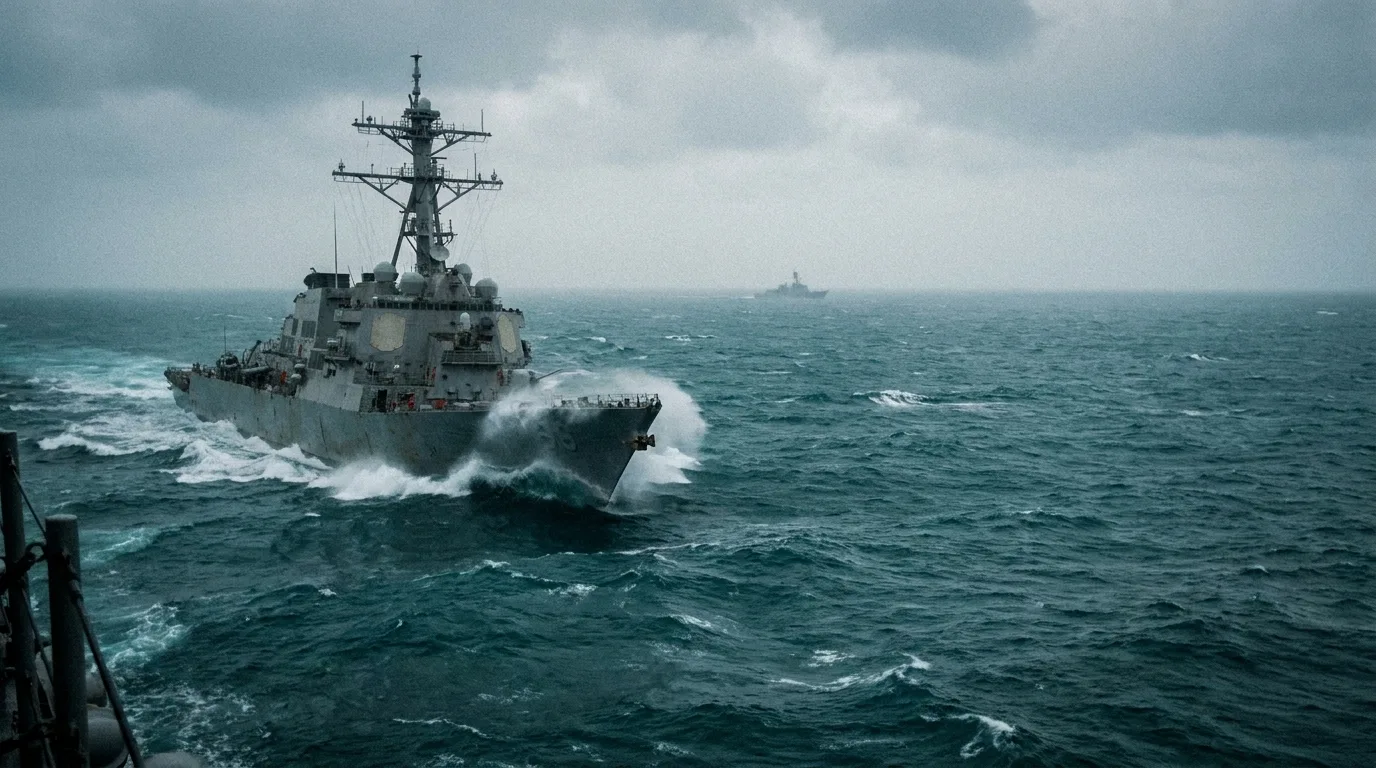
Hard power is the ability of a state to get its way through coercion or payment, using military force and economic pressure. Joseph Nye, the Harvard scholar who set it against soft power, summed it up as “carrots and sticks”: threats and inducements that change how another government acts, whether or not it agrees.
The idea is older than the label, and it still sits at the center of foreign policy. Seven points cover its meaning, its tools and the arguments around it.
1. The idea is ancient, the label is recent
Long before anyone used the phrase, writers on politics treated force as the final currency between states. In Thucydides’ account of the Melian Dialogue, Athenian envoys tell the people of Melos that “the strong do what they can and the weak suffer what they must.” Hans Morgenthau’s *Politics Among Nations* (1948) listed the elements of national power, from geography and industry to the size of the armed forces.
The modern term took hold as a counterpart. In *Bound to Lead* (1990) Nye introduced soft power, the ability to attract, and needed a name for the older kind. Hard power became shorthand for command. It echoes the political scientist Robert Dahl, who in 1957 defined power as A getting B to do something B would not otherwise do.
2. Two forms of power: the military stick and the economic carrot
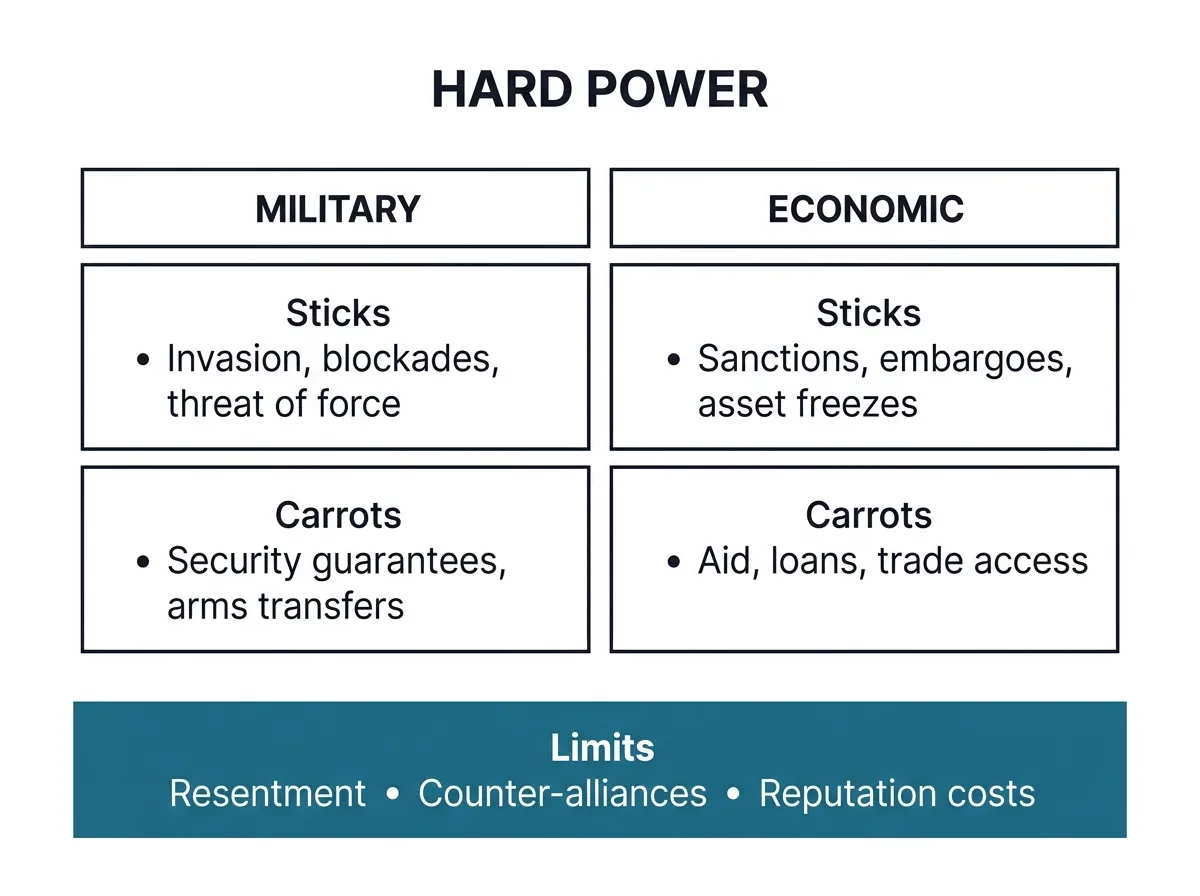
Most definitions split this form of power into a military branch and an economic branch. Each has sticks and carrots.
| Form | Sticks (threats, punishment) | Carrots (inducements) |
|---|---|---|
| Military | Invasion, air strikes, blockades, the threat of force | Security guarantees, arms transfers, basing deals |
| Economic | Sanctions, embargoes, asset freezes, tariffs | Aid, loans, trade access, investment |
Armed force is the most visible kind. Money often does more of the day to day work, because a large market can be opened or closed to a rival without firing a shot. The Marshall Plan, which sent American aid to Western Europe from 1948, is a classic carrot: assistance given with clear strategic aims in the early Cold War.
3. The threat often matters more than the use
Thomas Schelling argued in *Arms and Influence* (1966) that force is often most useful as “the power to hurt” held in reserve. He separated two goals:
- Deterrence: persuading a rival not to start something, as nuclear arsenals did between the United States and the Soviet Union.
- Compellence: forcing a rival to stop or undo something it has already begun.
The Cuban Missile Crisis is the textbook case of coercive diplomacy. In October 1962 President Kennedy announced a naval “quarantine” of Cuba and demanded that Soviet missiles be removed. Within days Khrushchev agreed, in return for a public American pledge not to invade Cuba and a private promise to withdraw U.S. missiles from Turkey. The State Department’s Office of the Historian sets out that sequence. A credible threat did most of the work, with a concession attached.
4. Examples from international relations: sanctions as coercion
Sanctions are a way to use hard power to influence others at a lower cost than war. Some well documented cases:
- Iraq, 1990: after Iraq invaded Kuwait, the UN Security Council imposed broad trade sanctions in Resolution 661.
- Iran: U.S., EU and UN measures over its nuclear program preceded the 2015 nuclear agreement (JCPOA), which eased sanctions in exchange for limits on enrichment.
- Russia: Western sanctions followed the annexation of Crimea in 2014 and grew much wider after the full invasion of Ukraine in 2022.
Whether such measures work is one of the oldest debates in the field. A study by Gary Hufbauer, Jeffrey Schott and Kimberly Elliott, *Economic Sanctions Reconsidered*, found partial success in roughly a third of the cases it examined. Robert Pape replied in *International Security* (1997) that most of those “successes” did not survive closer scrutiny.
5. It can be measured, roughly
Hard power rests on resources you can count, which is part of its appeal to analysts. Common measures include:
- defense spending and the size and quality of the armed forces,
- nuclear weapons and the means to deliver them,
- GDP, industrial base and technology,
- population and geography,
- alliances that add other countries’ strength to your own.
In *World Power Assessment* (1975) Ray Cline tried to combine such factors in a single formula, multiplying material capabilities by strategy and national will. Today the rise of China is the case most analysts watch. The Pentagon’s annual reports on China describe the People’s Liberation Army Navy as the largest in the world by number of ships, while the United States still spends more on defense than any other country. Yet holding the resources is one thing and getting the result is another.
6. More force does not guarantee the outcome
The United States had overwhelming superiority in Vietnam and still failed to secure its goals. In Iraq in 2003, a war justified by claims about weapons of mass destruction, conventional victory came within weeks, but the occupation lasted years and cost far more than planners expected. Coercion can also backfire: it breeds resentment, invites counter-alliances and can damage a country’s reputation, which is a soft power asset.
Defenders answer that none of this makes force less relevant. Diplomacy without a credible military behind it, they argue, is easy to ignore, and the deterrence that kept the Cold War cold rested on hard capabilities.
7. Realists, liberals and the smart power compromise
How much weight force deserves depends on the school of thought, and each makes a serious case.
- Realists hold that in a world without a central authority, states must rely on their own capabilities. John Mearsheimer’s *The Tragedy of Great Power Politics* (2001) treats military strength, and the wealth and population behind it, as what ultimately decides security. Robert Kagan’s essay “Power and Weakness” (2002) argued that the United States and Europe saw the world differently partly because they held such different amounts of it.
- Liberals stress institutions, trade and attraction. Nye himself never dismissed coercion, but he warned that relying on it alone is costly and wears thin over time.
- Smart power is the attempted synthesis of hard and soft power. Suzanne Nossel promoted the term in *Foreign Affairs* (2004), as did Nye, to describe combining coercive tools with diplomacy and attraction. A 2007 CSIS commission and Secretary of State Hillary Clinton both used it to describe American strategy.
Common questions
What is an example of hard power?
A military intervention, a naval blockade or a sanctions package. The 1962 quarantine of Cuba and the sanctions on Russia since 2014 are both widely cited.
What is the difference between hard and soft power?
The first changes behavior through threats or payment. Soft power changes what others want, through culture, political values and policies they find legitimate. Most states use both at once.
Who coined the term?
It came into wide use with Joseph Nye’s writing on soft power from 1990 onward, although the idea of power as coercion in international politics goes back much further.
Is foreign aid hard power?
When aid is offered as a reward for a specific policy change, it works as a carrot and counts as hard power. Aid that builds goodwill over time sits closer to soft power.
Sources
- Joseph S. Nye Jr., Bound to Lead: The Changing Nature of American Power (Basic Books, 1990)
- Thomas C. Schelling, Arms and Influence (Yale University Press, 1966)
- Robert A. Dahl, "The Concept of Power", Behavioral Science 2 (1957)
- Hans J. Morgenthau, Politics Among Nations (1948)
- Gary C. Hufbauer, Jeffrey J. Schott and Kimberly A. Elliott, Economic Sanctions Reconsidered
- Robert A. Pape, "Why Economic Sanctions Do Not Work", International Security 22 (1997)
- John J. Mearsheimer, The Tragedy of Great Power Politics (W. W. Norton, 2001)
- Office of the Historian: The Cuban Missile Crisis, October 1962