The essay in brief
In "Democratic Imperialism: A Blueprint" (Policy Review, 2003), Stanley Kurtz argued that British India, not postwar Japan, was the real precedent for democratizing Iraq. Democracy there grew slowly, through education of a liberal class and local self-government, so he urged a long, guided occupation with national elections postponed.

In the spring of 2003, as American troops moved toward Baghdad, the writer Stanley Kurtz published “Democratic Imperialism: A Blueprint” in *Policy Review* No. 118. Washington was already arguing over whether a war could make Iraq a democracy. Kurtz asked what nation building on that scale demands, and for how long.
For his answer, Kurtz set aside postwar Japan and turned to the history of British India and to three thinkers who argued over it: Edmund Burke, James Mill and John Stuart Mill. This guide walks through his plan step by step, then looks at the political debate, the critics and the record.
The argument in brief
Kurtz made five linked claims:
- The United States was not yet an empire, but Iraq forced the imperial question on it.
- Japan after 1945 was a misleading model, since it was already modern and had its own parliamentary past.
- British India was the better precedent, because a country with no democratic tradition became a lasting democracy.
- Democracy in India grew slowly, through education and a new administrative class.
- A period of guided, undemocratic control could therefore lead to democracy, and that idea fits within liberalism.
He did not hide the costs of the British imperial experience: exploitation, racial contempt, the harsh response to the revolt of 1857 and a long refusal of self-rule. In many respects, Kurtz wrote, India showed what not to do. Yet it was also the most striking case in which liberal policy had worked.
Why India and not Japan?
Many supporters of the war pointed to Japan and Germany, the two great democratization stories after the Second World War. President George W. Bush did so in a speech on the future of Iraq on 26 February 2003, saying that people had once called those cultures incapable of democracy and that the same doubt about Iraq was mistaken.
Kurtz thought the comparison made the task look easy. Japan had industry, a working bureaucracy and a single national culture when the occupation began. Iraq had none of these and was divided by region, sect and tribe. The starting point of democracy in India, he argued, was closer.
The blueprint, step by step
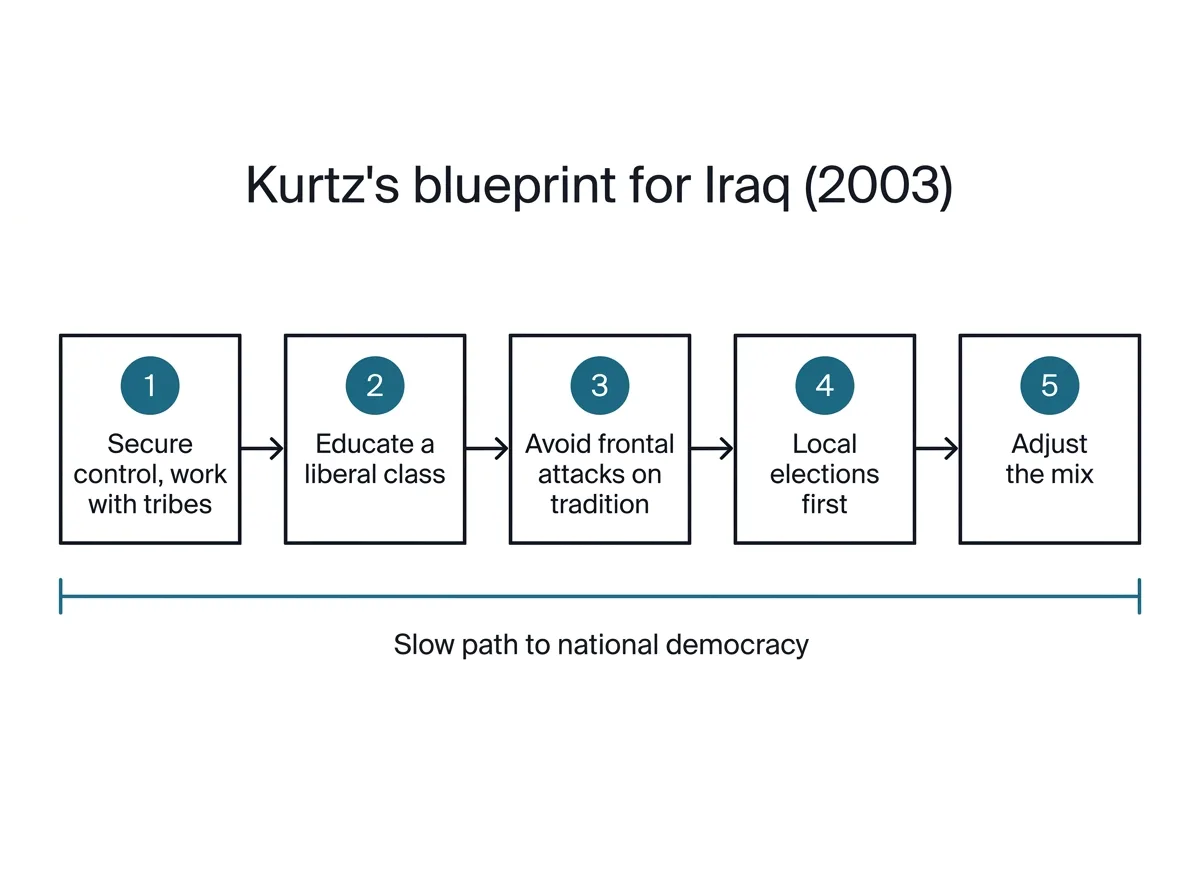
Kurtz did not number his plan, but the essay implies a sequence.
Step 1: Secure control and work with the tribes
An occupation begins under military control. Armed tribal leaders cannot simply be pushed aside, so the new authority has to cooperate while it builds its own reach. Over time, in his view, a modern state needs a monopoly on force, and patronage through kin and tribe has to give way to merit.
*Result: a stable order, bought with compromises that later have to be undone.*
Step 2: Educate a modern, liberal class
This was the core of the plan. In the 1830s, British reformers won a fight over education and built English-language schools. Over the next decades those schools produced a class of Indians trained in liberal ideas. They staffed the courts and offices, and after 1885 their leaders shaped the independence movement. Kurtz put this class at only 1 or 2 percent of the population.
For Iraq he proposed the same effort, compressed into one generation: Western teachers and judges, helped by Iraqis returning from exile.
*Result: a small reformist elite that grows up next to traditional social structures.*
Step 3: Avoid frontal attacks on tradition
James Mill’s land reforms were Kurtz’s warning. Mill expected that secure title for individual peasants would free them from local elites and set off growth. In Kurtz’s account the reforms broke up village government, yet no enterprising peasantry appeared, because caste and the joint family survived. The Iraqi counterparts, he suggested, are lineage, tribe and family honor.
*Result: patience about social change, and new institutions built beside old ones.*
Step 4: Start democracy at the local level
John Stuart Mill worked for the East India Company for more than three decades, as his father James Mill had before him. In *Considerations on Representative Government* (1861) he warned against elections in societies that lacked the habits democracy needs, and he described local assemblies that support the central power instead of competing with it. British India adopted reforms of this kind in the 1880s. Kurtz proposed the same order for Iraq: local elections first, while national power stays with the occupier.
*Result: practice in self-government without a national vote that could bring faction or a new dictator.*
Step 5: Adjust the mix as conditions change
British policy swung between respect for local elites and bursts of reform, and John Stuart Mill moved between these camps as circumstances changed. Kurtz saw Mill’s flexibility as the model for any foreign administration in Iraq. As he put it in his closing lines, “Authentic democracy develops slowly.”
*Result: what Kurtz called “blended rule”, a mix of direct and indirect control whose balance shifts with events.*
Where did the essay sit in the democratization debate?
The political argument before the war set realists against democratizers. Realists warned that elections in the Arab world could bring ethnic strife or elected tyranny. Democratizers answered that a people learns democracy by choosing its own governments. Kurtz stood between them. He treated delay as a liberal position and cited Mill as proof that the founders of liberalism had seen it the same way.
He also took on the moral case against the empire idea. For all the good it may do, any empire humiliates the people it governs, he admitted. But decades of independence had not brought democracy to Iraq, and an occupation aimed at building one, justified as self-defense after September 11, was in his view as just as such a project can be. European empires, by contrast, had been built for gain.

What did the critics say?
The first public exchange came within weeks. In April 2003 Kurtz traded posts with the blogger Josh Marshall, who had argued in *Washington Monthly* that the administration was not open about its democratizing aims for the region. Kurtz replied that these aims were no secret. Marshall held that the public had still not been told their full scope.
Critics of liberal imperialism have raised broader objections that also bear on Kurtz’s plan:
| Objection | The point |
|---|---|
| The India story is too rosy | Indian democracy owed much to Indian leaders and a mass movement against British rule. |
| Mill is a poor guide | Scholars such as Uday Singh Mehta and Jennifer Pitts have studied how liberal thinkers, Mill among them, justified empire, and see it as a flaw in liberalism. |
| Time and nationalism | Kurtz admitted Iraq would not allow a century of tutelage, and that Iraqis had rebelled against British rule in 1920. |
| Who governs? | Critics asked how deep American involvement could go under an Iraqi government and still look legitimate to the world. |
How has democratic imperialism held up?
Events did not follow the essay’s timetable. The Coalition Provisional Authority, created in 2003, ran Iraq for little more than a year. It dissolved the army and removed former Baath party members from public jobs. Unlike Kurtz’s proposal, these steps replaced existing institutions rather than building new ones beside them. Sovereignty passed to an interim Iraqi government in June 2004, national elections followed in January 2005, and a constitution was approved by referendum that October. American troops left at the end of 2011.
That timetable was close to the opposite of Kurtz’s. The occupation of Iraq was short, national elections came early, and the education of a new class played little part. His supporters see the insurgency and sectarian war as proof that his warnings were right. His critics answer that a longer, more openly imperial occupation would have provoked even more nationalist resistance against the occupier, and the alternative cannot be tested.
Readers’ questions
What does democratic imperialism mean here?
Kurtz used it for temporary, guided rule by a democratic power whose aim is to make the governed society able to rule itself.
Was Kurtz against elections in Iraq?
He opposed early national elections. Local voting was part of his plan from the start.
Where to read the original
The full text of “Democratic Imperialism: A Blueprint” by Stanley Kurtz, *Policy Review* No. 118 (April and May 2003), is archived by the Hoover Institution. It runs to more than 7,000 words.
Sources
- Stanley Kurtz, "Democratic Imperialism: A Blueprint", Policy Review 118 (2003)
- President George W. Bush, remarks on the future of Iraq, 26 February 2003
- John Stuart Mill, Considerations on Representative Government (1861)
- Josh Marshall, Talking Points Memo, reply to Stanley Kurtz, 8 April 2003