The essay in brief
Paul J. Saunders argued in 2001 that Washington's faith in globalization led it to expect too much from post-Soviet Russia: public pressure for change was weak, investment arrived anyway, markets did not bring democracy, and a democratic Russia would not automatically be a partner. He urged realistic expectations and less unsolicited advice.
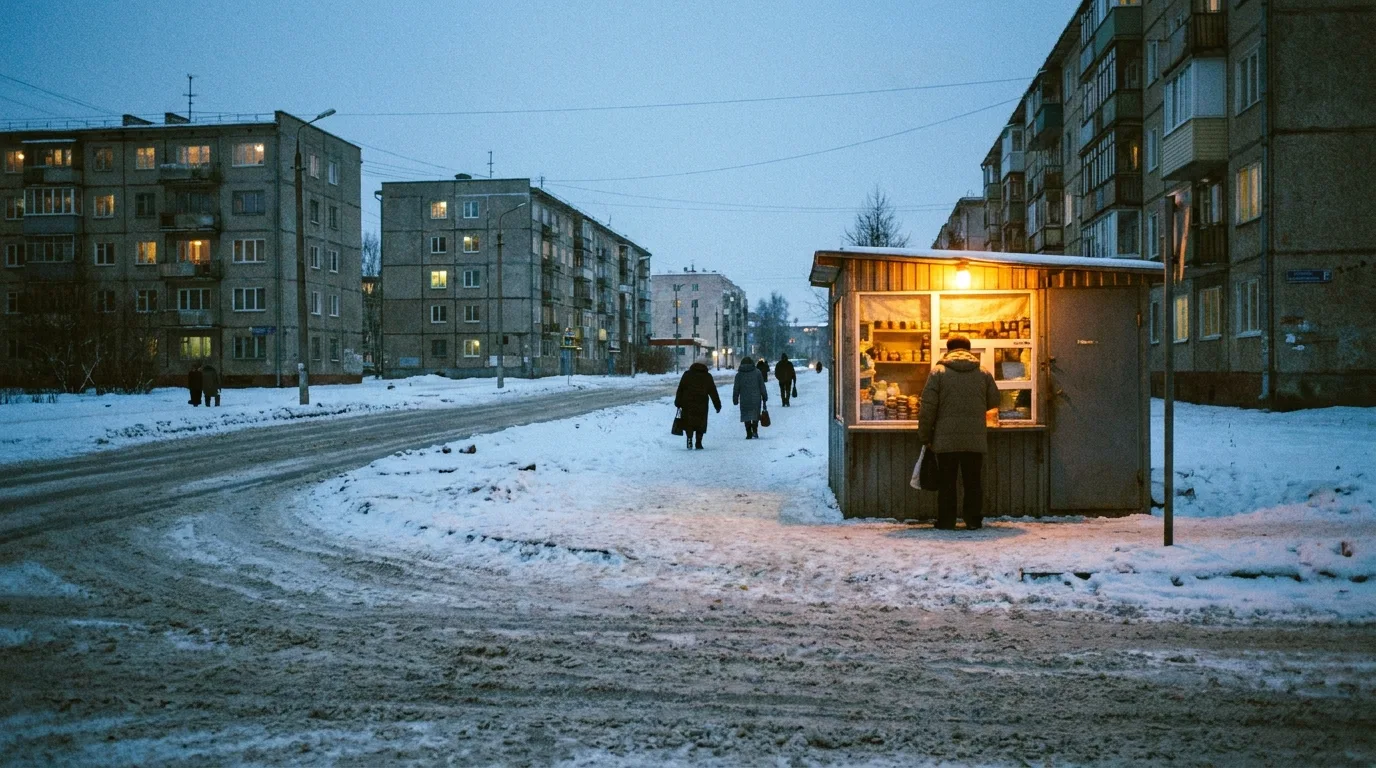
In 1992 Russia looked like an easy case. It had oil and gas, an educated population, a free press and leaders who wanted to join Western markets. Nine years and tens of billions of dollars in foreign aid later, Saunders found Russia still poor and far from democratic. In “Why ‘Globalization’ Didn’t Rescue Russia,” published in *Policy Review* No. 104 (February & March 2001), Paul J. Saunders looked at globalization and Russia side by side and asked why the two had not fit. His short answer: Washington trusted a theory more than the country in front of it.
What did Saunders actually argue?
Saunders, then director of the Nixon Center in Washington, accepted that global integration explained much of what had changed since the end of the Soviet Union. His target was a chain of reasoning that, in his view, shaped American policy toward Moscow from 1992 on.
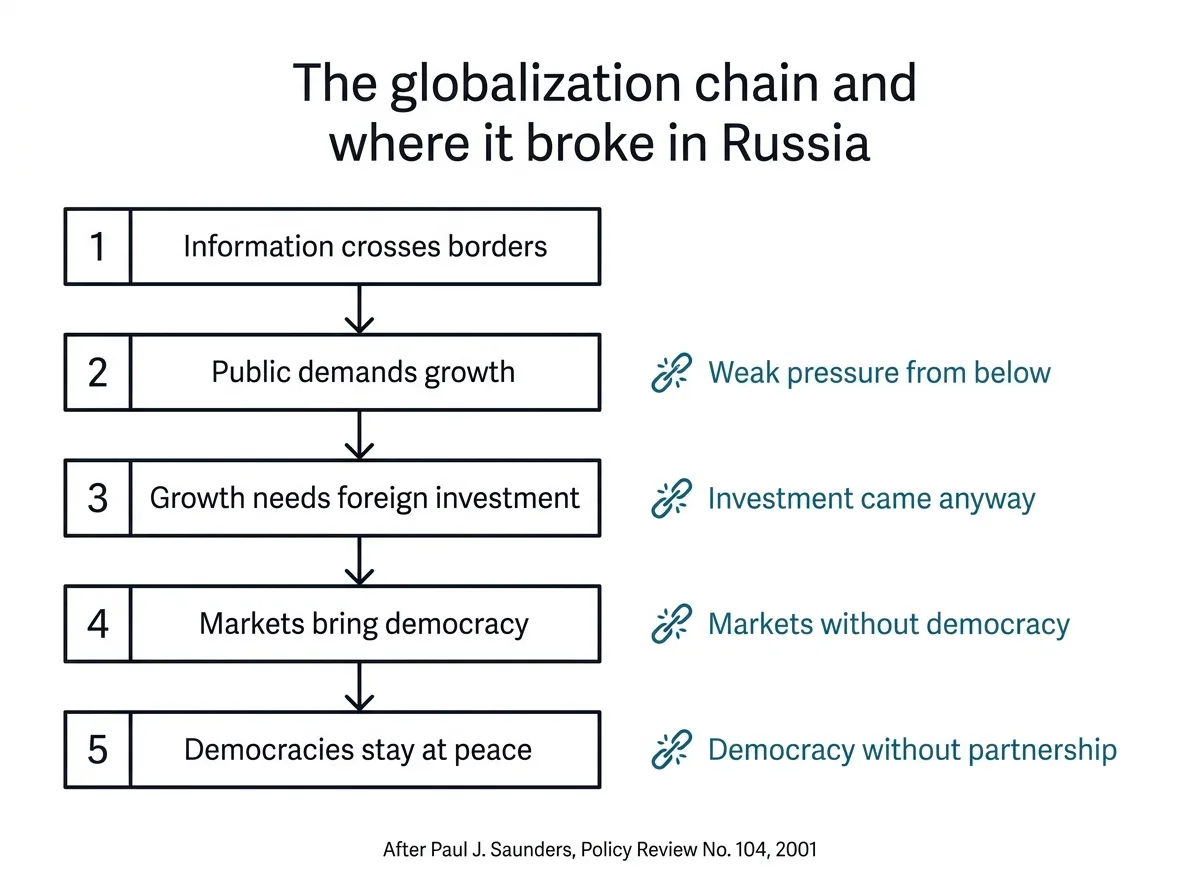
Thomas Friedman of The New York Times gave that chain its best-known form in *The Lexus and the Olive Tree* (1999). Saunders summarized it roughly like this:
- Information crossing borders shows ordinary people how well the West lives.
- They press their government for economic growth.
- Growth needs foreign capital, and Friedman’s “electronic herd” of investors rewards an open market economy and the rule of law.
- The institutions that attract capital also favor democracy.
- Prosperous democracies trade with each other instead of fighting.
In Russia, Saunders argued, almost every link was weak. In his view, the result was a set of expectations that could not be met, and American advice that made things worse.
Where did the expectations of the 1990s go wrong?
The heart of the essay is a comparison between what the theory predicted and what Russia had become by 2000.
| What the theory expected | What Saunders saw by 2001 |
|---|---|
| Exposure to Western life creates public demand for change | Most of the Russian people wanted a “normal” life; many missed the modest comforts of the Brezhnev years, and a minority were hostile to American consumer culture |
| Only liberal policies attract investment | Oil, gas and a market of 150 million drew some money anyway; returning flight capital and IMF credits filled other gaps |
| Economic change brings democracy | Yeltsin dissolved the Supreme Soviet by force in 1993 and often ruled by decree; Putin pursued liberal economic goals while curbing governors, oligarchs and NGOs |
| A democratic Russia becomes a willing partner | Russia and the United States split over NATO, humanitarian intervention, missile defense and Caspian pipelines; by his count some 85 percent of Russians thought Washington wanted to dominate the world |
From this he drew four flaws. Pressure from below was weak. Pressure from investors was weak too, because some money would arrive whatever the Russian government did, so it could muddle along for years. Political and economic opening did not travel together, and a “Chilean model” of growth under a strong hand already had admirers in Moscow. Finally, democracy did not guarantee friendship: a state that answered to its own voters might well be more assertive.

How did the theory shape American advice?
Saunders saw two consequences. The first was tone. Officials spoke as if history ran in one direction, toward the American model, and many Russians heard this as lecturing. He pointed to a 1997 letter from Deputy Treasury Secretary Lawrence Summers to Anatoly Chubais, then first deputy prime minister, which reached a Moscow newspaper and offered tactical advice on getting a tax code through the Duma.
The second was that economics came before politics. Aid was run through the International Monetary Fund, and progress was measured by inflation and deficits, not by the quality of Russian democracy. Credits kept flowing through the first Chechen war and the 1996 presidential campaign, whose fairness many observers questioned.
The shock therapy program began with the freeing of most prices in January 1992 under Yegor Gaidar. By December he was out as acting prime minister, replaced by Viktor Chernomyrdin. Strobe Talbott’s remark that Russia needed “less shock and more therapy” came, in Saunders’s account, only after the violent crisis of October 1993 and the nationalist gains in the Duma elections. He stressed that the economic program was meant to serve a political end: a middle class that would anchor democracy. In his assessment, neither goal was reached.
What was happening in Russia when he wrote?
Boris Yeltsin resigned at the end of 1999. Vladimir Putin won the presidency in March 2000 and promised a “dictatorship of law.” The Russian economy was growing again after the August 1998 ruble crash, helped by high oil prices and a cheap currency. In Washington the Clinton administration was leaving and the new Bush team was reviewing its approach.
His advice to that team was modest:
- expect little pressure from below and modest results for Russian democracy;
- stop giving unsolicited advice to foreign governments, except in extreme cases such as genocide;
- treat Moscow as a democracy only if it acts like one;
- stop granting status it has not earned, as with its seat at the G-7 table;
- help Russia find its own place in the global system, since a power left outside may unsettle markets.
How did critics and defenders respond?
Saunders joined a debate that was already sharp. He drew on Joseph Stiglitz, then chief economist of the World Bank, who argued that the reformers neglected the laws and institutions a market needs. Stiglitz’s 1999 keynote “Whither Reform? Ten Years of the Transition” set China against Russia: over the decade, as the World Bank’s conference volume summarizes it, China doubled its GDP while Russia’s fell by more than half and inequality doubled.
Defenders of the reformers are less gloomy:
- Anders Åslund blamed rent seeking by a well-placed elite, not excessive speed.
- Marek Dabrowski, Stanislaw Gomulka and Jacek Rostowski answered Stiglitz in “Whence Reform?” (2000), arguing that he misread both the Chinese and the Russian cases.
- Andrei Shleifer and Daniel Treisman argued in *Foreign Affairs* (2004) that Russia had become “a normal country,” a typical middle-income state.
Stephen F. Cohen’s *Failed Crusade* (2000) judged Washington far more harshly. Saunders sat between these camps. He agreed that change had outrun political consent, but he wrote as a foreign policy realist and placed the error in a theory that promised markets, democracy and partnership as one package.
Has his argument held up?
Supporters of the essay point to later events. Within months state-controlled Gazprom took over the independent television network NTV. The 2003 arrest of Mikhail Khodorkovsky and the breakup of Yukos drew criticism from Western governments as selective justice. Russia joined the World Trade Organization in 2012 and stayed tied to European energy and other markets, while political competition narrowed, which supporters read as close to the Chilean model he flagged. Its foreign policy also became more assertive as the country grew richer, from the 2008 war with Georgia to the annexation of Crimea in 2014 and the full-scale invasion of Ukraine in 2022.
Critics point to parts that were less accurate. He expected investment to stay too thin for sustained growth, but the oil boom of the 2000s gave the Kremlin far more money than he foresaw. Defenders of the Yeltsin era also note that growth after 1999 rested partly on foundations laid in the 1990s.
Readers’ questions
Why did shock therapy fail in Russia?
How far it failed is itself debated. Stiglitz and Saunders stress missing institutions and neglected politics. Åslund points to rent seeking and half-finished change. Many accounts agree that privatization without working courts and corporate governance concentrated wealth instead of building a broad middle class.
Was Saunders against globalization?
No. He objected to treating it as a guarantee that markets, democracy and partnership would arrive together.
Does the democratic peace idea apply to Russia?
Saunders doubted it would help much. Even if democracies rarely fight each other, a democratic Russia could still clash with American interests, for example over Iran, and most of its neighbors are not consolidated democracies.
Where can I read the original essay?
The full text of “Why ‘Globalization’ Didn’t Rescue Russia” by Paul J. Saunders, *Policy Review* No. 104 (February & March 2001), is in the Hoover Institution’s Policy Review archive.
Sources
- Paul J. Saunders, "Why 'Globalization' Didn't Rescue Russia", Policy Review 104 (2001)
- Joseph E. Stiglitz, "Whither Reform? Ten Years of the Transition", Annual World Bank Conference on Development Economics 1999
- Thomas L. Friedman, The Lexus and the Olive Tree (Farrar, Straus and Giroux, 1999)
- Marek Dabrowski, Stanislaw Gomulka and Jacek Rostowski, "Whence Reform? A Critique of the Stiglitz Perspective" (2000)
- Andrei Shleifer and Daniel Treisman, "A Normal Country", Foreign Affairs (2004)
- Stephen F. Cohen, Failed Crusade: America and the Tragedy of Post-Communist Russia (Norton, 2000)