The essay in brief
Nicholas Eberstadt argued in 2004 that population shapes power in Asia less through raw size than through what happens inside countries: aging, health and sex ratios. His most quoted line: Japan became rich before it became old, China will do it the other way around.

In early 2004, *Policy Review* published a long essay by the demographer Nicholas Eberstadt titled “Power and Population in Asia.” It asked a question that sounds simple: how, exactly, do human numbers change the strategic balance between states? He looked ahead to 2025, a year that has now come and gone, which makes the essay unusually easy to test.
This guide walks through the argument one step at a time, then covers the context, the debate and a check of his 2025 figures against UN data.
The argument in seven steps
Eberstadt, then at the American Enterprise Institute, adapted the essay from a chapter for *Strategic Asia 2003–04*, published by the National Bureau of Asian Research. Nicholas Eberstadt builds his case in steps, each of which narrows the question.
Step 1: Demography shapes what is possible
He opens with the line attributed to Auguste Comte, “demography is destiny,” and says it “promises too much and offers too little.” Demographic changes are slow and regular compared with economic or political ones, because they unfold over decades. That is why they can be projected for the next generation: most of the people who would live in East Asia in 2025 had already been born. Demography does not decide outcomes. It widens or narrows the options open to governments.
Step 2: The population explosion is over
The image of Asia as a place of runaway growth was, he argued, out of date. Over the last three decades, fertility rates had fallen by about three fifths in East Asia and by over half in Southeast Asia. Thailand and cities like Mumbai were already below replacement. The growth that remained came mostly from longer lives, not from large families. In his phrase, the Asian population explosion had really been a health explosion.
Step 3: Shifts in relative size matter less than people think
He listed striking changes between neighbors from 1975 to 2025: India nearly catching up, Vietnam pulling ahead of Thailand, Pakistan overtaking Russia. Then he questioned their weight. Germany outgrew France in the nineteenth century, but industry and unification did more of the work. Raw headcounts, he concluded, tell strategists less than they assume, because force and influence depend on what happens inside a country: its age structure, its health and its social cohesion.
Step 4: Aging is the real constraint, and it is uneven
The core of the essay is the graying of the region. He was cautiously hopeful about Tokyo’s prospects, because a healthy and rich society can keep its senior citizens working and repair its pension rules. The mainland was another matter. His best-known sentence put it plainly: “Japan became rich before it became old; China will do things the other way around.” Beijing had no broad pension system, much work was manual, and fewer children would support their aging parents.
Step 5: Mortality can go backwards
Russia was his warning case: male life expectancy in 2001 was lower than four decades earlier, in peacetime, driven by heart disease and injuries. He doubted the country could build a modern economy on that health profile. HIV/AIDS was his wild card for Russia, India and China.
Step 6: Missing girls and a marriage squeeze
The 2000 Chinese census recorded a sex ratio at birth of just under 118 boys per 100 girls, against a biological norm of about 103 to 105. Son preference, low fertility and prenatal sex selection had combined. He expected that more than 10%, perhaps 15% or more, of young Chinese men would find no bride, with India showing similar trends. He thought claims that this would make China more warlike went too far, but he did expect social strain for the next generation.
Step 7: America’s demographic advantage
With immigration and higher fertility than Europe or East Asia, the United States was projected to grow by 26% between 2000 and 2025 and to age slowly. He saw a limited but real margin for American influence.

Context: why the essay appeared when it did
By 2004 China had joined the World Trade Organization and its economic growth was rapid. The older literature still worried about overpopulation. A newer school, the “demographic dividend” work of David Bloom, David Canning and Jaypee Sevilla, credited part of East Asia’s boom to a favorable age structure, which meant many workers for every dependent.
Eberstadt pushed back on both: the alarm about global growth was stale, and dividend arguments gave crude age ratios too much credit for economic success.
Reception and debate
The line about getting old before getting rich has been repeated in policy reports and the press for two decades as shorthand for China’s demographic trends and its social challenges. The *Asia-Pacific Journal: Japan Focus* reprinted the essay later in 2004.
There are several lines of disagreement:
- Sex ratios and conflict: Valerie Hudson and Andrea den Boer argued in “A Surplus of Men, A Deficit of Peace” (2002) and later in *Bare Branches* that a large surplus of young men can raise the risk of instability. Eberstadt engaged that view but judged the link to the use of force overstated.
- Aging and military strength: the political scientist Andrew Oros argues in *Asia’s Aging Security* (2025) that shrinking states can remain formidable military actors, partly through technology, and that countries are not condemned by their age profiles.
- The dividend: economists in the Bloom and Canning tradition have continued to find that age structure helps explain economic growth when policy allows it.
Eberstadt has kept developing the theme, most visibly in his 2024 *Foreign Affairs* essay “The Age of Depopulation.”
How the 2025 projections have held up
The essay drew on the UN Population Division’s 2002 revision. The table below sets his 2025 figures beside the estimates in the UN’s World Population Prospects 2024.
| Country | Projected for 2025 (2004 essay) | UN WPP 2024, year 2025 |
|---|---|---|
| China | over 1.4 billion | 1.42 billion |
| India | over 1.3 billion | 1.46 billion |
| Japan | 123 million | 123 million |
| South Korea | 50 million | 52 million |
| Pakistan | 250 million | 255 million |
| Russia | 124 million | 144 million |
| Vietnam | 105 million | 102 million |
| Thailand | 74 million | 72 million |
| United States | 358 million | 347 million |
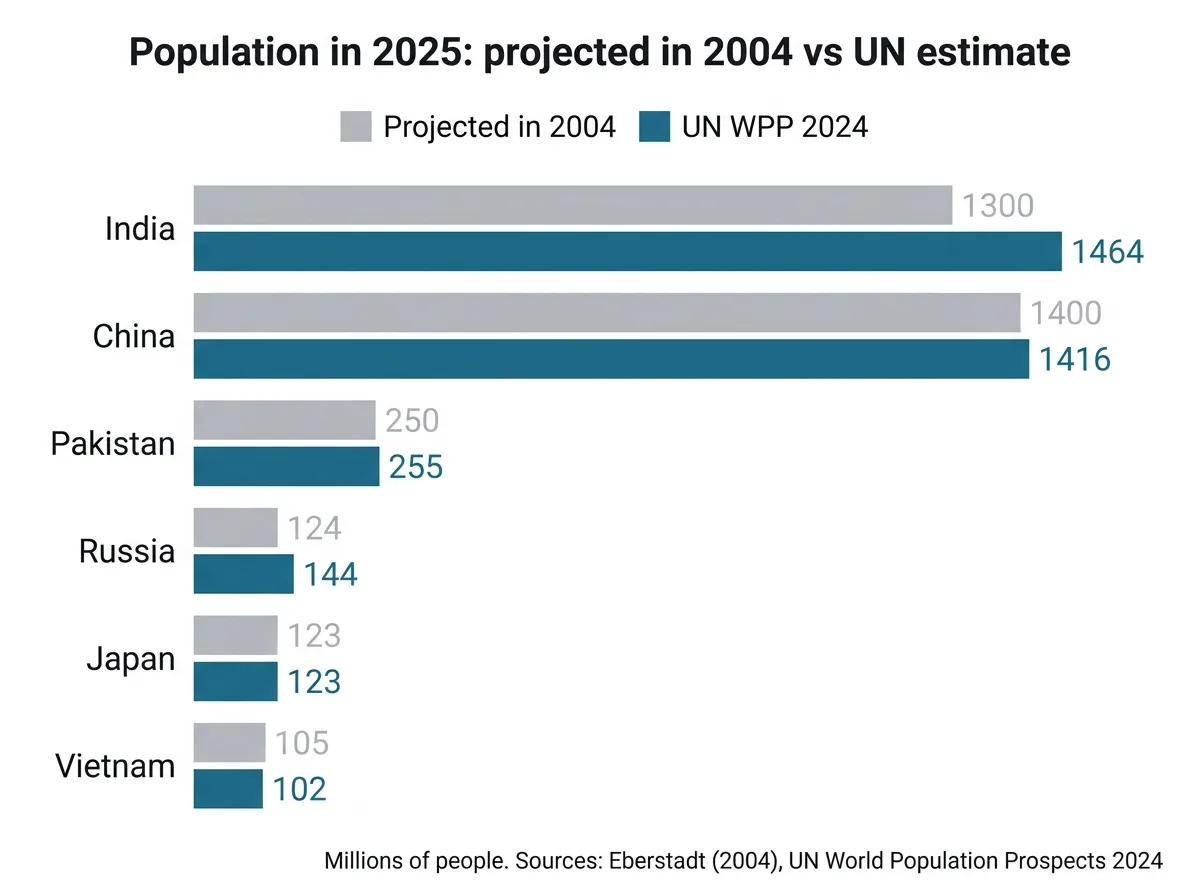
Where the projections hit and missed:
- India came faster than expected. He projected China to stay about 5% larger. Instead, the UN estimates that India overtook China in 2023, and the Chinese fertility rate has fallen to about one birth per woman.
- Russia did better than he feared. UN data put male life expectancy near 68 in 2025, up from below 60 at the start of the century, and the population is about 20 million above the 2004 figure.
- The aging calls were close. The median age is about 50 in Japan, 46 in South Korea and 40 in China, all at or slightly above his projections.
China’s sex ratio at birth, now about 110 in UN estimates, has eased from its 2000 peak but is still above the natural range. The US total is lower than projected, though Americans remain younger on average and are aging more slowly over the years than people in China, South Korea or Japan.
Readers’ questions
Is demography destiny?
Not in Eberstadt’s account. Population sets limits, but politics and institutions decide what states do with them.
Did China get old before it got rich?
By the measures Eberstadt used, largely yes. Its median age has passed 40, while income per person is still far below the level of the richest East Asian economies.
What did the essay get most wrong?
The Russian collapse he feared did not arrive in the form he modeled, partly because mortality improved, and the HIV scenarios for India and China proved far too high.
Where to read the original
The full text of “Power and Population in Asia” by Nicholas Eberstadt, *Policy Review* No. 123 (February & March 2004), is in the Hoover Institution’s Policy Review archive.
Sources
- Nicholas Eberstadt, "Power and Population in Asia", Policy Review 123 (2004)
- United Nations, World Population Prospects 2024
- Valerie M. Hudson and Andrea den Boer, "A Surplus of Men, A Deficit of Peace", International Security (2002)
- Andrew L. Oros, Asia's Aging Security (Columbia University Press, 2025)