Foreign Policy
How states deal with one another: power, alliances, doctrines and the theories that explain them.
7 concepts explained · 5 essay guides
Left: closer to domestic politics. Up: closer to theory. Placement is orientation, not judgement.
Placement: Policy Review editors, reviewed October 2026.
Concepts in this field
- Balance of Power in International Relations: A Plain Guide The balance of power is the idea that states stay secure when power in the international system is spread out, so that no single…
- Eisenhower Doctrine: Five Myths and What the 1957 Policy Said The Eisenhower Doctrine was a 1957 Cold War policy under which the United States offered economic aid, military assistance and, on request, US armed…
- Hard Power Explained: Seven Things to Know About Force, Money and Coercion Hard power is the ability of a state to get its way through coercion or payment, using military force and economic pressure. Joseph Nye…
- Isolationism: What It Means and How It Shaped American Foreign Policy Isolationism is a foreign policy that keeps a country out of the political affairs, alliances and wars of other nations. In the United States…
- Realpolitik: From Bismarck to Kissinger, and the Argument Over What It Means Realpolitik is an approach to politics and foreign policy guided by the actual distribution of power and by concrete national interests, rather than by…
- Soft Power Compared: How Attraction Differs from Hard and Smart Power Soft power is the ability of a country or another actor to get what it wants by attracting others rather than by coercing or…
- What Is Foreign Policy? Goals, Tools and Four Schools Compared Foreign policy is the set of goals, strategies and actions a country uses to manage its relationships with other nations and international bodies. It…
Essay guides in this field
- Democratic Imperialism: Stanley Kurtz’s Blueprint for Iraq In "Democratic Imperialism: A Blueprint" (Policy Review, 2003), Stanley Kurtz argued that British India, not postwar Japan, was the real precedent for democratizing Iraq.…
- Power and Population in Asia: Nicholas Eberstadt’s 2004 Essay, Step by Step Nicholas Eberstadt argued in 2004 that population shapes power in Asia less through raw size than through what happens inside countries: aging, health and…
- Why Globalization Didn’t Rescue Russia: Paul Saunders’s 2001 Essay Paul J. Saunders argued in 2001 that Washington's faith in globalization led it to expect too much from post-Soviet Russia: public pressure for change…
- China’s Quest for Asia: Five Claims About Southeast Asia, Checked Against What Happened Dana Dillon and John J. Tkacik Jr. argued in 2005 that China had already become the dominant power in Southeast Asia, using trade deals,…
- Power and Weakness: Robert Kagan’s Mars and Venus Essay Explained Robert Kagan argued in 2002 that Americans and Europeans see the world differently because of a gap in power: the strong are more willing…
Foreign policy is the part of public policy that deals with everything outside a country’s borders: how a government treats other countries, international organizations and non-state actors, and what it is prepared to do to protect its interests and values. This section collects explainers on the core concepts of foreign policy and guides to essays that shaped the debate. The notes below map the field, so you can see how the pieces fit together.
What does the field of foreign policy cover?
Foreign policy is both a practice and a subject of study. As a practice, foreign policy involves the goals, strategies and diplomatic decisions a country uses in its relations with other nations. The study of foreign policy sits inside political science, next to international relations, and asks why governments choose the foreign policies they do. Political scientists compare countries, while historians trace how one country’s foreign policy has changed over time.
The field usually covers four broad areas:
- Diplomacy: negotiation, embassies, treaties and diplomatic work in international bodies such as the United Nations.
- Economic statecraft: trade agreements, sanctions, foreign aid for development and access to global markets and energy.
- Defense: military alliances and deterrence, and the commitments nations make to their allies.
- Ideas and values: promoting human rights, democracy or national independence, and the image a country projects in the international system.
The objectives of foreign policy often pull against each other. A country may want cheap imports and also want to punish the regime that sells them. A policy can also promote economic development abroad while hurting a domestic industry. Much of the work, and most of the argument, is about ranking objectives when they collide.
How is foreign policy different from international relations?
The two terms overlap, and many university departments teach them together. The difference is the level of analysis.
International relations looks at the whole international system: how capabilities are distributed among nations, why wars start, why cooperation holds or breaks down. Foreign policy analysis looks inside one country and asks how its decisions are made. Who sits in the room? Which agencies compete? What do leaders believe about the world?
A classic example is Graham Allison’s *Essence of Decision* (1971). Allison studied the Cuban missile crisis through three lenses: the rational actor model, in which the government acts like one calculating person; an organizational model, in which agencies follow their routines; and a bureaucratic politics model, in which officials bargain with each other. The book is still a standard text because it shows that the same decision can look very different depending on where you look.
Robert Putnam added another layer in 1988 with the idea of two-level games. Leaders negotiate abroad and at home at the same time, so any deal with other countries also has to survive domestic politics.
What are the main schools of thought in foreign policy?
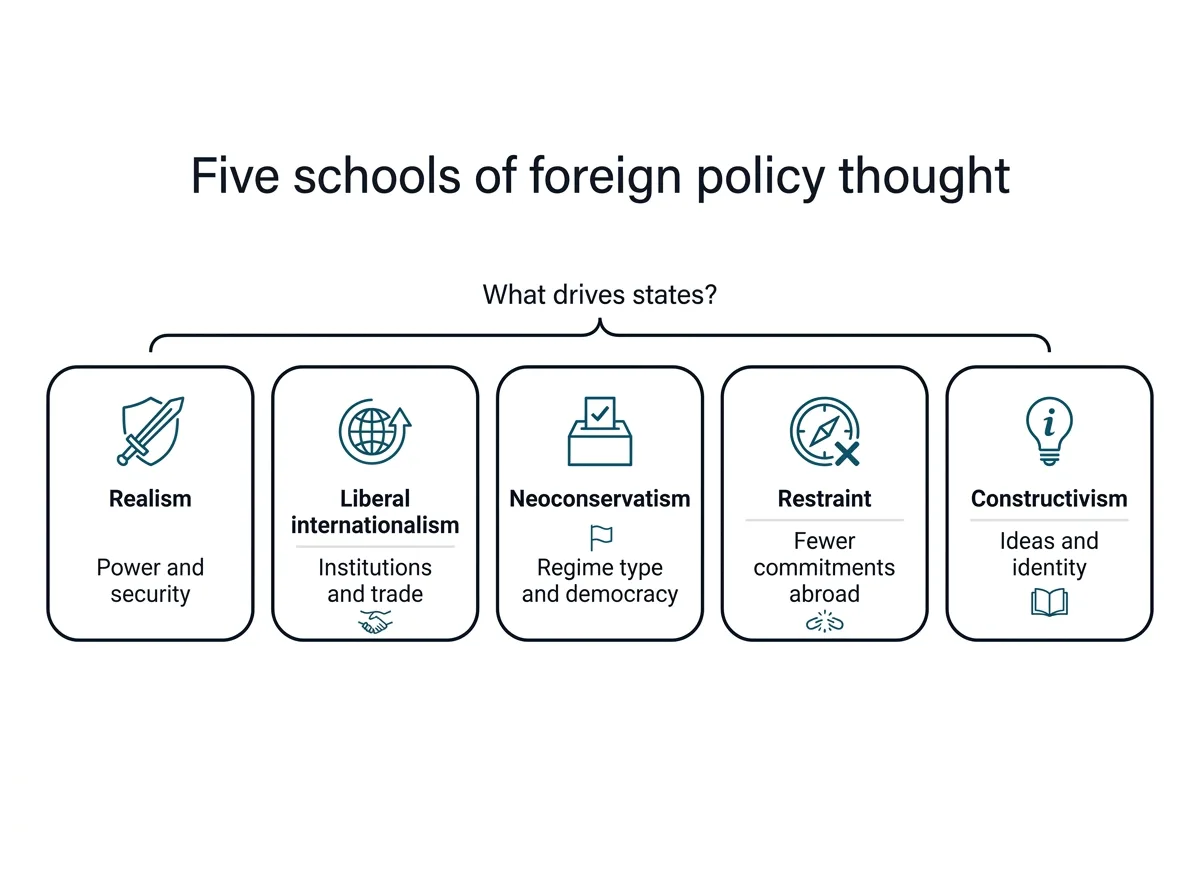
No single theory explains how states behave abroad, and each school below is best read in its own terms. Each starts from a different answer to one question: what drives countries in their dealings with each other?
| School | Core claim | Typical priorities | Associated thinkers |
|---|---|---|---|
| Realism | States pursue power and security in a world with no higher authority | National interest, balance of power, prudence | Hans Morgenthau, George Kennan, Henry Kissinger |
| Liberal internationalism | Institutions, trade and law can make cooperation lasting | Alliances, international organizations, open markets | Woodrow Wilson, Joseph Nye |
| Neoconservatism | The character of regimes matters, and American power can advance liberal democracy | Military strength, democracy promotion, moral clarity | Irving Kristol, Norman Podhoretz |
| Restraint | Most foreign commitments cost more than they return | Limited alliances, avoiding wars of choice, defense at home | George Washington (Farewell Address, 1796), Barry Posen |
| Constructivism | Interests are shaped by identity and shared ideas | Norms, reputation, legitimacy | Alexander Wendt |
Realists such as Hans Morgenthau, whose *Politics Among Nations* appeared in 1948, argue that leaders should judge policies by their effect on national security and be wary of crusades. Liberal internationalists answer that a world of treaties, international institutions and trade can change how countries behave over time. Neoconservatives agree with realists that strength matters, but they add that the nature of a regime shapes how it acts abroad, so spreading democracy is also a security interest. Advocates of restraint, a tradition sometimes labeled isolationism by its critics, argue that America is safest when it avoids open-ended commitments. Constructivists, following Alexander Wendt’s 1992 argument that “anarchy is what states make of it,” focus on how ideas and identities define what counts as an interest in the first place.
American debates are often framed with Walter Russell Mead’s four traditions from *Special Providence* (2001): Hamiltonian (commerce first), Wilsonian (values and law), Jeffersonian (protect democracy at home) and Jacksonian (honor and fierce self-defense). These labels cut across party lines, which is one reason coalitions on foreign affairs rarely match the domestic ones. A senator may be Jacksonian on defense and Hamiltonian on trade.
Which concepts does this section explain?
The explainers in this section take one idea at a time, define it, trace where it came from and set out the main objections. The current set includes:
- Foreign policy itself: definition, goals, tools and who makes it in the United States.
- Realpolitik: the politics of interest and circumstance, from Bismarck to Kissinger.
- Balance of power: why nations group together to stop any one of them from dominating.
- Hard power: force, money and coercion as instruments of policy.
- Soft power: Joseph Nye’s term, introduced in 1990, for getting what you want through attraction.
- Isolationism: the long American argument over staying out of foreign wars and alliances.
- The Eisenhower Doctrine: the 1957 commitment to defend Middle Eastern countries against communist aggression, and how it was later interpreted.
The essay guides add depth on specific debates. One is Robert Kagan’s 2002 essay on American power and European weakness, the “Mars and Venus” argument. Others cover China’s influence in Southeast Asia, the “Scoop Jackson” tradition of Cold War Democrats and the rise of private firms in peacekeeping.
Who actually makes foreign policy?
In the United States, the Constitution divides the job between two branches. The president negotiates treaties, receives ambassadors and commands the armed forces. The Senate must approve treaties by a two-thirds vote, and Congress controls the budget, regulates foreign commerce and holds the power to declare war.
Much of the daily work now runs through institutions created after the Second World War. The National Security Act of 1947 set up the National Security Council and the Central Intelligence Agency and brought the armed services under what became the Department of Defense. The State Department, the Treasury, the trade representative and the intelligence agencies all compete for influence over the result.
Other actors have a say too: courts, interest groups, the media, allies and non-state actors such as multinational companies, charities and armed groups. In the global economy, a large firm’s investment decisions may matter more to a small country than another state’s diplomatic notes.

How does foreign policy connect to the other fields?
The field is rarely self-contained. Most questions in it lead quickly into another section of this site:
- Security: deterrence, nuclear strategy such as mutually assured destruction, terrorism, failed states and private military contractors.
- Economy and society: globalization, free trade and the domestic politics of tariffs and sanctions.
- Law: treaty powers, war powers and the role of courts in reviewing executive action.
- Ideas: the political philosophies behind each school, from classical liberalism to conservatism.
- Policy analysis: the tools for judging whether a policy works, which apply abroad as much as at home.
A tariff is a good example. It is a decision about other countries, a tax on consumers at home and, sometimes, a legal fight over how much trade authority Congress has handed to the president. Reading across sections shows the whole of a foreign policy choice, including the costs that each school tends to downplay.